A Rockwall County court can order a spouse to pay temporary spousal support, child support, attorney fees, health insurance, mortgage or utilities, and possession-related costs, but none of these payments is automatic. The exact amount depends on the financial evidence and the judge's written order.
You may be sitting at your kitchen table in Rockwall, Heath, Fate, Royse City, or McLendon-Chisholm with divorce papers nearby and a practical question that feels urgent: What will the court make my spouse pay while this case is pending? Maybe the mortgage is due, the children need medical coverage, or your attorney is asking for a retainer before the first hearing.
The short answer is that Texas temporary orders can shift financial responsibilities during a pending divorce or custody case. The judge looks at need, available resources, and the other spouse's ability to contribute, then signs an order defining who pays what. A verbal promise, text message, or informal arrangement isn't a substitute for that signed order.
Table of Contents
- What a Rockwall County Temporary Order Can Require
- The Legal Foundation for Temporary Payment Orders
- Categories of Payments Temporary Orders Can Impose
- How Rockwall County Judges Decide the Amount
- Preparing for a Temporary Orders Hearing in Rockwall County
- How a Rockwall County Temporary Orders Case Moves
- Mistakes That Hurt a Temporary Orders Case
- Next Steps and Local Help for Rockwall County Families
What a Rockwall County Temporary Order Can Require
Consider a common hypothetical. A spouse living in Rockwall is served with divorce papers while the other spouse continues earning the household's primary income. The bills remain due, the children still need insurance and transportation, and both spouses now face legal expenses. The receiving spouse has only a short time to determine whether to request temporary support, payment of household expenses, attorney fees, or child-related costs.
A temporary order is a written court order that operates while the divorce or related family-law case is pending. It can address financial support, property management, insurance, attorney fees, and certain responsibilities involving children. The order doesn't finally divide the marital estate, decide permanent spousal maintenance, or guarantee that the same arrangement will apply after the final decree.
The payment categories that matter most
Depending on the evidence and the relief requested, a Rockwall County district court may address:
- Temporary spousal support, when one spouse lacks sufficient resources for necessary expenses and the other spouse can contribute.
- Child support, which is separate from spousal support and follows its own legal framework.
- Attorney fees and litigation expenses, when the requesting party shows that the fees are reasonable and necessary.
- Mortgage, rent, utilities, insurance, and other household expenses, when payment responsibility is needed to preserve stability.
- Health and dental coverage, along with allocations for uninsured medical expenses.
- Property and debt management, including requirements that preserve assets and identify liabilities.
- Possession-related costs, such as expenses connected to the children's care under the temporary arrangement.
The court does not divide every bill in half. It considers who has income, who has access to liquid funds, which expenses are necessary, and whether the requested payment would leave the paying spouse unable to meet reasonable obligations.
Practical rule: If you want a payment included in temporary orders, identify the expense, prove its amount, connect it to a real need, and show why the other spouse can contribute.
For a Rockwall County family, the relevant case may proceed through the 382nd District Court, 439th District Court, or another court with authority over the matter. The courthouse location doesn't eliminate the need to prove the request. A judge needs financial evidence, not only a statement that the other spouse has always paid the bills.
The Legal Foundation for Temporary Payment Orders
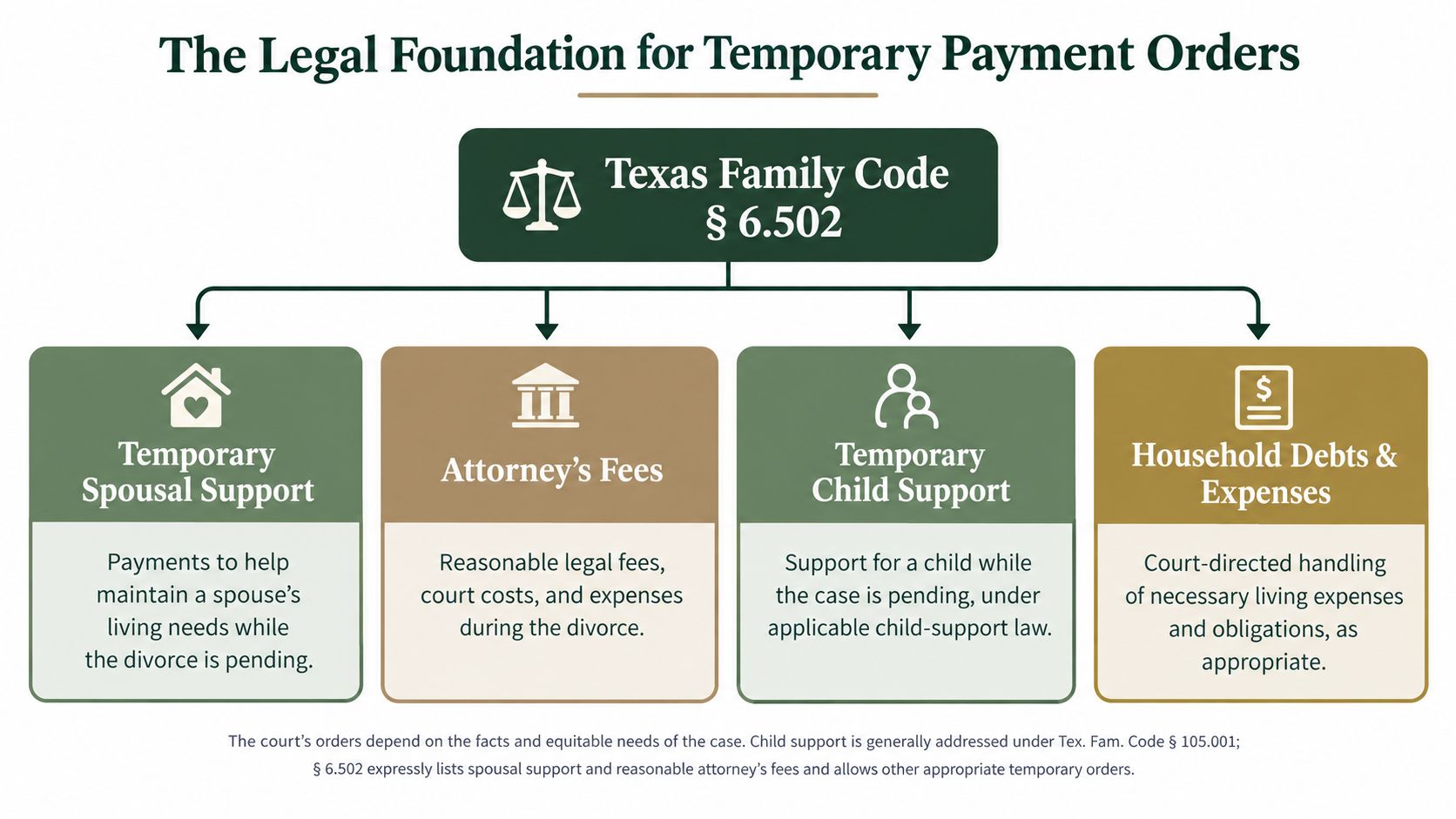
Texas Family Code § 6.502 authorizes a court handling a pending divorce to issue temporary orders after notice and a hearing when temporary financial or protective arrangements are necessary. The statute expressly permits an order requiring one spouse to pay support to the other spouse and an order requiring payment of reasonable and necessary attorney fees, court costs, and litigation expenses. You can review the statutory language in Texas Family Code § 6.502.
Notice and a hearing matter because the court isn't supposed to impose a disputed financial obligation without giving the parties an opportunity to present evidence. In practice, the requesting spouse explains the need, the opposing spouse can challenge the amount or ability to pay, and the judge decides what relief belongs in the written order.
What the statute permits and what it doesn't guarantee
The statute gives the court authority. It doesn't promise that a spouse will receive a particular monthly amount. Texas Bar practice materials explain that temporary spousal support may continue until the final divorce decree and, in some circumstances, while an appeal is pending, but the request must be supported by evidence showing that the payment is necessary and equitable.
That distinction answers the question many people ask after filing. A divorce filing alone doesn't automatically trigger a fixed payment. The court evaluates the parties' financial circumstances and the evidence presented at the temporary-orders hearing.
Temporary orders can also support the case financially by addressing attorney fees, court costs, and litigation expenses. A spouse who can't afford representation should discuss whether to request interim fees rather than waiting until the final trial. Information about a related Rockwall County family-law appointment and cost issue is available through this Rockwall County amicus attorney resource.
The order generally lasts only while the case is pending, including any period expressly covered by the statute or written order. It doesn't determine the final property division and doesn't guarantee an award of post-divorce maintenance.
Categories of Payments Temporary Orders Can Impose
A temporary order can affect both support and the practical costs of keeping a family functioning. The categories below should be treated as separate requests. Evidence supporting one category may not prove another.
Support and legal expenses
Temporary spousal support is based on financial need and the other spouse's capacity to contribute. The requesting spouse should show income, necessary expenses, accessible funds, and any shortfall.
Child support is a separate obligation. The Texas Office of the Attorney General identifies Texas Family Code § 154.125 as the basis for low-income child-support guidelines in actions filed on or after September 1, 2021. For an obligor with $1,000 or less in monthly net resources, the published schedule uses 15% for one child, 20% for two, 25% for three, 30% for four, and 35% for five children. For six or more children, the guideline is at least the amount prescribed for five children. These figures come from the Texas child support calculator and guideline resources.
Those percentages aren't a general temporary-spousal-support rule. Child-support guidelines can differ from ordinary calculations, and a court may deviate when the evidence supports a different amount.
Household and child-related costs
Temporary orders may address medical and dental insurance, as well as the allocation of uninsured medical expenses. They may also assign responsibility for the mortgage, rent, utilities, vehicle expenses, or other costs necessary to preserve the home and the children's routine.
Possession-related costs depend on the temporary parenting arrangement. A parent may ask the court to account for childcare, transportation, or unusual child-related expenses when those costs affect the overall needs analysis.
| Category | Statutory hook | Typical evidence required |
|---|---|---|
| Temporary spousal support | Texas Family Code § 6.502 | Budget, income records, liquid resources, necessary expenses, and evidence of the other spouse's ability to contribute |
| Child support | Texas Family Code § 154.125 and applicable guidelines | Income and net-resource information, number of children, insurance information, and child-related expenses |
| Attorney fees and litigation costs | Texas Family Code § 6.502 | Retainer agreement, invoices, work performed, anticipated litigation needs, and evidence that the requesting spouse cannot reasonably pay |
| Insurance and medical expenses | Temporary-order authority and applicable family-law orders | Premium statements, coverage information, medical bills, and proposed allocation |
| Mortgage, utilities, and household bills | Temporary-order authority concerning support and preservation of property | Statements, payment history, account records, and proof that the expense is necessary |
| Property and debt responsibilities | Temporary-order authority concerning management and preservation | Asset and liability records, account statements, loan documents, and a sworn inventory |
A Rockwall County parent researching child support may also need to understand the Rockwall County Title IV-D child support docket. The key point is simple: the signed order controls, not an estimate produced before the judge reviews the evidence.
How Rockwall County Judges Decide the Amount
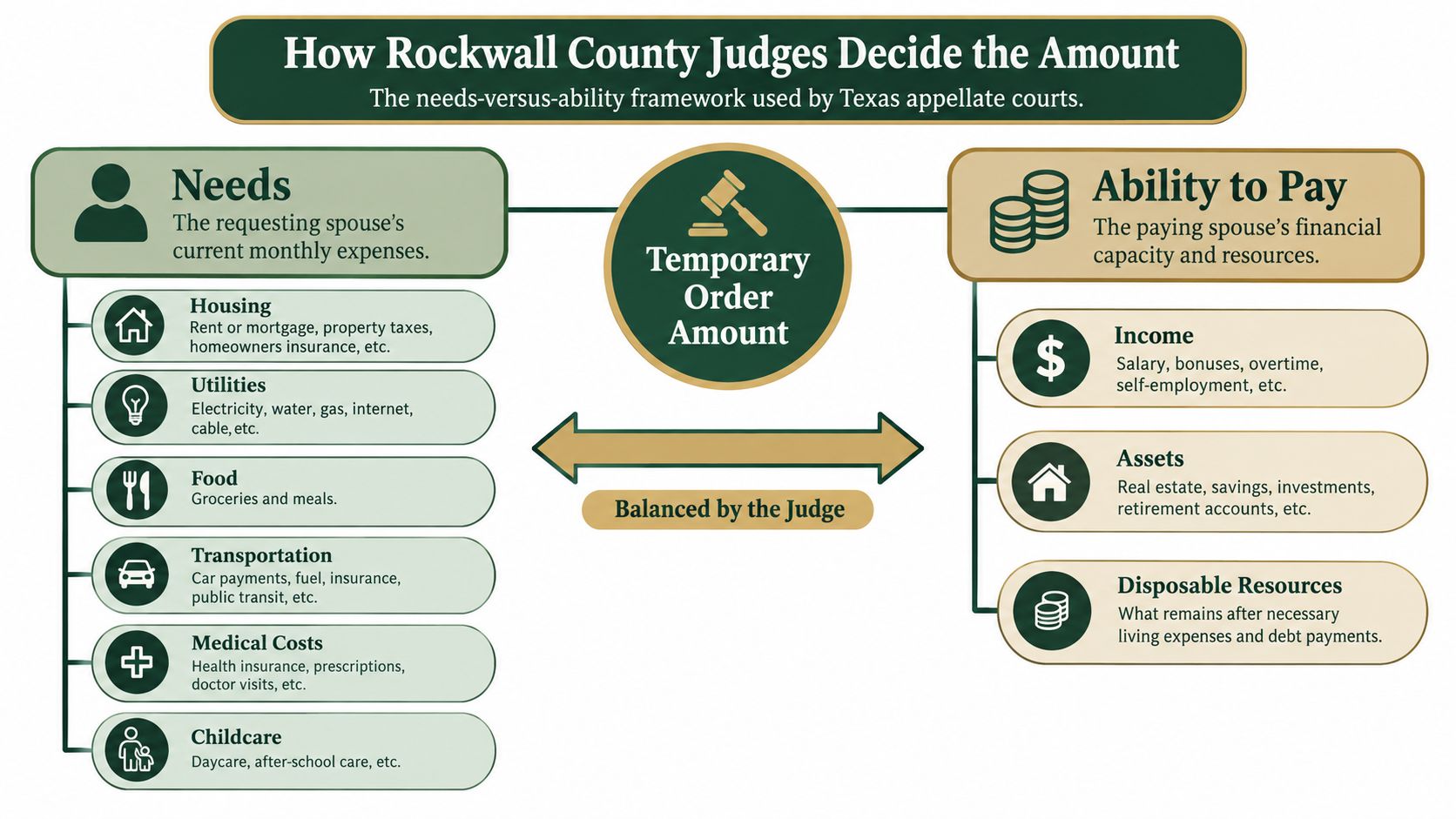
Texas temporary-orders judges don't use a universal percentage for temporary spousal support. The central question is whether the requesting spouse lacks sufficient means to pay necessary expenses and whether the other spouse has the ability to pay without being left destitute. Texas appellate authority describes this needs-versus-ability framework as a way to maintain the family during litigation, and the same reasoning applies to requests for interim attorney fees. The framework appears in Texas appellate authority addressing temporary support and attorney fees.
The needs side
The requesting spouse should show the household's current financial reality, not an unsupported wish list. Relevant expenses may include:
- Housing, mortgage, rent, and utilities
- Food and transportation
- Health insurance and medical costs
- Minimum debt payments
- Childcare and unusual child-related expenses
- Necessary legal expenses
The judge then considers income and accessible resources. A spouse with earnings, money in accessible accounts, or other liquid resources may have a smaller demonstrated shortfall than a spouse with the same bills but fewer available funds.
The ability-to-pay side
The proposed paying spouse's net income, recurring obligations, reasonable living expenses, and available assets all matter. The court can't order a payment that effectively makes that spouse destitute. That limitation is especially important when one spouse requests both monthly support and payment of attorney fees.
Watch the video below for a visual explanation of the framework.
The judge may reach a different result in two cases that appear similar because the financial proof differs. One household may have a documented shortfall and substantial income on the other side. Another may have disputed expenses, accessible savings, or debt that reduces the proposed payer's capacity.
Only the signed written order establishes an enforceable payment obligation. If a spouse ignores that order, enforcement remedies may be available, although the proper remedy depends on the obligation's wording and nature.
Preparing for a Temporary Orders Hearing in Rockwall County
Your preparation should begin with financial records, because the arguments at the hearing carry weight only when documents support them. Texas law permits temporary orders addressing support, property, and related expenses while a case is pending, subject to the terms and period stated in the order. Review the Texas Family Code § 6.502 materials when organizing your request.
Build the financial record
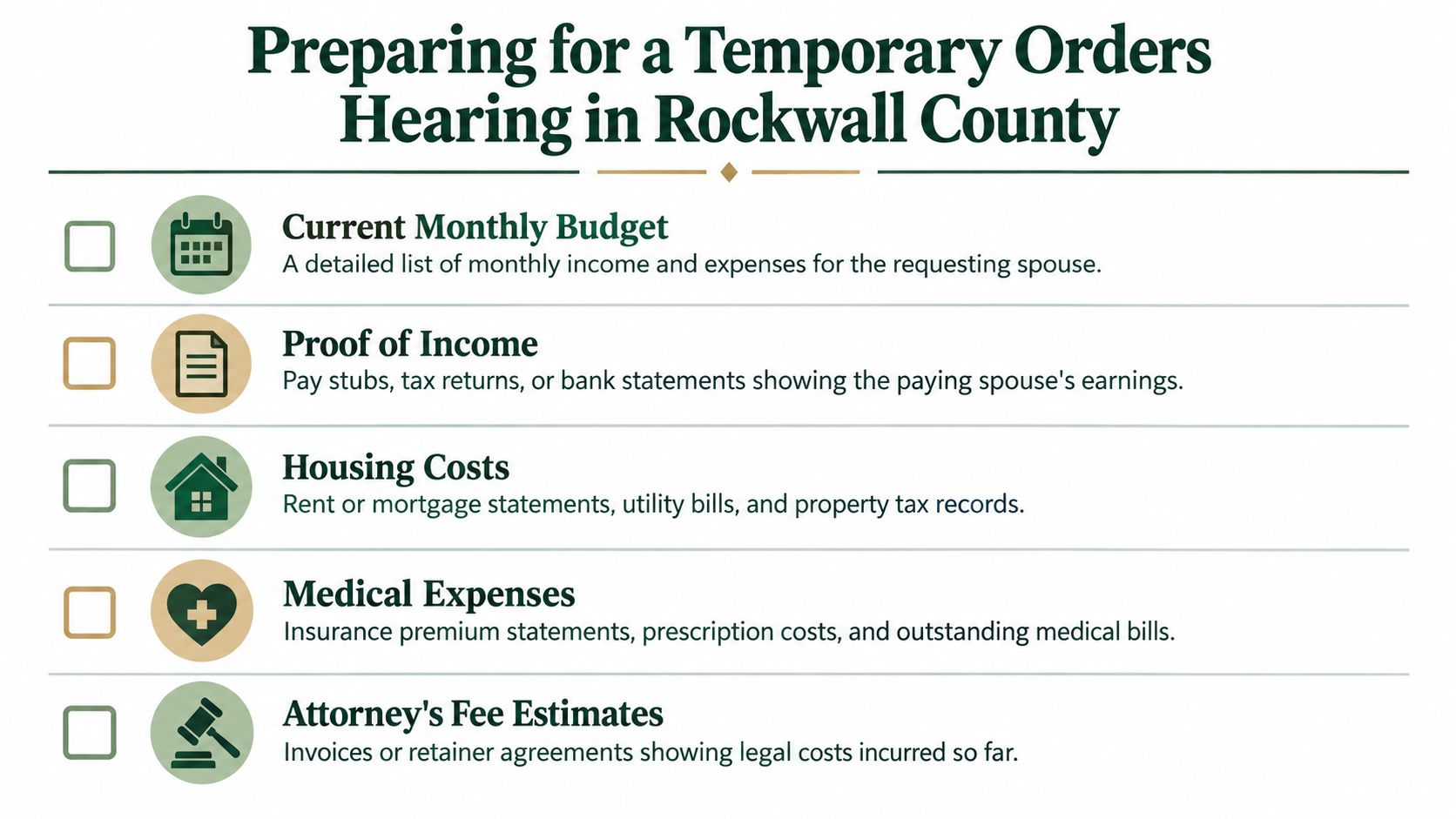
Bring an orderly file containing:
- Current monthly budget: Show housing, utilities, food, transportation, insurance, medical costs, debt payments, and child-related expenses.
- Pay records: Include your income records and, if available, evidence of the other spouse's earnings.
- Bank statements: Mark liquid resources, recurring deposits, transfers, and unusual withdrawals.
- Tax returns: Use them to establish income history and possible compensation sources.
- Debt statements: Document mortgage balances, vehicle loans, credit obligations, and minimum payments.
- Unusual expense proof: Add records for major medical bills, childcare, and child-related needs.
- Attorney-fee records: Preserve invoices, retainer documents, work completed, and anticipated litigation needs.
For a courtroom walkthrough, read what to expect at a Rockwall County temporary orders hearing.
A sworn inventory can help the judge identify assets and liabilities and decide how property should be preserved or managed during the divorce. Keep every entry factual. Disclose accounts even when you believe they are separate, and connect each listed asset or debt to supporting records.
Prepare practical requests for health insurance, uninsured medical expenses, the family residence, and utilities. State the amount sought, who should pay it, which income or account should fund it, and how the arrangement meets the household's needs without exceeding the proposed payer's ability to pay. That needs-versus-ability analysis gives the 382nd and 439th District Courts a workable basis for setting temporary payments.
How a Rockwall County Temporary Orders Case Moves
A temporary-orders request generally begins with a motion filed through the Rockwall County District Clerk when the case is within the district court's jurisdiction. The filing identifies the relief requested, such as support, attorney fees, property management, insurance, or household expenses.
The other party must receive notice under the applicable procedure, and the parties may exchange financial information before the hearing. Because local filing requirements and court procedures can change, confirm current instructions with the clerk or qualified counsel rather than relying on an old form or online discussion.
The hearing and the written order
At the hearing, each side presents evidence and responds to the other side's requests. A family-law matter may be handled in the 382nd District Court or 439th District Court, subject to the case's jurisdiction and current assignment. Don't assume that living in a particular city automatically determines venue. Rowlett and Royse City, for example, can involve county-boundary questions, so the applicable county and court authority must be confirmed.
After the court rules, the obligations need to appear in a signed written order. If income, expenses, or family circumstances change, a party may need to seek a modification rather than changing payments independently. The temporary phase eventually gives way to settlement, trial, or the final divorce or custody order.
Mistakes That Hurt a Temporary Orders Case
Waiting for the final divorce hearing is a costly mistake when bills are due now. Temporary orders exist to address the financial and parenting situation during the case, so ask for necessary relief when the case requires it.
Common problems and better choices
- Assuming support is automatic: Filing for divorce doesn't create a fixed temporary-spousal-support payment. Present a documented need and evidence of ability to pay.
- Arriving without organized records: A judge can't evaluate a shortfall clearly when expenses, income, and resources are scattered across phone screenshots. Prepare a readable budget and supporting statements.
- Treating a promise like an order: “I'll keep paying the mortgage” can fail after conflict escalates. Put the agreement in a signed enforceable order or obtain legal advice about formalizing it.
- Ignoring the family home: Failing to address mortgage, utilities, insurance, and maintenance can create avoidable instability. Request clear responsibility for each major bill.
- Failing to track payments: Keep proof of every payment you make toward an obligation assigned to the other spouse. Records may matter if reimbursement or enforcement becomes an issue.
- Assuming temporary means unimportant: Temporary orders can shape finances, possession, and settlement discussions for the rest of the case. Take the hearing seriously without treating the order as the final property division.
If the other spouse violates a signed order, enforcement may be available. The remedy depends on the language of the order and the type of obligation, so preserve the order, payment records, messages, and other relevant documents.
Next Steps and Local Help for Rockwall County Families
A temporary-orders request should end with a clear list of payments, proof of need, and records showing each spouse's ability to pay. Rockwall County filings may involve the Rockwall County Courthouse, District Clerk, County Clerk, 382nd District Court, and 439th District Court. Confirm current filing procedures and hearing information directly, because court requirements and self-help materials can change.
Questions Rockwall County spouses ask
How long can temporary spousal support last?
It generally continues until the final divorce decree. In some circumstances, it may continue during an appeal if the law or written order covers that period. Read the order carefully.
Can a spouse be ordered to keep paying the mortgage?
Yes. A judge may assign mortgage, utility, insurance, or related household expenses when the evidence supports the arrangement. Ask for each responsibility to be stated specifically, including payment dates and account information when appropriate.
Can temporary orders change if income changes?
A party may request modified relief after a meaningful change in financial or family circumstances. Do not stop paying or alter an order without court approval.
Where can I look for help if I can't afford an attorney?
Legal Aid of NorthWest Texas serves eligible Rockwall County residents. The Texas Law Help website, texaslawhelp.org, provides self-help forms and family-law information. Ask a qualified attorney whether interim attorney fees should be requested from the other spouse.
The Law Office of Bryan Fagan, PLLC maintains a Rockwall office and handles family-law matters involving divorce, custody, child support, enforcement, property division, and temporary orders. Review the firm's Start Here process, organize your financial records, and seek advice specific to your facts.
The Law Office of Bryan Fagan, PLLC can discuss temporary support, attorney-fee requests, household bills, and child-related financial issues with Rockwall County families. (—)