You open the mailbox in Rockwall and find a hearing notice with a case number, a court reference, and the words Title IV-D. If you live in Heath, Fate, Royse City, McLendon-Chisholm, Mobile City, or the Rockwall County portion of Rowlett, that notice can feel more alarming than informative. You may wonder whether you're being accused of a crime, whether custody will be decided, and where you're supposed to go.
A Rockwall County Title IV-D child support docket is generally a specialized child-support proceeding. It focuses on matters such as parentage, support obligations, medical support, arrears, and payment enforcement. It usually isn't the place to decide the full range of custody, possession, visitation, or property issues. The Texas Office of the Attorney General, through its Child Support Division, may be involved, while the local court process operates through Rockwall County's existing family-law structure.
The Rockwall County Courthouse is located at 1111 East Yellowjacket Lane, Suite 200, Rockwall, Texas, where child support payments are administered through the District Clerk's office during publicly listed weekday business hours of 8 a.m. to 5 p.m. TexasLawHelp's explanation of child support IV-D court provides useful background on what parents can expect. The sections below explain what the docket means, how Rockwall County routes these cases, how to find the correct setting, and how to prepare.
Table of Contents
- A Rockwall County Parent's First Look at the Title IV-D Docket
- What Title IV-D Means in Texas
- How Rockwall County Routes IV-D Child Support Cases
- Finding Your Docket Date and Court Records in Rockwall County
- What Happens at a Title IV-D Hearing in Rockwall County
- Enforcement, Modifications, and Common IV-D Issues
- Preparing for Your Rockwall County IV-D Hearing
- Practical Next Steps for Rockwall County Parents
A Rockwall County Parent's First Look at the Title IV-D Docket
A parent in Royse City might receive the notice after the other parent applied for help collecting support. A parent in Fate might see it after paternity was never formally established. A parent in Heath might already have a support order but now face a hearing because payments, medical support, or arrears need court attention.
The first thing to understand is that Title IV-D is not a criminal label. It identifies the federal-state child-support enforcement framework used by Texas. The Texas Office of the Attorney General is the state's official Title IV-D agency, and its Child Support Division may assist with locating a parent, establishing paternity, obtaining or enforcing support orders, and collecting payments. Texas guidance on Title IV-D and child support describes the program's role in those areas.
What the notice usually tells you
Your notice may identify:
- The cause number, which tracks the court file.
- The parties, usually the parent receiving support and the parent expected to pay.
- The court or docket, which helps identify where the matter is set.
- The hearing date and time, which require careful attention.
- The issue, such as parentage, support establishment, enforcement, or another support-related question.
A Title IV-D setting normally centers on the evidence needed to address child support. That can include income information, parentage evidence, the existing order, payment records, medical-support information, and proof that notices or pleadings were properly served.
Practical rule: Read the notice from top to bottom, keep every page, and bring the complete notice with you. The cause number is often the fastest way to locate the right record.
The docket isn't designed to resolve every disagreement between parents. If your main concern is a parenting schedule, a geographic restriction, relocation, conservatorship, or a broader divorce dispute, you may need a separate family-law filing. The IV-D hearing is best approached as a focused court date about support and parentage, not as a substitute for a full custody case.
What Title IV-D Means in Texas
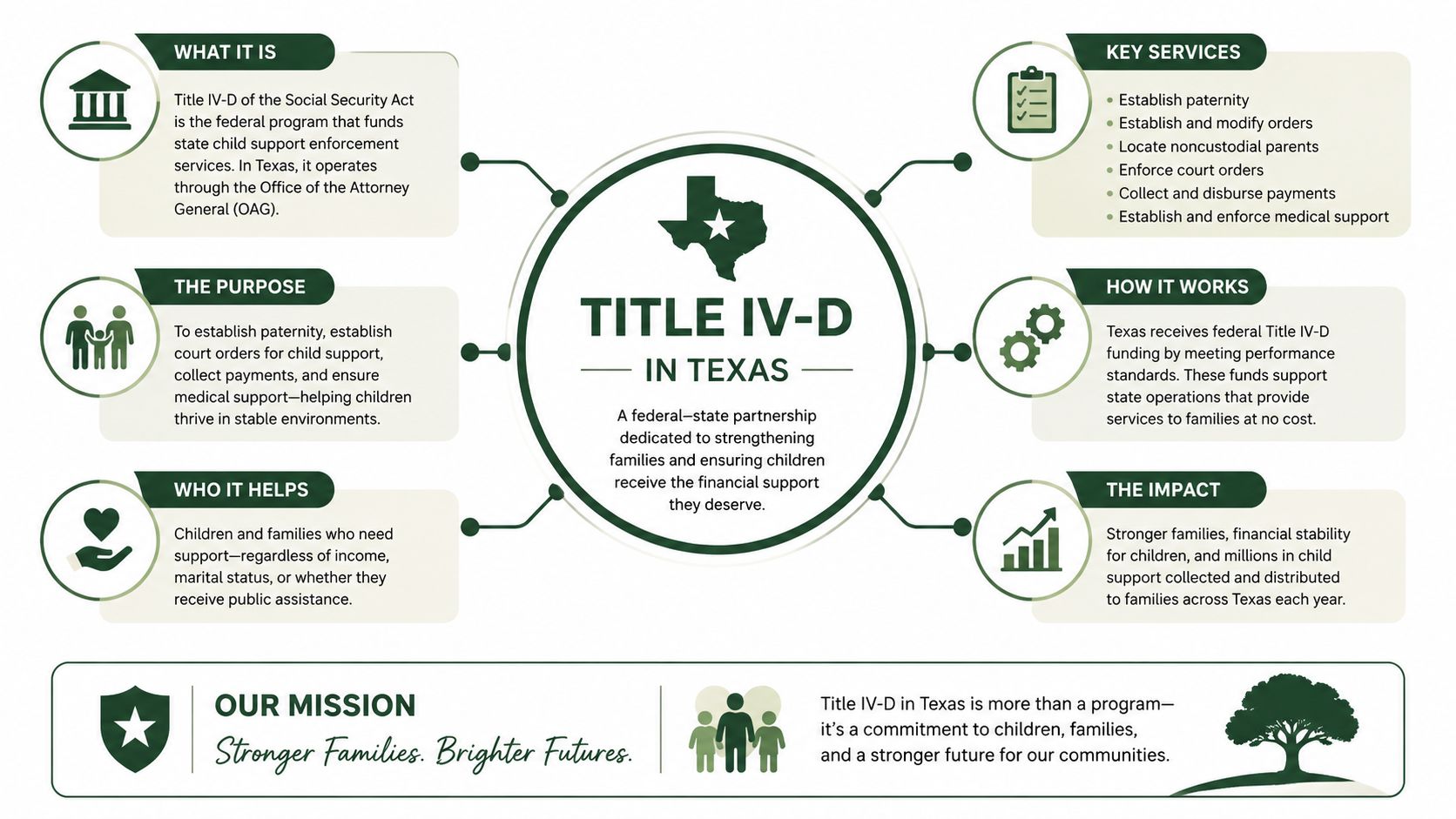
A Title IV-D setting can look like a regular family-law hearing, but the program behind it has a specific public role. Title IV-D is the federal framework through which states operate child-support programs. In Texas, the Office of the Attorney General administers the state's official Title IV-D program. The program supplies tools for establishing and enforcing support, while a judge makes court decisions about orders, findings, and enforcement.
The OAG functions within the public child-support system and does not automatically serve as personal counsel for either parent. In practical terms, the agency may pursue support for the benefit of a child, while each parent remains responsible for protecting that parent's own legal interests.
The functions parents usually encounter
The Texas program may handle several connected jobs:
- Locating a parent: Staff may work to identify a current address or employer when a parent has moved.
- Establishing paternity: Parentage may need to be resolved before support can be ordered against an alleged father.
- Establishing support: If no enforceable order exists, the case may seek financial and medical-support orders.
- Enforcing an existing order: Court or administrative procedures may address missed payments and other compliance problems.
- Collecting and distributing payments: Payments generally pass through the state child-support collection system instead of relying only on informal exchanges.
A mother in Fate may need to establish legal parentage before asking for support from a father who was never married to her. A father in Royse City may be responding to unpaid medical support under an existing order. A Heath family may face an interstate question because one parent lives outside Texas.
These examples involve different steps, but the program's purpose remains consistent: it gives the support case an administrative and legal process to follow. The judge still controls judicial decisions, and Title IV-D does not automatically decide custody, visitation, or a parenting schedule.
How Rockwall County Routes IV-D Child Support Cases
Rockwall County doesn't appear to maintain a standalone, publicly described IV-D child-support court. Instead, family matters are routed through the county's existing court structure. The Rockwall County courts information page identifies the county's court system, while family filings and records are handled through the appropriate clerk's office.
For many IV-D referrals, the District Clerk is the key records office because the matter is connected to the district-court family-law structure. The 382nd District Court and 439th District Court are relevant family-law courts in Rockwall County. The County Clerk may handle related county-court-at-law records, including some family filings such as divorce records, but the correct office depends on the filing and the court assigned to it.
Who starts the case
An OAG-initiated matter may begin because a parent requested child-support services. The OAG can then file or pursue pleadings concerning parentage, support, enforcement, or payment compliance. A private parent may also file a family-law case involving divorce, custody, support, modification, or enforcement.
Those paths can overlap. For example, a parent may have a private SAPCR, divorce, modification, or enforcement case while an OAG-related support matter is also pending. The court needs a clear record so related issues aren't sent to the wrong docket or treated as separate when they belong together.
| Filing Type | Clerk Office | Typical Court |
|---|---|---|
| OAG-related IV-D pleadings | District Clerk for district-court family filings | Assigned family-law district court, such as the 382nd or 439th District Court |
| Private divorce or SAPCR filing | Clerk office identified by the filing and court | Appropriate Rockwall County family court |
| Related county-court-at-law family record | County Clerk, when applicable | Rockwall County Court at Law |
| Support issue connected to an existing case | Clerk maintaining the relevant case record | Court assigned to that family-law case |
A mailing address doesn't always determine venue. This matters for communities such as Rowlett and Royse City, which can cross county boundaries. Check the county tied to the court file, not only the city printed on an address.
For broader background on the county's court divisions, review Rockwall County court-at-law jurisdiction, then confirm your specific cause number and assigned court with the clerk.
Finding Your Docket Date and Court Records in Rockwall County
Start with the hearing notice. The notice from the OAG Child Support Division should identify the assigned court, which may be the 382nd or 439th District Court, along with the hearing date, time, and cause number. Don't rely on memory or on a text message from the other parent. Use the official notice and the court's record as your starting point.
A practical records search
- Write down the cause number. Copy it exactly, including letters, numbers, and punctuation.
- Search by cause number first. If that produces no result, search by the party names as they appear on the notice.
- Review the case header. Confirm the names, court, case type, and any IV-D designation.
- Open the register of actions. Look for filed pleadings, notices, prior settings, orders, and the next scheduled event.
- Compare the online record with your notice. If dates or court information seem inconsistent, contact the clerk before assuming one is correct.
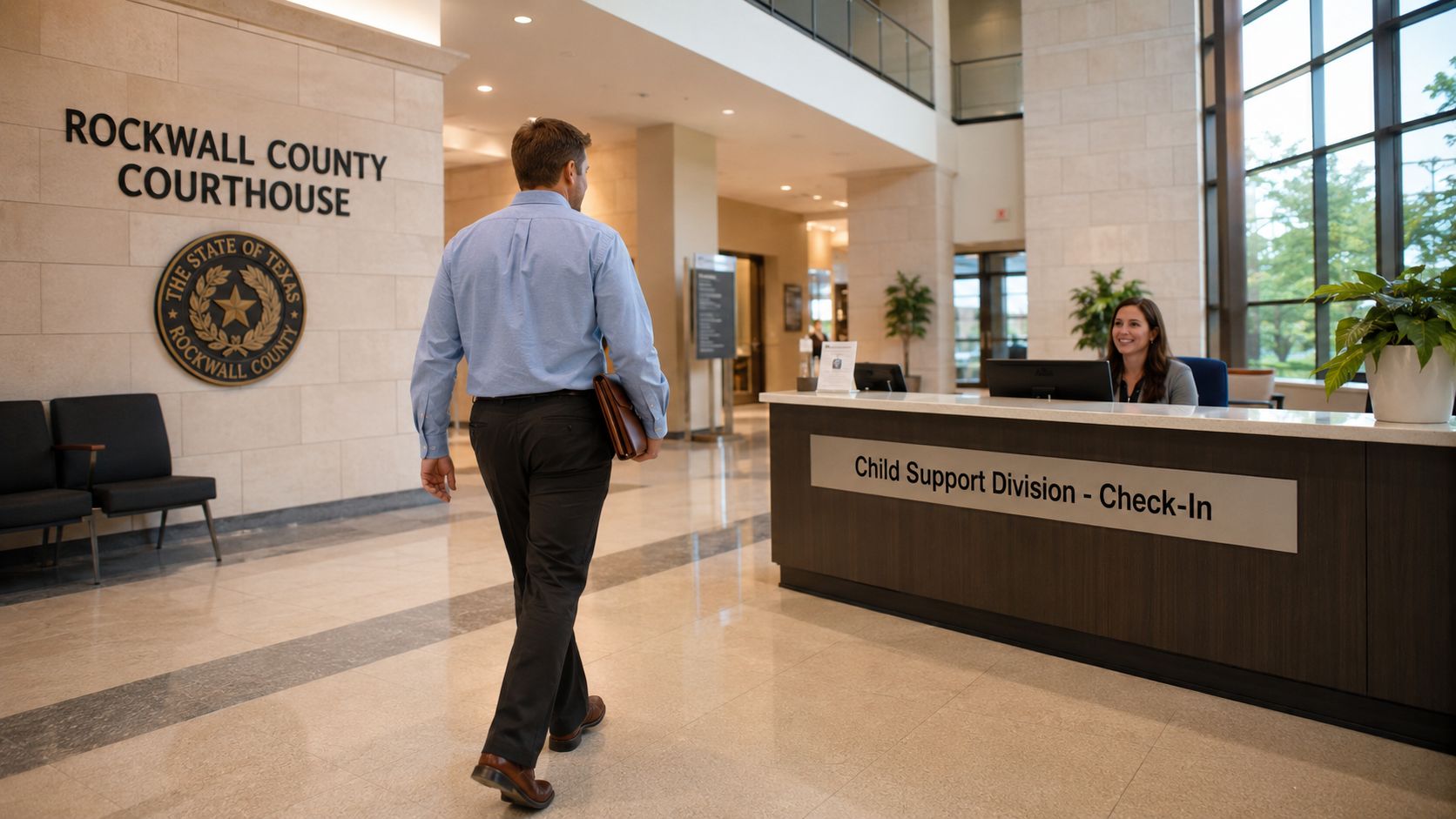
The Rockwall County District Clerk's office operates at 1111 East Yellowjacket Lane, Suite 200, Rockwall, Texas. Public records access may include an online portal and a public terminal in the courthouse lobby, but availability and access procedures can change. The Rockwall County 382nd District Court family docket procedures can provide additional local context, but your filed notice remains the controlling source for your setting.
When the online file doesn't answer the question
Call the District Clerk's office during its listed business hours if you can't locate the case, can't tell which document controls, or see a setting that conflicts with your notice. Ask about the correct procedure for requesting copies. If you need a copy for another agency or legal proceeding, ask whether a certified copy is required rather than assuming a downloaded document will be enough.
Keep a personal file containing the notice, every order, payment evidence, and correspondence. A clean file makes it easier to explain the history to the clerk, the OAG, or a private attorney.
What Happens at a Title IV-D Hearing in Rockwall County
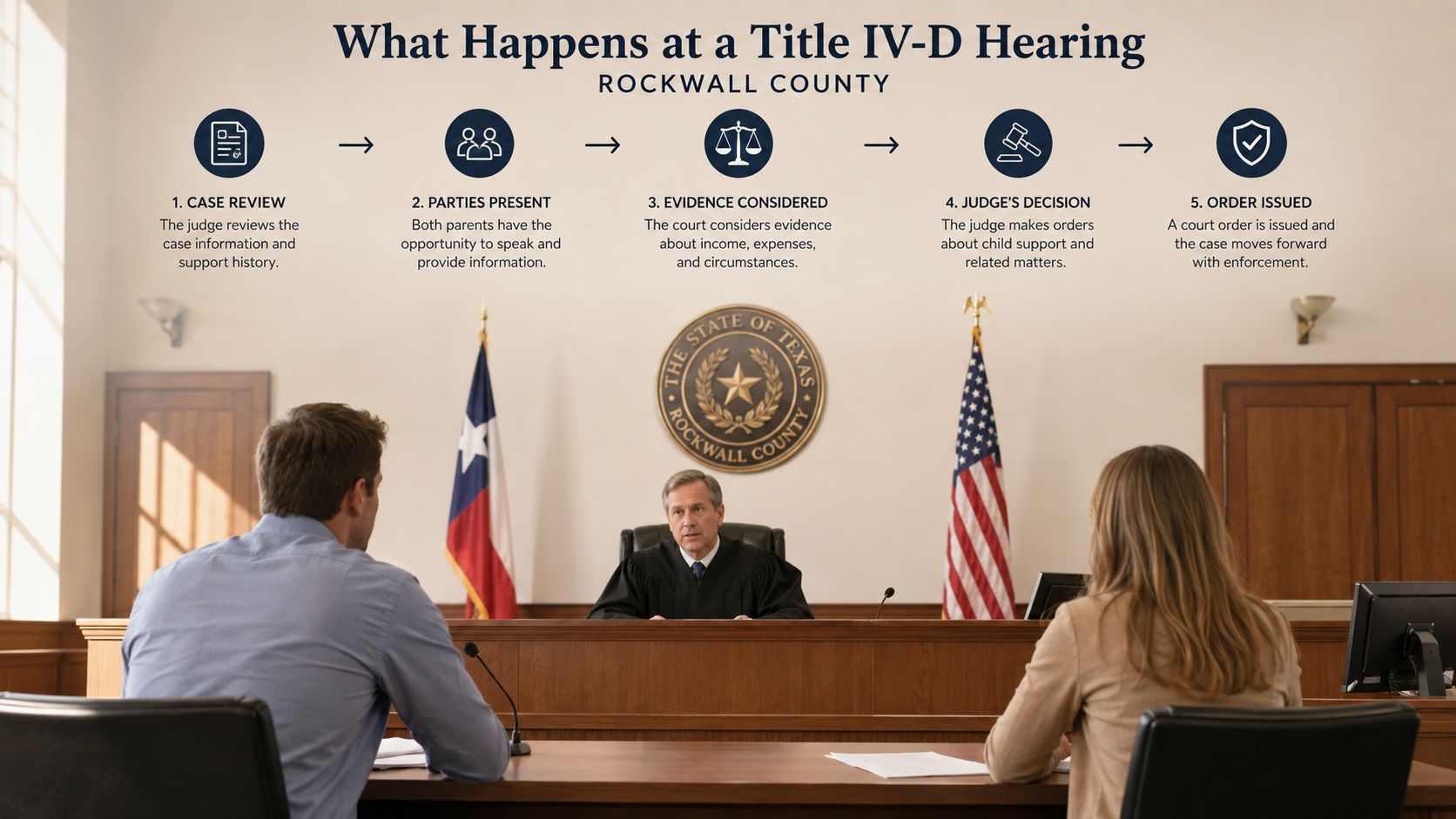
A docket day may move differently from what you see on television. You arrive at the Rockwall County Courthouse, pass through security, find the courtroom listed on your notice, and wait while the court calls other matters. Some cases may resolve through a brief announcement, while others require testimony or additional documents.
The OAG attorney generally announces the case for the state's child-support program. The judge may address whether the parties were properly served, confirm identities, and review the support order or the specific relief requested. If evidence is needed, the parent may be sworn in and asked questions from the bench or by the attorneys.
The issue determines the conversation
A parent attending an administrative order confirmation may be asked to identify the parties, confirm parentage information, and respond to the proposed support terms. A paternity bench trial can require testimony and documentary evidence about parentage. An income-withholding review may focus on employment, payment records, or whether withholding information is accurate.
A contempt show-cause hearing is different again. The court may examine the existing order, the alleged noncompliance, payment history, and the parent's explanation. The judge may rule, request more evidence, or continue the setting, depending on the record and the legal issues presented.
The safest approach is to answer the question asked, use respectful language, and avoid turning a support hearing into a general argument about the other parent's character.
You may have an opportunity to speak before the court makes a ruling or sets another date. Bring your documents in an organized form, but don't assume the judge will review a large unmarked stack. If you don't understand what the court is asking, ask for clarification rather than guessing.
The court's focus remains support-related. A dispute about missed visitation may matter in a separate custody or enforcement proceeding, but it doesn't automatically erase a support obligation or transform the IV-D docket into a custody trial.
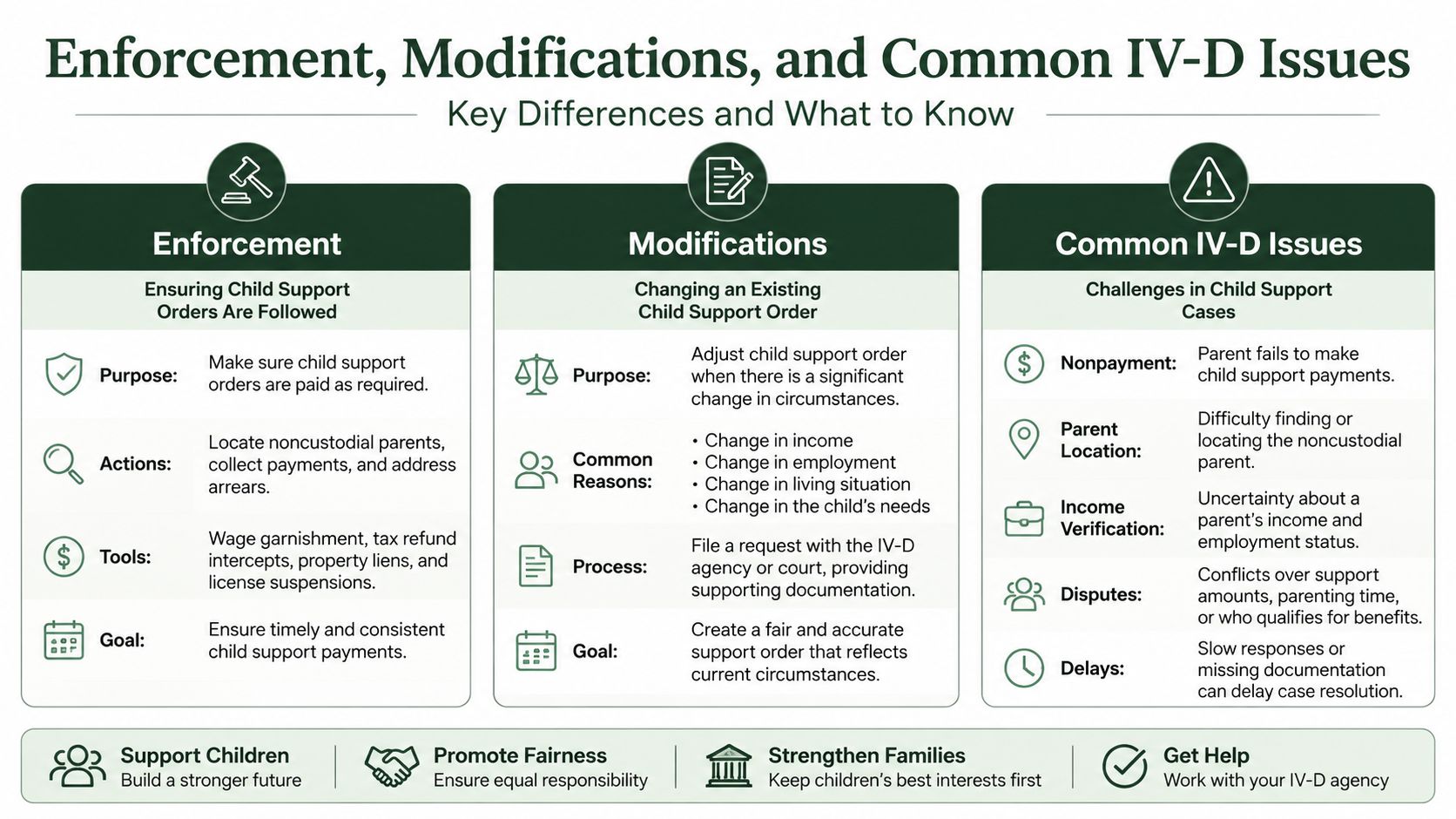
Enforcement, Modifications, and Common IV-D Issues
The OAG's IV-D track is designed for support enforcement and collection. Depending on the order, service, procedural posture, and facts, enforcement may involve income withholding, administrative remedies, payment interception, or a court-based contempt proceeding. The remedy follows the problem before the court.
A parent may bring several child-related concerns to one hearing, but the court still must identify the legal question. Is the hearing about enforcing an existing support obligation, or about changing the arrangement itself? That distinction often determines what evidence and filing the court can consider.
Separate the enforcement question from the change question
Suppose a parent says, “I lost my job, so the monthly support amount should be lower.” That situation typically requires filing a modification proceeding rather than raising the issue at an enforcement setting. Changing medical support, altering the support amount, or addressing conservatorship generally requires the appropriate private family-law filing in the court handling the case.
A new possession schedule or relocation order also belongs in the proper family-law proceeding. Title IV-D proceedings focus on support and parentage, while broader conservatorship and visitation disputes follow a different path. The limits of an IV-D hearing are explained in TexasLawHelp's IV-D court guidance.
Payment and arrears problems
Common record disputes include:
- Private payments: Cash, direct transfers, rent, clothing, or other assistance may not appear automatically in the state payment ledger.
- Job changes: A new employer or unemployment can affect withholding and the evidence needed at a hearing.
- Arrears disagreements: Parents may dispute credits, dates, fees, or payments made outside the formal channel.
- Interstate complications: An out-of-state parent may require coordination between agencies and courts.
Gather proof before the hearing. Bank records, receipts, employer information, insurance documents, and written communications can help show what the official ledger includes and what it leaves out. Keep the records organized so the court can connect each payment or change to the relevant period.
A private agreement does not, by itself, change a court order. The proper court must enter an enforceable modification. Until that occurs, the existing order remains the point of reference for enforcement.
Preparing for Your Rockwall County IV-D Hearing
Preparation starts at the kitchen table, not in the courthouse hallway. Put the hearing notice and cause number in a folder, then add the documents that show your income, support history, and current obligations.
Build a focused hearing file
Collect documents that may be relevant to the particular setting:
- Income records: Recent pay stubs, W-2s, tax returns, and documentation of job-search efforts if employment has changed.
- Healthcare information: Medical insurance details, premium information, and records concerning the child's coverage.
- Child-related expenses: Child-care receipts and other records tied to the support issue.
- Court documents: Existing support orders, paternity orders, divorce decrees, SAPCR orders, modification orders, and enforcement papers.
- Payment records: Your OAG case number and payment history from the Texas Child Support Enforcement system or other official records.
- Disputed credits: Bank statements, receipts, money-order records, or written proof of payments you believe were not credited.
Texas guidance identifies recent tax returns, pay stubs, and evidence of support or job-search efforts as relevant materials for a support hearing. Keep originals where possible and make organized copies for the court and the other side if required.
Plan for the courthouse
The courthouse address is 1111 East Yellowjacket Lane, Suite 200, Rockwall, Texas. Allow time for parking, security screening, finding the correct courtroom, and checking in. Arriving thirty minutes early is a practical way to reduce avoidable stress, though the notice and courthouse instructions control your actual obligations.
Don't bring children unless the court specifically directs you to do so. Leave weapons and large bags at home because courthouse security rules may restrict them. Wear clean, respectful clothing and silence your phone before entering the courtroom.
A one-page summary can help you stay organized. List the issue, the order date, the payments or events you dispute, and the result you're asking the court to consider. Don't use the page as a substitute for evidence, and don't hand the judge a document without understanding whether it can be admitted or reviewed.
If you're unsure whether you need counsel, consider the seriousness of the issue. A straightforward records question may be manageable with OAG or clerk assistance. Parentage disputes, contempt exposure, disputed arrears, interstate issues, and requests affecting custody or support modification deserve careful legal review. For local scheduling information, see how to set a hearing through the Rockwall County court coordinator.
Practical Next Steps for Rockwall County Parents
After reading your notice, decide whether you're dealing with a records problem, an OAG service question, or a legal dispute that needs a court filing. Those are different problems, and sending the wrong request to the wrong office can cost time.
When self-help may be enough
The OAG portal and Rockwall County records tools may be useful when you need to:
- Confirm a cause number or upcoming setting.
- Review the payment history already maintained in the system.
- Update contact or employment information through the appropriate agency process.
- Obtain copies of existing orders or identify the clerk maintaining the record.
- Ask the OAG about the status of an agency-initiated support matter.
The Texas Office of the Attorney General's Child Support Division lists 1-800-252-8014 as a contact number for child-support questions. Use the agency for case-status and program questions, but remember that agency staff can't provide the same individualized legal advice as your own attorney.
When a private filing or lawyer may be appropriate
A private family-law attorney may be useful when you need to:
- Seek a modification of support or medical support.
- Challenge an arrears calculation with disputed evidence.
- Respond to a contempt or enforcement request.
- Establish or contest paternity.
- Address custody, possession, visitation, relocation, or conservatorship.
- Coordinate a private divorce or SAPCR with an OAG-related matter.
- Handle a complicated interstate or multi-county record.
The appropriate filing may belong in the 382nd or 439th District Court, or in another court connected to the existing case. Venue and jurisdiction depend on the facts and the court record, so don't assume the city where you live answers those questions.
Keep a durable record
IV-D cases can involve multiple notices, agency records, payment entries, and court orders. Keep copies of every order, filed document, payment confirmation, employer notice, and letter. Missing a docket date can lead to serious enforcement consequences, including license suspension or wage withholding, so address a notice promptly rather than waiting for the next letter.
Local self-help options may include Rockwall County courthouse resources, the Rockwall County Law Library, the Texas Legal Services Center hotline, and the State Bar of Texas Lawyer Referral Information Service. These resources can help you identify forms, general information, or referral options, but they may not evaluate every fact in your case.
If you're unsure what the Rockwall County Title IV-D child support docket is asking you to do, first preserve the notice and records, then contact the correct clerk or agency. If the hearing involves disputed parentage, enforcement, contempt, modification, custody, or relocation, schedule a consultation with a qualified Texas family-law attorney before making assumptions about your rights.
The Law Office of Bryan Fagan, PLLC offers consultations and family-law representation for Rockwall County parents facing Title IV-D hearings, child-support enforcement, modifications, paternity issues, and related custody matters. Visit The Law Office of Bryan Fagan, PLLC to learn about local support and discuss practical next steps for your Rockwall County case.