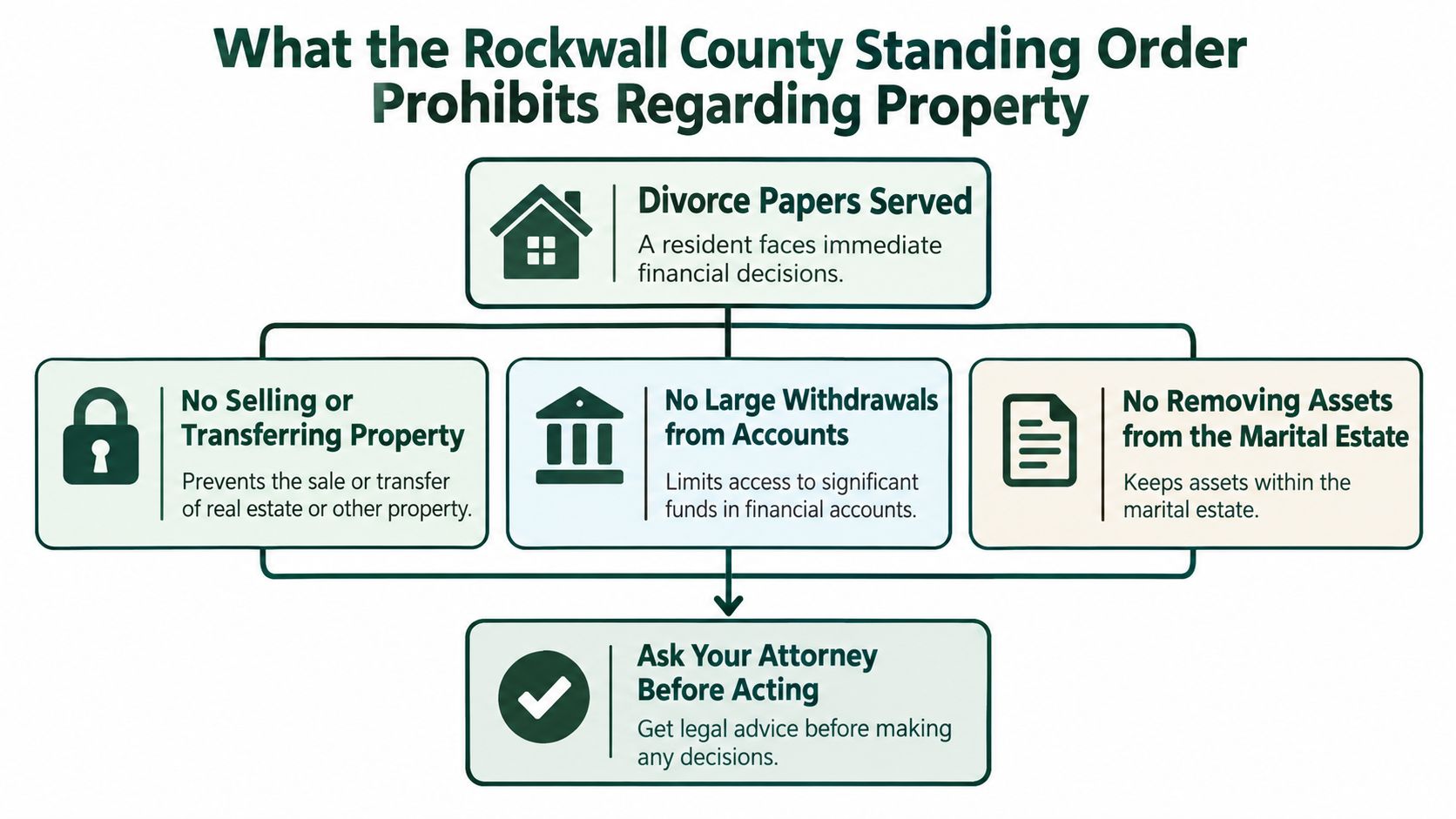
The Rockwall County standing order generally prohibits selling, transferring, concealing, encumbering, or harming marital and separate property, while still allowing ordinary living expenses and transactions the order specifically authorizes. It isn't an absolute freeze on every bank account, bill payment, or household purchase.
You may be dealing with this right now in Rockwall, Heath, Fate, Royse City, McLendon-Chisholm, or another Rockwall County community. Divorce papers arrive, the mortgage is due, a vehicle needs repairs, and you may wonder whether using a joint account or selling an asset will create a legal problem. The safest answer depends on the actual standing order, any temporary restraining order, and the facts of your case.
A standing order is designed to preserve the marital estate while the court addresses property rights through temporary orders, settlement, or final judgment. It doesn't decide who ultimately owns the house, account, vehicle, business, or retirement benefit. It controls conduct while the case is pending so one spouse can't change the financial picture before the court has an opportunity to act.
Table of Contents
- What the Rockwall County Standing Order Prohibits Regarding Property
- Which Property and Assets Are Covered
- Permitted Expenses and Common Misunderstandings
- How Texas Family Code Temporary Orders Interact With the Standing Order
- What Happens After Divorce Papers Are Served in Rockwall County
- How to Request Permission for Necessary Property Transactions
- Consequences of Violating the Standing Order and Next Steps
What the Rockwall County Standing Order Prohibits Regarding Property
Suppose you receive divorce papers in Rockwall County and immediately consider moving money to another account, signing a deed, selling a vehicle, or removing furniture from the home. Those actions may feel protective, especially if you fear your spouse will act first. The Rockwall County standing order generally prohibits either spouse from destroying, removing, concealing, encumbering, transferring, or otherwise harming or reducing the value of property belonging to either spouse. The order applies to community property and separate property, not only assets titled in both names. (Rockwall County standing order)
That means you shouldn't assume you can:
- Sell or transfer an asset: Don't sell a home, vehicle, investment, business interest, or valuable household item without confirming that the order permits it or obtaining authorization.
- Move or hide property: Don't place money in a relative's account, move valuable items outside Texas, or conceal an asset from your spouse or the court.
- Create a lien: Don't mortgage, refinance, pledge, or otherwise encumber disputed property without reviewing the order and getting appropriate approval.
- Damage or waste property: Don't destroy furniture, disable equipment, remove fixtures, or spend down an account in a way that reduces the estate.
- Alter records: Don't falsify, delete, conceal, or destroy family, financial, business, income, debt, or property records.
Why the order reaches separate property
The order is a procedural safeguard, not a final property division ruling. Even if you believe an account came from an inheritance or a home was purchased before marriage, the order may still restrict what you do with it while the case is pending. That temporary protection gives the court a chance to determine ownership, reimbursement claims, tracing issues, and the proper division of the marital estate.
A person facing a property dispute may also benefit from reviewing this guide about inherited property in a Texas divorce. Separate-property claims can matter, but the claim itself isn't permission to transfer, conceal, or deplete the asset.
Rockwall County's family-law cases may be handled through the 382nd District Court, 439th District Court, County Court at Law No. 1, or County Court at Law No. 2, depending on the case and court assignment. The order's restrictions apply to covered family-law cases handled by those courts, but the actual documents served with your case control your immediate obligations.
Which Property and Assets Are Covered
The phrase property means more than the family residence. The Rockwall County order addresses tangible and intangible property, including real estate, personal belongings, documents, and records. It also reaches property that one spouse says is separate, because the court may need to preserve the asset before deciding ownership and division. (Rockwall County standing order)
Common categories include:
| Category | Examples of conduct requiring caution |
|---|---|
| Real estate | Selling, transferring title, refinancing, mortgaging, or removing fixtures |
| Financial accounts | Large withdrawals, transfers, concealment, or unexplained spending |
| Vehicles and valuables | Selling, giving away, hiding, damaging, or removing them |
| Business interests | Transferring ownership, diverting income, or taking business records |
| Retirement and investments | Liquidating, moving, or changing ownership arrangements |
| Insurance and tax-related assets | Changing ownership, beneficiaries, or handling refunds without review |
| Digital and documentary property | Hiding digital assets or deleting financial and business records |
A joint account isn't the only account that matters. A separately titled account, a retirement benefit, a business interest, an insurance payment, a tax refund, or digital property may still become relevant to property division or tracing.
Practical rule: If the transaction changes ownership, location, control, value, or documentation, pause before acting.
Consider a spouse who owns a company in Royse City and believes the business is separate because it existed before marriage. Paying ordinary business expenses may be necessary, but transferring equipment to a friend, diverting revenue, or removing company records could raise a very different issue. The same distinction applies to a vehicle, investment account, or valuable collection in Heath or Fate.
The order also prohibits misrepresenting or refusing to disclose property to the other spouse or the court. A person shouldn't wait for formal discovery before preserving statements, deeds, account histories, titles, and business records. Keep originals and maintain a clear record of ordinary transactions.
Permitted Expenses and Common Misunderstandings
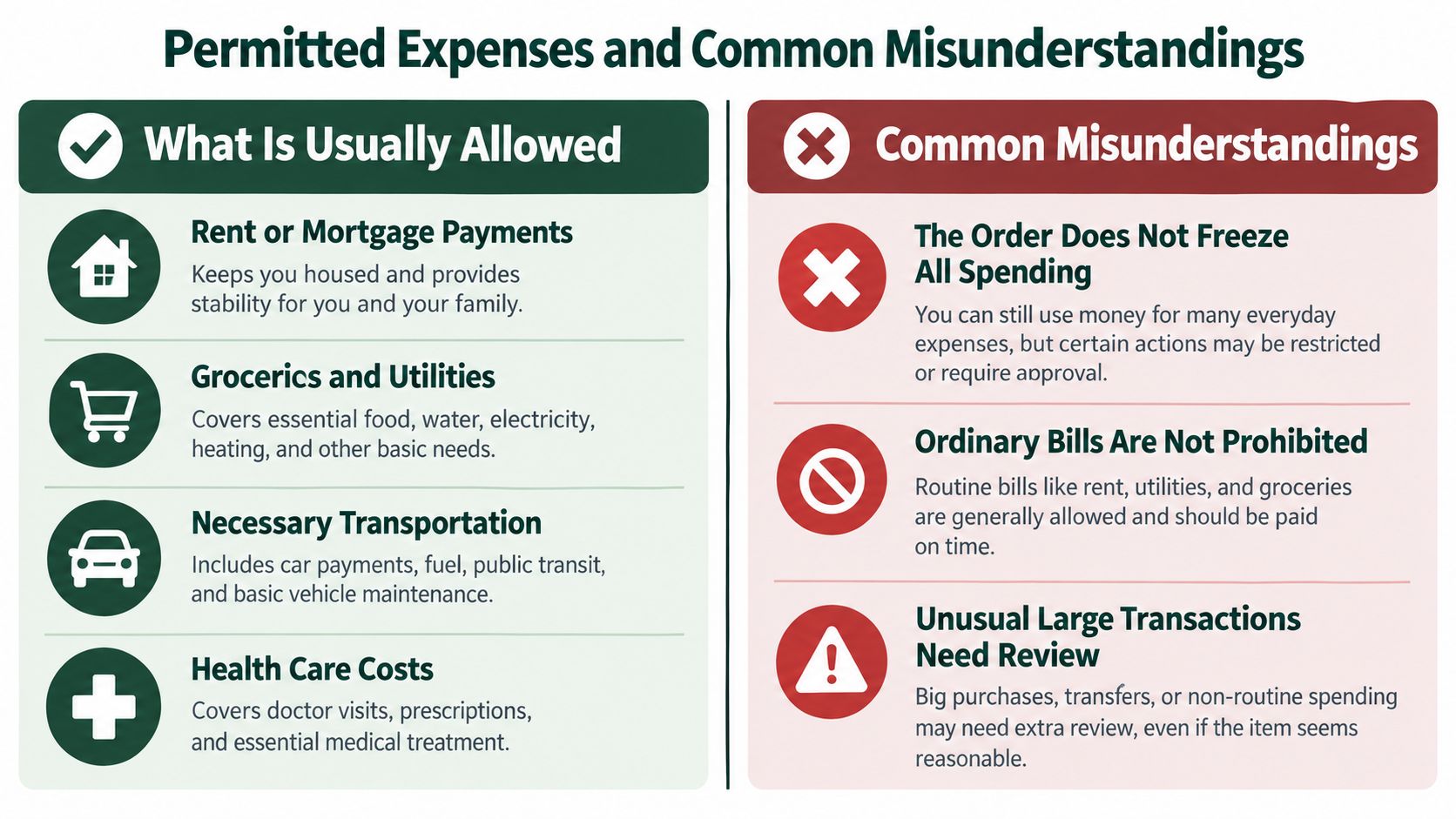
A standing order generally doesn't freeze all spending. The available county-order guidance recognizes that people still need housing, food, transportation, medical care, and child-related necessities while a divorce proceeds. Ordinary and necessary living expenses may remain permitted, along with transactions the specific Rockwall order authorizes. (County standing-order example addressing permitted expenses)
You may generally need to continue paying:
- Housing costs: Rent, mortgage payments, property taxes, utilities, and necessary home expenses.
- Household needs: Groceries, clothing, ordinary supplies, and routine bills.
- Transportation: Fuel, insurance, repairs, and transportation needed for work or family responsibilities.
- Medical costs: Health care, prescriptions, and necessary treatment.
- Child-related expenses: School needs, care, activities, and other ordinary costs for the children.
The line becomes less clear when the transaction is unusual, large, difficult to reverse, or likely to reduce the value of the estate. Paying the mortgage from a joint account is different from withdrawing the account balance and placing it in a private location. Replacing a broken appliance may be different from removing undamaged furniture and selling it without documentation.
The danger of over-compliance
Some people become so worried that they stop paying bills, cancel necessary services, or refuse to use money for the children. That can create its own hardship and may conflict with provisions allowing ordinary expenses. The right objective isn't paralysis. It's documented, reasonable spending that preserves stability.
| Usually routine | Usually needs review |
|---|---|
| Paying regular household bills | Selling a home or vehicle |
| Buying groceries and medicine | Liquidating an investment |
| Paying necessary transportation costs | Changing title or beneficiaries |
| Covering ordinary child expenses | Moving money to another person |
| Maintaining insurance and utilities | Refinancing or pledging property |
The exact exceptions depend on the Rockwall County order, the pleadings, and any additional order entered in your case. If a transaction is necessary but unusual, keep invoices, statements, photographs, and written explanations. Don't treat your spouse's silence as consent.
How Texas Family Code Temporary Orders Interact With the Standing Order
The standing order is only one part of the legal framework. Texas Family Code § 6.502 allows a court handling a pending divorce to issue temporary orders preserving marital property and protecting the parties. Those orders may require a sworn inventory and appraisal of real and personal property, require financial records and other documents, limit spending to reasonable and necessary living expenses, award one spouse exclusive occupancy of the residence, or give one spouse temporary control of a business. (Texas Family Code § 6.502)
A temporary order can provide more specific instructions than the countywide safeguard. For example, a judge may address who pays the mortgage, who occupies the home, who controls a business, or how records must be exchanged. The order may also include restrictions connected to the temporary-restraining-order provisions of Texas Family Code § 6.501.
Different orders can operate together
A Rockwall County spouse may receive a petition, a standing order, a temporary restraining order, and a citation. Those documents aren't interchangeable. The standing order provides general restrictions, while a temporary restraining order or temporary injunction may address immediate facts and requested relief.
Texas Bar practice materials explain that, after a divorce suit is filed, a court may issue a temporary restraining order without advance notice when necessary to preserve property or protect a party. A temporary injunction may continue after notice and a hearing. (Texas Bar practice material on temporary orders)
For a practical explanation of local scheduling and preparation issues, review this resource on a Rockwall County temporary-orders hearing. Your case may require temporary relief if ordinary bills, access to records, business control, residence use, or support cannot be handled safely under the existing documents.
What Happens After Divorce Papers Are Served in Rockwall County
A hypothetical helps show how quickly an ordinary financial decision can become risky. Suppose a spouse in McLendon-Chisholm is served with divorce papers on a Friday and plans to sell a second vehicle on Monday to cover household expenses. The vehicle may be unnecessary, but signing the title and depositing the proceeds without reviewing the standing order could create a dispute about whether the sale was authorized, whether the price was fair, and where the money went.
Read every page immediately. Pay attention to the standing order, temporary restraining order, temporary orders, and citation, not only the divorce petition. The restrictions may apply to the filing party when the case begins and to the responding party when served, depending on the language of the governing order and documents.
If you were served through a Rockwall County constable, you can review general information about service of divorce papers by the Rockwall County constable. Service answers how papers reached you, but it doesn't replace the need to read the orders attached to them.
Start with these actions:
- Preserve the current picture: Save account statements, titles, deeds, loan records, tax documents, business records, and photographs of valuable property.
- Pause unusual transactions: Don't sign a deed, liquidate an investment, change ownership, empty an account, or move property outside Texas until you have reviewed the order.
- Protect records: Don't delete digital files, destroy receipts, alter statements, or remove business records.
- Track necessary spending: Keep a simple record of bills paid, the account used, the amount, and the reason.
- Communicate carefully: Keep messages factual and avoid threats, accusations, or statements about hiding property.
The same caution applies to less obvious actions. Changing beneficiaries, transferring digital assets, removing valuable household goods, or taking business records can affect the financial picture even if no real estate changes hands.
Don't assume a transaction is safe because it seems financially sensible. If the family needs the transaction, document the need and ask counsel whether the order permits it or whether court authorization is appropriate.
How to Request Permission for Necessary Property Transactions
A standing order remains operative even when you believe a restriction is unfair or impractical. Silence isn't permission, and acting first can create an enforcement problem that could have been avoided with a written request or court order.
When a necessary transaction falls outside ordinary expenses, use a structured process:
Start with the actual documents
Obtain the current Rockwall County standing order and every order entered in your case. Compare the proposed transaction against the exact language, including exceptions for ordinary expenses, emergency action, business operations, or other authorized conduct.
Build a factual record
Gather the documents that show why action is necessary:
- Ownership records: Titles, deeds, account statements, contracts, or business documents.
- Financial support: Invoices, estimates, bills, insurance information, and current account records.
- Transaction terms: The proposed sale price, purchaser information, closing documents, or replacement plan.
- Preservation details: Where proceeds will go and how you will keep them identifiable.
A clear paper trail helps distinguish a necessary transaction from an attempt to waste, conceal, or transfer property.
Notify your attorney and seek written relief
Tell your family-law attorney before signing anything. Counsel may recommend written agreement, a motion for permission, temporary orders, or another filing suited to the circumstances. The request should identify the asset, explain the need, describe the proposed action, and state how the proceeds or replacement property will be protected.
If the matter is urgent, explain the timing and the harm that may result from waiting. Don't rely on an informal text message from your spouse unless your attorney confirms that it provides adequate protection under the governing order.
Documented compliance is the goal. You shouldn't have to choose between violating an order and ignoring a genuine household emergency.
Ordinary necessary spending may not require a separate court request, but unusual transactions deserve review. Keep receipts and records even when you believe the order clearly permits the expense.
Consequences of Violating the Standing Order and Next Steps
A violation can lead to an enforcement proceeding and may expose the person to contempt sanctions or other relief allowed by the governing order and applicable law. The court may also consider missing property, altered records, or unexplained transfers when evaluating credibility and dividing property. The outcome depends on the language of the order, the evidence, the explanation, and the relief requested.
The safest response after a mistake isn't concealment. Stop further activity, preserve the records, and tell your attorney exactly what happened. Trying to reverse a transfer, delete messages, or create a different explanation can compound the original problem.
Why county-specific wording matters
You shouldn't borrow a standing order from another Texas county and assume it controls a Rockwall case. For example, an official Denton County order prohibits destroying, removing, concealing, encumbering, transferring, or harming property claimed as separate or community property. It becomes effective when the original petition is filed, operates as a temporary restraining order for 14 days after service, and may continue as a temporary injunction if no party contests it within that period. (Denton County standing order example)
Those details illustrate why a Rockwall litigant must verify the order for the court where the case is filed. A mailing address in Rowlett or Royse City also doesn't, by itself, establish the county, venue, or court handling the case. Check the case documents and official clerk information rather than relying on a city name.
For Rockwall County filing and document-copy questions, the Rockwall County District Clerk is a relevant courthouse resource. The county also publishes family-law general orders and identifies its district-court structure through its official website. (Rockwall County general orders and policies)
A practical compliance checklist
Before acting with property during a divorce, ask:
- What document controls: Have you read the standing order and any temporary order?
- What changes: Will the transaction change ownership, value, control, location, or records?
- Why is it needed: Is it an ordinary living expense, an emergency, or an unusual transaction?
- Can you document it: Do you have statements, receipts, estimates, and a clear explanation?
- Is written authorization needed: Have you asked counsel whether to seek agreement or court permission?
The Law Office of Bryan Fagan, PLLC handles property-division enforcement and other family-law matters for Rockwall County clients, including residents of Rockwall, Heath, Fate, Royse City, and surrounding communities. A qualified attorney can review the specific orders in your case, help address a necessary transaction, and explain how divorce, custody, support, or enforcement issues may affect the next step.
If divorce papers have been served or you're worried about a property transaction, gather the orders, account records, titles, and receipts before taking action. Visit The Law Office of Bryan Fagan, PLLC to learn how the Rockwall office can help you review the standing order and plan a lawful response.