The correct county for a Royse City divorce depends entirely on the spouses' physical address and the 90-day county-residency rule, not the Royse City mailing address. Royse City spans Rockwall, Collin, and Hunt counties, so the answer may be Rockwall, Collin, or Hunt based on where a qualifying spouse lives.
You may be looking at a Royse City address on a driver's license, utility bill, or lease and assuming the courthouse choice is obvious. It isn't. A subdivision, street, or mailing label can identify the city while leaving the legally relevant county question unresolved.
That detail affects more than convenience. Filing in the wrong county can create avoidable delays, additional expense, and a challenge to venue. If children, temporary orders, property, protective orders, or a recent move are involved, choosing the correct county before filing becomes even more important.
Table of Contents
- Why Your Mailing Address Does Not Determine Divorce Venue
- Texas Residency Rules and the Royse City County Map
- Comparing Rockwall Collin and Hunt County Filing Options
- The Recent Mover Problem in Fast-Growing Suburbs
- How to Verify Your Correct County and Prepare to File
- Strategic Next Steps for Royse City Families
Why Your Mailing Address Does Not Determine Divorce Venue
A municipal address and a legal county venue are different things. “Royse City” identifies the city associated with the property or mailing address. It doesn't, by itself, establish which county's court should receive a divorce petition.
Royse City is primarily in Rockwall County, but the city also extends into Collin and Hunt counties. That means two households with Royse City mailing addresses may fall under different county systems. A couple may live in one county, work in another, and use a mailing address that gives no clear answer about where the home sits for legal purposes.
The physical home controls the county question
Start with the actual residence, not the city name printed on mail. The relevant question is generally where one spouse has lived and established the required county residency, subject to the Texas rules discussed below.
A zip code isn't a substitute for a county boundary. Neither is the location of a school, workplace, church, or post office. Those facts may help identify a neighborhood, but they don't independently establish divorce venue.
Practical rule: Confirm the county tied to the residence before preparing or filing the petition. Don't rely on a Royse City label alone.
This issue also appears in other North Texas communities that cross county lines. The same city-versus-county distinction matters when reviewing which county handles a Rowlett divorce. A filing decision based only on a city name can send the case to the wrong clerk or court.
Why the mistake matters
A venue problem may not end the entire divorce, but it can still force the parties to address where the case belongs. That can slow the process and complicate early decisions about service, temporary orders, custody, and financial protection.
If the spouses disagree about the county, don't treat the issue as a minor clerical detail. Confirm the physical address, the date the qualifying spouse moved into the county, and whether the children's case involves separate jurisdictional concerns.
Texas Residency Rules and the Royse City County Map
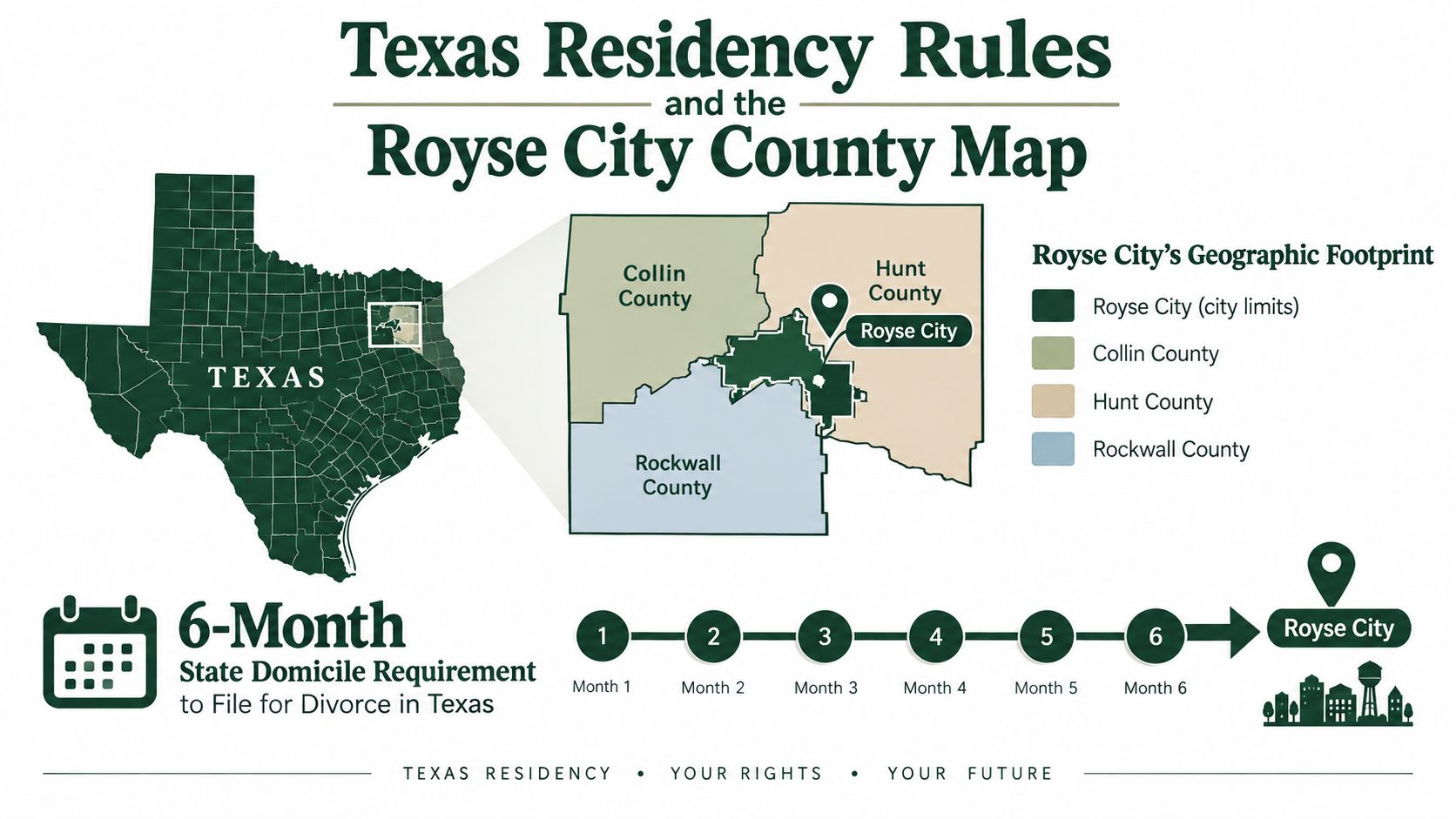
Texas uses a dual-residency rule for divorce. At the time of filing, either spouse must have been domiciled in Texas for at least six months and must have been a resident of the county where the case is filed for at least 90 days. The rule is summarized in the Texas Board of Law Examiners family-law materials.
The six-month requirement addresses Texas residency. The 90-day requirement addresses county residency. Satisfying one doesn't automatically satisfy the other.
Applying the rule to Royse City
Royse City covers 15.1 square miles, including 15.0 square miles of land and 0.1 square miles of water, according to geographic information about Royse City. The important legal point isn't the size of the city. It's the fact that the city extends across county lines.
A home in the Rockwall County portion generally points to Rockwall County venue when a spouse satisfies the 90-day requirement there. A home in the Collin or Hunt County portion generally points toward that county instead. The city name remains the same, but the county court system changes.
A recent Texas Almanac profile of Royse City describes the community's location along State Highway 66 in the northeastern part of Rockwall County and its connection to the Dallas-Fort Worth region. That setting helps explain why county boundaries can be easy for residents to overlook. New development, expanding roads, and neighborhood names don't always make the county line obvious.
A simple address test
Ask these questions before filing:
- Where is the residence physically located? Identify the county attached to the home, not just the city.
- When did a qualifying spouse begin living there? Count the county-residency period from the facts of the move.
- Has either spouse lived in Texas for the required period? County residency doesn't replace the Texas domicile requirement.
- Are children involved? Custody jurisdiction may raise additional questions beyond divorce venue.
If the address sits near a boundary or the move was recent, have the county and dates reviewed before filing. School-district information may also matter in a custody dispute, as discussed in this guide to Rockwall ISD and Royse City ISD boundary custody disputes, but school enrollment doesn't decide divorce venue by itself.
Comparing Rockwall Collin and Hunt County Filing Options
Once the residence and residency dates identify the proper county, the practical filing destination becomes clearer. Don't choose a county because its courthouse seems closer or because one spouse prefers that location. The county must be supported by the qualifying residency facts.
For residents on the Rockwall County side, the District Clerk is the local office associated with civil and family judicial matters. Rockwall County identifies divorce, custody, adoption, and child support matters as accessible through that office, with family cases handled by the 382nd and 439th District Courts, as described in the Rockwall County court resources.
| County | Primary Family Courts | Courthouse Location |
|---|---|---|
| Rockwall | 382nd District Court and 439th District Court | Civil/Family Judicial office, 1111 East Yellowjacket Lane, Suite 200, Rockwall, TX 75087 |
| Collin | The appropriate Collin County court with family-law authority | Confirm the current courthouse and clerk for the qualifying Collin County residence |
| Hunt | The appropriate Hunt County court with family-law authority | Confirm the current courthouse and clerk for the qualifying Hunt County residence |
Rockwall County's local filing structure
The Rockwall County District Clerk's official page lists the Civil/Family Judicial office at 1111 East Yellowjacket Lane, Suite 200, Rockwall, Texas 75087, with hours Monday through Friday, 8 a.m. to 5 p.m. That local resource is relevant to residents of Rockwall, Heath, Fate, Royse City, McLendon-Chisholm, and other communities when the underlying residence is in Rockwall County.
Do not confuse the District Clerk with the County Clerk. The Rockwall County Clerk's office handles functions such as vital records, real-property filings, assumed names, and other county-office responsibilities. The District Clerk handles civil and family judicial matters.
Collin and Hunt require the same discipline
A Royse City address on the Collin or Hunt side doesn't make Rockwall County available because Rockwall is the county most associated with the city. Likewise, a convenient courthouse in another county isn't enough if neither spouse satisfies the county-residency requirement there.
Before filing in Collin or Hunt, verify the physical residence, the relevant county, and the qualifying dates with the appropriate county clerk or a Texas family-law attorney. Family cases may also involve temporary orders, protective orders, child support, property division, or enforcement issues that make a filing error more disruptive.
The Recent Mover Problem in Fast-Growing Suburbs
Royse City's growth has made recent moves across county lines a recurring practical problem. One source lists a population of 15,978, while another lists 20,037 for 2024, illustrating the substantial change reported for the community in recent years. See the Royse City population information.
The legal trap appears when a couple moves into a new subdivision and assumes the new Royse City address immediately creates filing eligibility in the new county. It may not.
The county clock follows the move
Suppose a spouse lived on the Rockwall County side of Royse City, then moved to a home on the Collin County side several weeks before deciding to file. The new home may have a Royse City mailing address, but the spouse may not yet have satisfied the 90-day Collin County residency requirement.
That doesn't automatically mean the spouse has no filing option. The other spouse may independently satisfy the residency rule in a different county. The facts must be analyzed spouse by spouse, including where each person lived and when.
The answer also changes if one spouse moved out of the marital residence, if the couple lived temporarily with relatives, or if the address was a short-term arrangement rather than an established home. Those facts can affect domicile and county residency, so don't reduce the analysis to the date on a lease alone.
Divorce venue and custody venue can diverge
A divorce case and a child-custody dispute don't always present identical jurisdictional questions. A child may have lived in one location while a parent recently moved to another county. The court handling the divorce may need to consider whether it has authority to address custody issues, or whether another court already has jurisdiction over the child-related case.
That distinction matters in cases involving relocation, geographic restrictions, possession and visitation, child support, enforcement, or temporary orders. Filing divorce first doesn't automatically resolve every custody-jurisdiction question.
A recent move can change the filing strategy without changing the family's mailing city.
If a parent recently crossed from Rockwall County into Collin or Hunt County, gather the move dates, prior addresses, the child's residence history, and any existing orders before filing. A lawyer should review those facts rather than treating the subdivision's city label as the answer.
How to Verify Your Correct County and Prepare to File
A careful county check is a practical fact-gathering exercise. You don't need to guess based on a neighborhood name, but you should verify the residence through reliable records before drafting the petition.
Four checks to complete
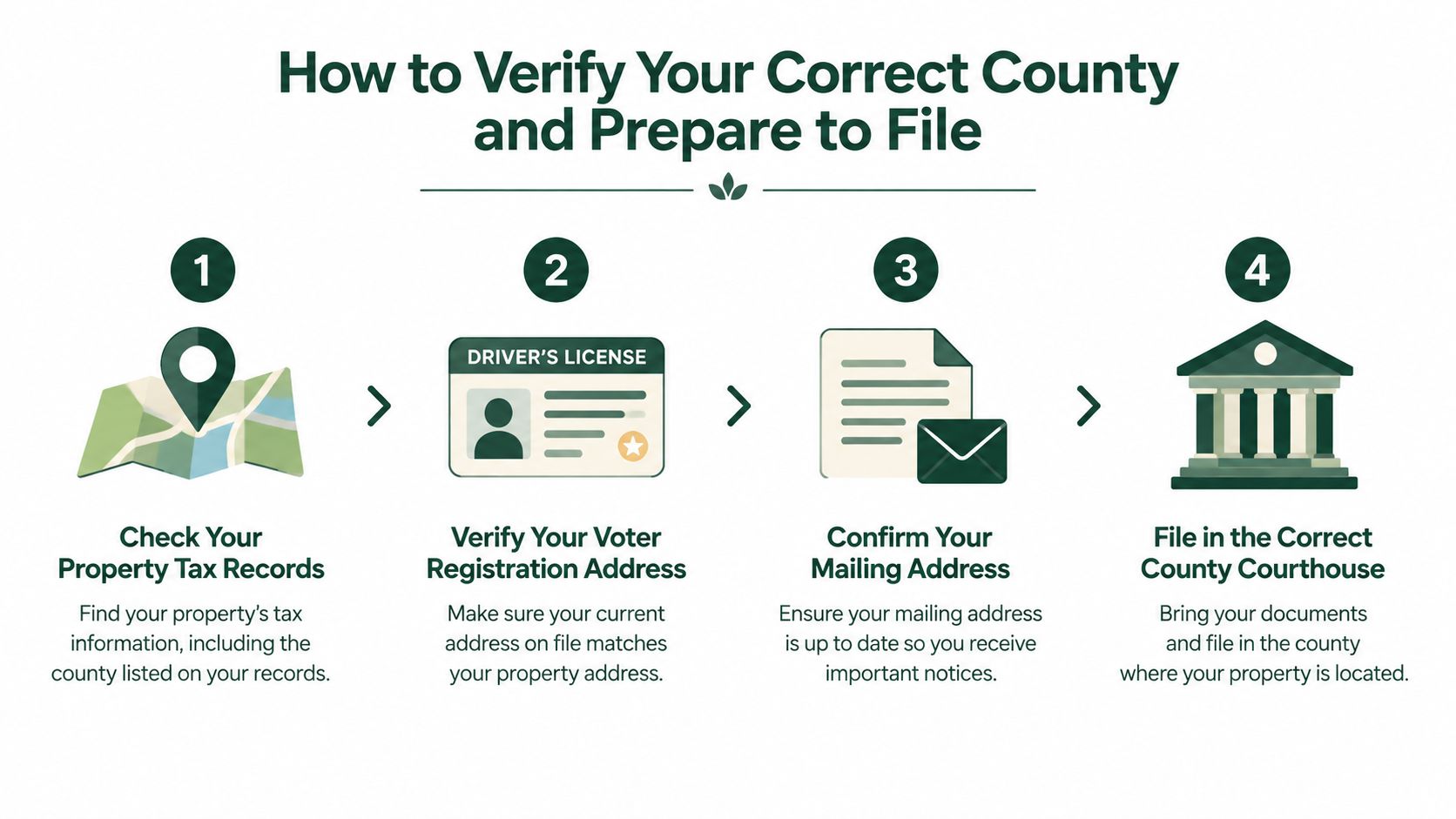
Review property tax records. Look for the county identified with the home. Tax records can provide a useful starting point, especially when a development sits near a boundary.
Check an official county map or GIS resource. Confirm the parcel's location rather than relying on a nearby road, subdivision, or postal designation.
Compare address records. Review the lease, deed, utility records, voter registration address, and driver's-license information. These records help establish the residence history, although no single document automatically decides every legal issue.
Write down the move dates. Record when each spouse began living in the county and whether either spouse moved again. The date history is essential to the 90-day analysis.
Rockwall County residents can also review the county's court structure before filing. The distinction between county-level and district-level authority is addressed in this explanation of Rockwall County Courts at Law jurisdiction. For a divorce, custody case, or support matter, make sure the filing goes to the office responsible for the family judicial case.
Prepare the facts, not just the form
Before submitting an original petition for divorce, organize:
- Current and prior addresses: Include the county connected to each address.
- Residency dates: Identify when the Texas and county residency periods began.
- Children's information: Gather residence history, school details, existing orders, and current care arrangements.
- Safety concerns: Flag family violence, threats, protective-order issues, or urgent concerns that may require immediate legal attention.
- Financial and property facts: List major assets, debts, real estate, businesses, retirement accounts, and income sources.
The filing county is only the first strategic decision. The same facts may affect property division, temporary orders, child support, possession, relocation, and enforcement.
Strategic Next Steps for Royse City Families
For the search “Royse City which county for divorce Rockwall Collin or Hunt,” the correct answer is fact-specific: identify the physical county of the qualifying spouse's residence, then apply the Texas residency requirements. A Royse City mailing address can point in the right direction, but it cannot replace the county and date analysis.
Don't file until you can answer these questions clearly:
- Which county contains the home?
- Which spouse satisfies the Texas domicile requirement?
- Which spouse satisfies the county-residency requirement?
- Has either spouse recently moved across a county line?
- Are custody, support, protective-order, or existing-case issues involved?
A local office can be useful when the issue involves Rockwall County courts, the 382nd or 439th District Court, or a Royse City residence near the Collin or Hunt boundary. The Law Office of Bryan Fagan, PLLC maintains a Rockwall office and handles family-law matters including divorce, custody, child support, temporary orders, modifications, enforcement, relocation, property division, CPS matters, adoption, and appeals. Treat the county question as the first part of the case strategy, not as a last-minute filing detail.
The Law Office of Bryan Fagan, PLLC can review your Royse City address history, county-residency dates, and custody or property concerns before you file. Visit The Law Office of Bryan Fagan, PLLC to learn about family-law services and request a consultation focused on choosing the correct county and protecting your next steps.