
Rowlett straddles Dallas County and Rockwall County, so the correct divorce filing county depends on which side of the county line the qualifying spouse has lived on for the preceding 90 days. A Rowlett mailing address alone doesn't decide whether the case belongs in Rockwall County or Dallas County.
That question comes up often for families near Lake Ray Hubbard and the Dalrock Road corridor. A household can identify as being in Rowlett while its legal filing location depends on the county shown for the actual residence. Before filing a divorce petition, custody case, support action, or related family-law matter, confirm the county rather than relying on a ZIP code, city name, or assumption about the nearest courthouse.
The rule matters because filing in the wrong county can create avoidable procedural problems. A transfer request, a challenge to venue, additional filing work, and delay can all complicate a case that should have started in the proper court system.
Table of Contents
- Which County Handles a Rowlett Divorce?
- Texas Residency and Venue Rules Explained
- Tests That Decide Dallas County vs. Rockwall County
- Comparing the Two Local Court Systems
- How to Confirm Your Correct Filing County
- Common Venue Mistakes and What Happens Next
- Why the Right County Matters Beyond the Divorce Filing
Which County Handles a Rowlett Divorce?
The answer is practical: a Rowlett home on the Rockwall County side generally points to Rockwall County, while a home on the Dallas County side points to Dallas County, provided the statutory residency requirements are satisfied. Rowlett's official city materials identify the city as extending across both counties, with Dalrock Road serving as the dividing county line. The city says most of Rowlett lies in Dallas County, but the city name still doesn't establish the county for every residence. See the City of Rowlett's description of its county boundaries.
Texas Family Code § 6.301 requires that, when the divorce suit is filed, one spouse must have been a Texas domiciliary for the preceding six months and a resident of the county where the suit is filed for the preceding 90 days. The statute makes the county residence requirement decisive for a Rowlett filing. Review the Texas Family Code residency rule in Section 6.301.
| Filing residence | Likely filing system | What controls |
|---|---|---|
| Rockwall County side of Rowlett | Rockwall County District Clerk and local family court system | Qualifying spouse's county residence |
| Dallas County side of Rowlett | Dallas County family court system | Qualifying spouse's county residence |
| Recent move between counties | May require closer analysis | The preceding 90-day county history |
For the Rockwall side, filings go through the Rockwall County District Clerk, with family matters handled through the Rockwall County court system. The Rockwall County civil and family filing information confirms that family and civil filings are handled through the District Clerk's office.
On the Dallas side, a filer may be directed to the George L. Allen Sr. Courts Building in Dallas. But the correct building isn't chosen because it seems more familiar or closer. It follows the legally qualifying county residence.
A useful local explanation of court jurisdiction is available in this guide to Rockwall County court-at-law jurisdiction. The rest of the analysis turns on four questions: where the qualifying spouse lived, whether the other spouse lives elsewhere, where important family ties are located, and whether the case includes children whose custody issues require separate jurisdictional analysis.
Texas Residency and Venue Rules Explained
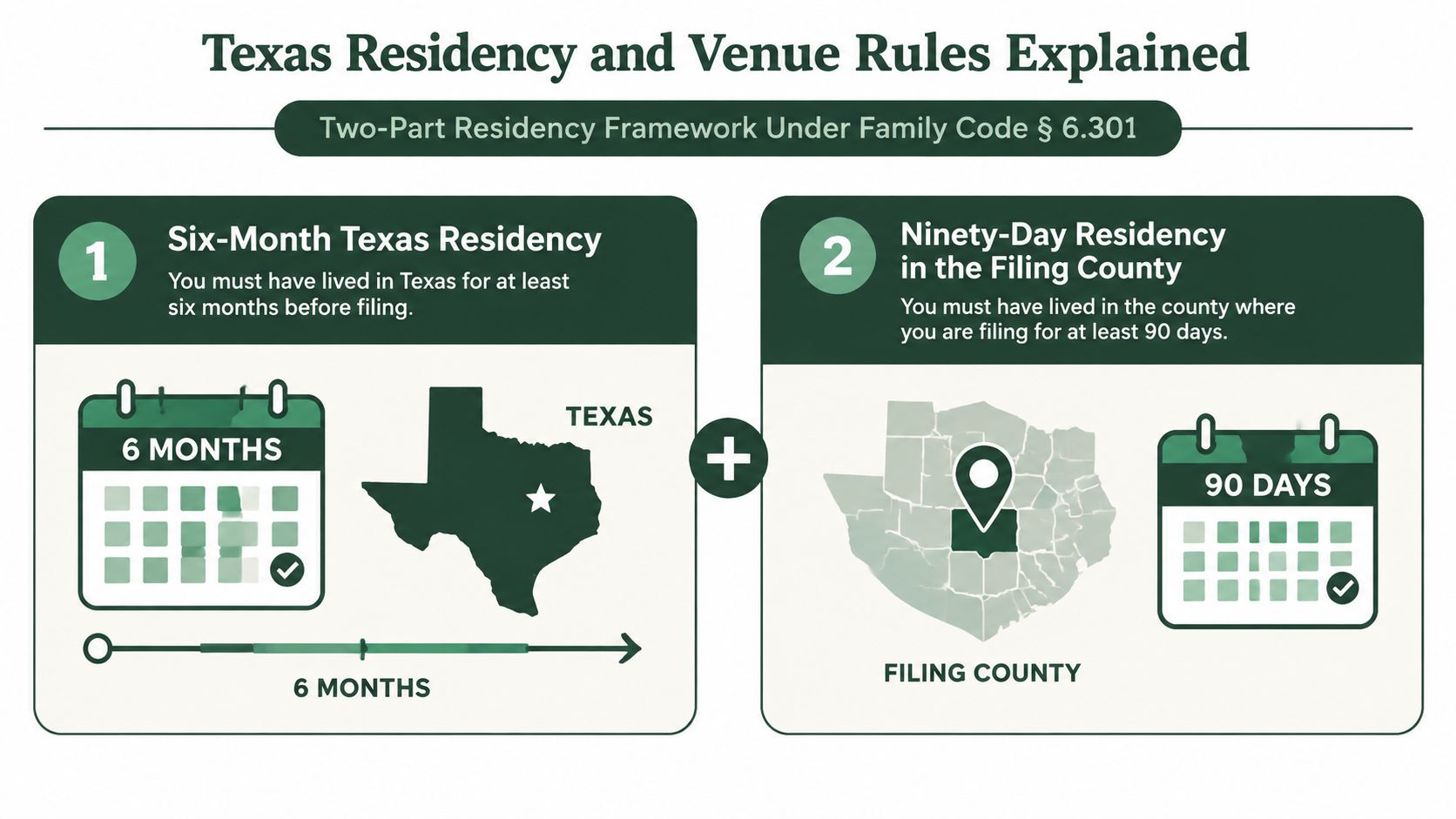
Texas divorce venue starts with a two-part residency test. Under Texas Family Code § 6.301, either the filing spouse or the responding spouse must have been domiciled in Texas for six months and must have lived in the county where the suit is filed for 90 days before filing. The statute is the controlling authority for the basic residency requirement.
Venue is not the same as jurisdiction
Venue means the proper county or location for filing a case. Jurisdiction concerns a court's legal power to decide the type of dispute and, in some situations, the people or property involved. Those concepts overlap in practice, but they aren't interchangeable.
For a Rowlett resident, the city is a geographic label. The county is the venue question. Because Rowlett crosses the Dallas and Rockwall boundary, two neighbors with Rowlett addresses can face different filing destinations.
The six-month requirement asks whether the relevant spouse has established Texas domicile for the required period. The 90-day requirement asks a narrower question, whether that spouse has lived in the specific filing county for the required period. A person who recently moved from Dallas County to Rockwall County may still live in Texas for purposes of the first prong while lacking the county residence needed for an immediate Rockwall filing.
Why the county clock deserves attention
Count backward from the planned filing date and document where the qualifying spouse lived. A lease, deed, utility history, voter record, tax record, or other reliable residential evidence may help establish the timeline, but the legal analysis depends on the facts and available proof.
Texas Rules of Civil Procedure 86 and 87 address venue objections, venue motions, and transfers. Venue objections can be waived in some circumstances, but a party may challenge an improper filing. That means a filing that seems harmless can become a contested procedural issue after the respondent appears.
Practical rule: Treat the 90-day county requirement as a filing condition, not as a general description of where the family considers itself to be from.
For families near Dalrock Road, the best first question isn't “Which courthouse is closer?” It's “Which county was the qualifying spouse's actual residence during the preceding 90 days?” That answer provides the starting point for the divorce venue analysis, while custody and other claims may require additional jurisdictional review.
Tests That Decide Dallas County vs. Rockwall County
The 90-day county residence test is the primary venue question, but a family-law attorney may need to review other facts before filing. A spouse's separate residence, service location, property, and children's living history can affect strategy, even when they don't replace the statutory venue requirement.
| Venue test factor | Dallas County side of Rowlett | Rockwall County side of Rowlett |
|---|---|---|
| Qualifying spouse's residence | Supports Dallas County when the spouse lived there for the preceding 90 days | Supports Rockwall County when the spouse lived there for the preceding 90 days |
| Other spouse's residence | May matter if the spouses live separately and service occurs in Dallas County | May matter if the other spouse lives in Rockwall County |
| Community property | Dallas County location may be relevant to records, residence, or property evidence | Rockwall County location may be relevant to lake-area property, residences, or local records |
| Children's primary residence | May support Dallas-related custody facts | May support Rockwall-related custody facts |
| City label or ZIP code | Doesn't independently establish venue | Doesn't independently establish venue |
Residence comes before convenience
A Rowlett resident in a Dallas County portion of the city may have a Dallas County venue if the qualifying spouse has maintained that residence for the required period. A resident on the Rockwall side may instead have Rockwall County venue. The exact address matters more than whether the family shops, works, or attends activities in one county or the other.
If the spouses live apart, the other spouse's residence can matter to service and to the available filing strategy. Texas law can permit a filing based on the county where the resident spouse lives when the statutory requirements are met, but the facts should be checked carefully rather than assumed.
Property and children add context
Community property can create practical evidence questions. The family home, vehicles, accounts, and other assets may be located or maintained in different places. Those facts can affect property division, discovery, and convenience, but a property location doesn't automatically override the county-residence requirement for divorce venue.
Children create another layer. Their primary home during the relevant period can matter in a custody or Suit Affecting the Parent-Child Relationship, commonly called a SAPCR. A custody case also requires attention to the Uniform Child Custody Jurisdiction and Enforcement Act, or UCCJEA. The proper county for divorce and the proper jurisdiction for custody aren't always answered by one fact.
A ZIP code can help locate an address, but it isn't a substitute for county verification. When the factors point in different directions, the statutory residence analysis should lead the filing decision, with the remaining facts reviewed for custody, service, property, and procedural purposes.
Comparing the Two Local Court Systems
Once the county is identified, the filing process becomes more concrete. Rockwall County matters are routed through the Rockwall County District Clerk, while Dallas County matters proceed through Dallas County's family-court and clerk structure. The local courthouse system, clerk instructions, available settings, and filing logistics can differ.
Rockwall County's official civil and family information states that attorneys haven't been able to file paper documents at the clerk's counter since July 1, 2015. That makes current electronic filing instructions especially important for attorneys handling a Rockwall family case. Review the local information before assuming that a paper packet can be delivered to a counter.
| Feature | Rockwall County | Dallas County |
|---|---|---|
| Initial filing destination | Rockwall County District Clerk | Dallas County clerk and family-court filing system |
| Family-court location | Rockwall County Courthouse system | George L. Allen Sr. Courts Building and related Dallas court facilities |
| Electronic filing | Current clerk instructions should be followed | Current Dallas County instructions should be followed |
| Paper filing assumptions | Don't assume counter filing is available for attorneys | Confirm the applicable clerk procedure before appearing |
| Hearing logistics | Depend on the assigned court and local scheduling process | Depend on the assigned court and Dallas scheduling process |
| Contested versus agreed cases | Timing depends on cooperation, issues, and court availability | Timing depends on cooperation, issues, and court availability |
The Rockwall County Courthouse is identified in local materials at 1111 E. Yap Street. Dallas filers commonly encounter the George L. Allen Sr. Courts Building, but the correct destination can depend on the filing type and current clerk instructions.
For a deeper local reference, consult the guide to Rockwall County 382nd District Court family docket procedures. Don't treat general descriptions of docket pace, temporary-hearing scheduling, standing orders, or self-help materials as a substitute for the court's current instructions. Those details can change, and a family with emergency concerns, contested property, or child-safety issues needs a procedure appropriate for the filing.
An uncontested case usually involves fewer disputed issues than a contested divorce, but no responsible attorney should promise a particular completion date. Children, property, temporary orders, protective-order concerns, support disputes, and service problems can change what happens after filing.
How to Confirm Your Correct Filing County
A Rowlett resident can reduce venue risk by checking the residence directly before preparing the petition. The process should be orderly, because a small geographic mistake can affect the entire opening phase of a family-law case.

Start with the physical address
First, identify the actual residence where the qualifying spouse lived. Compare the address with Rowlett's county boundary, including the Dalrock Road area, rather than relying only on the city name printed in a mailing address. If the home is near Lake Ray Hubbard or another boundary-sensitive location, get county confirmation from an official record.
Then check supporting documents:
- Review the property record. A deed or property-tax record may identify the county associated with the home.
- Check voter registration and other official records. These can help confirm residence, but they should be evaluated alongside the complete residential history.
- Build a date timeline. Count backward from the intended filing date and identify where the qualifying spouse lived during the preceding 90 days.
- Separate residence from routine activity. Employment, schools, shopping, worship, and medical care may occur in another county without changing the residence analysis.
- Review the children and property facts. Note where the children primarily lived and where major community assets are located, because custody and property issues may require separate analysis.
Use a filing checklist
Before paying a filing fee or submitting documents, answer these questions:
- County: Is the home in Dallas County or Rockwall County?
- Timeline: Has the qualifying spouse lived in that county for the preceding 90 days?
- Texas domicile: Has the applicable spouse maintained Texas domicile for the preceding six months?
- Other spouse: Does the other spouse live in another county or state?
- Children: Does the case include custody or SAPCR claims requiring a separate jurisdiction review?
- Evidence: Can the residence timeline be supported if the venue is challenged?
A city name tells you where the neighborhood is. It doesn't necessarily tell you which county clerk should receive the petition.
The appropriate district clerk can provide procedural information, but clerks generally can't choose litigation strategy or determine how disputed facts will be argued. A local family-law attorney can review the address, timeline, service plan, children, property, and any emergency issues before filing.
Common Venue Mistakes and What Happens Next
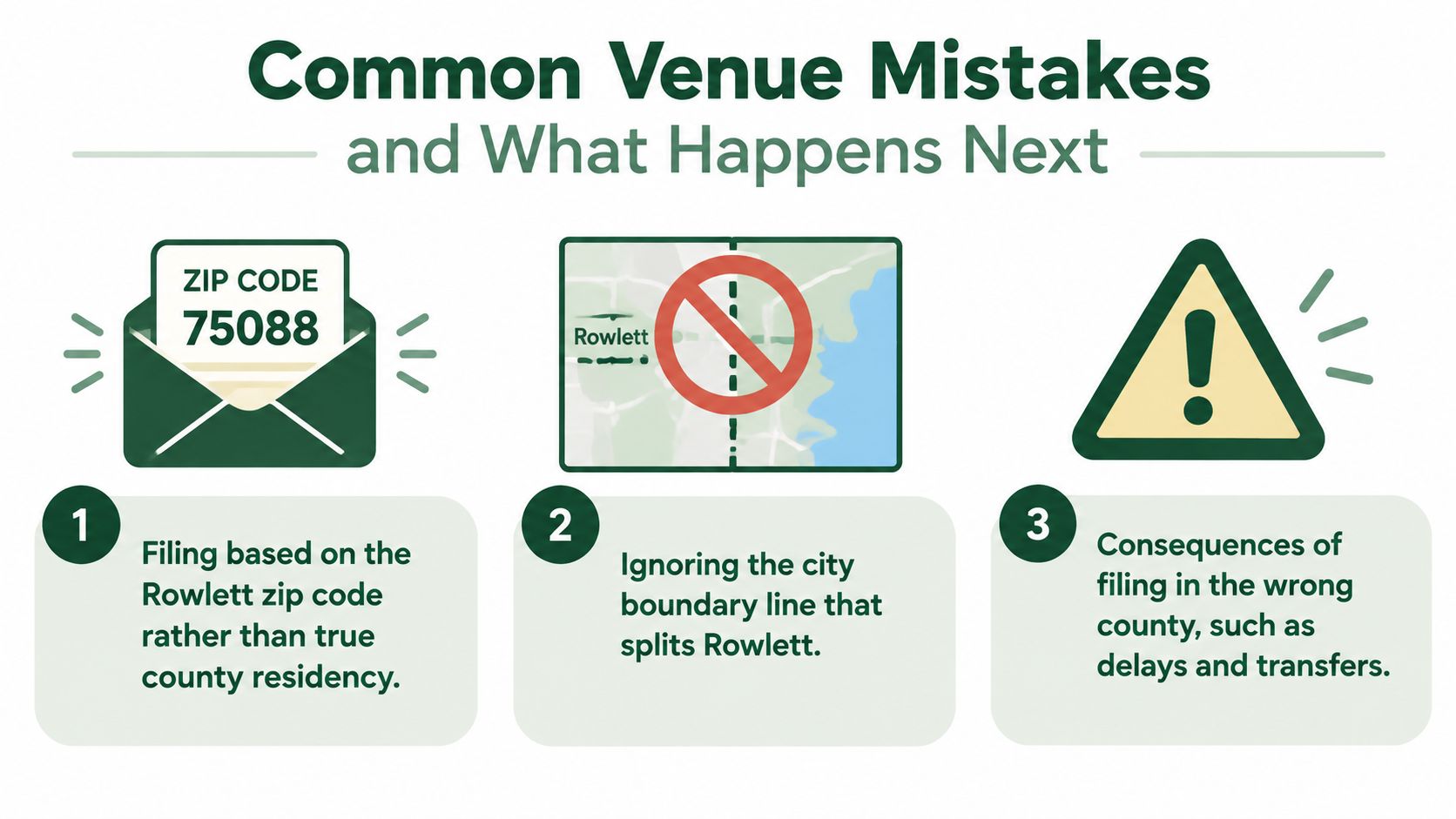
The most common mistake is treating Rowlett as a single-county city. That shortcut is understandable, especially when a household uses one mailing city and one ZIP code for every bill, but the city extends across Dallas and Rockwall counties. The legal filing question follows the county of qualifying residence, not the branding of the mailing address.
Mistakes that create avoidable problems
- Filing by ZIP code: A ZIP code doesn't independently establish the legal county. Verify the property's actual county.
- Ignoring the 90-day clock: A move across Dalrock Road can change the county-residence analysis. The Texas requirement is measured against the filing date.
- Assuming both spouses must live there: The statute focuses on whether the qualifying spouse satisfies the Texas and county requirements. The spouses don't necessarily need to share a county.
- Treating property as the deciding factor: A home or account in one county may matter to the case without automatically fixing divorce venue.
- Overlooking service logistics: If the respondent lives separately, the service location and method still need to be planned correctly.
A respondent may raise a venue objection or seek transfer under the applicable procedural rules, including Texas Rules of Civil Procedure 86 and 87. Depending on the facts and the relief requested, the court may transfer the case, and an improperly filed case may create added cost or delay. Whether dismissal is available, appropriate, or avoidable depends on the pleadings, objections, waiver, and circumstances.
Correcting the filing
The practical response depends on where the case stands. An attorney may evaluate whether to oppose a transfer, agree to transfer, refile, or wait until the county residency requirement is satisfied. None of those options should be selected mechanically, because refiling can affect service, scheduling, filing costs, and the timing of related custody or emergency requests.
A divorce filing also has a statutory 60-day waiting period before it can generally be finalized, subject to legal exceptions. A venue problem can interfere with the expected timeline if the case must be transferred or refiled, because the filing history and procedural posture must be reviewed carefully.
If service is needed in Rockwall County, the Rockwall County constable information for service of divorce papers may be a useful local starting point. It doesn't replace confirming the proper service method for the specific case.
Why the Right County Matters Beyond the Divorce Filing
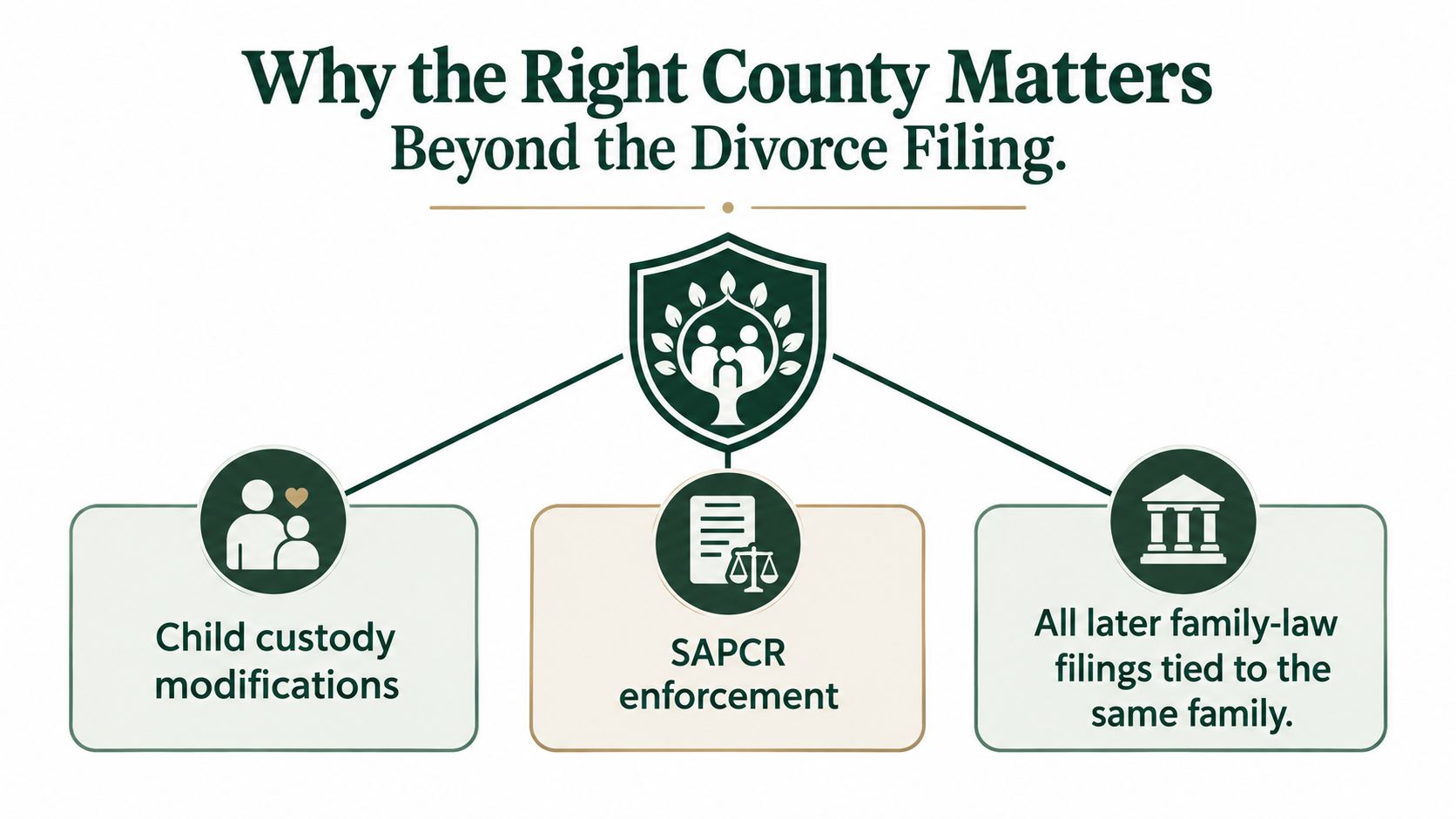
Venue affects more than the first petition. A divorce may also involve child custody, child support, possession and visitation, property division, temporary orders, protective orders, enforcement, and later modifications. Each issue has its own legal requirements, and the county analysis shouldn't be treated as a one-time administrative detail.
Later family-law matters require continuity
After a court signs orders involving children, later enforcement or modification requests may be connected to the existing case and continuing jurisdiction. A parent who moves from the Dallas side of Rowlett to the Rockwall side, or the reverse, may need a new venue and jurisdiction analysis rather than assuming the move automatically transfers the case.
The same caution applies when a parent seeks to relocate, change possession terms, enforce support, or address alleged violations of an order. Protective-order concerns, CPS matters, paternity disputes, adoption proceedings, and parental-rights litigation can involve different statutory frameworks and should be reviewed independently.
Property issues can also outlast the initial divorce. A family may need to address enforcement or clarification involving a home, retirement account, business interest, or other asset located across the county line. The location of an asset doesn't by itself answer every procedural question, but it can affect evidence, notice, and the practical organization of the case.
Choose carefully before the first filing
A filing county can influence where documents are submitted, where hearings occur, which clerk maintains the file, and how later requests connect to the original case. Moving a family-law matter after filing may require new notices, transfer orders, revised scheduling, and additional attorney work.
The right approach is to verify the qualifying spouse's 90-day county residence, identify any custody-jurisdiction concerns, and gather the records that support the conclusion. Families in Rockwall, Heath, Fate, Royse City, McLendon-Chisholm, and the Rockwall County portion of Rowlett can use a local consultation to review venue alongside the actual family-law issues, whether the concern is an agreed divorce, high-asset property division, temporary orders, support, custody, enforcement, relocation, or parental rights.
The Law Office of Bryan Fagan, PLLC offers consultations and family-law representation through its local Rockwall office for residents who need to determine whether a Rowlett matter belongs in Rockwall County or Dallas County. Visit The Law Office of Bryan Fagan, PLLC to discuss the residence timeline, county records, custody or property issues, and the appropriate next step before filing.