
You've left a dangerous relationship in Rockwall, Heath, Fate, Royse City, or another Rockwall County community. You have messages, photographs, and a child-related court case already pending, but you don't know whether to start at the courthouse, the District Attorney's Office, or a shelter advocate. That uncertainty can cost time, especially when immediate protection may be available.
For a Rockwall County protective order application where to file is the first question, the answer depends on two things: whether you're filing independently or need help preparing the paperwork, and whether you already have a divorce or custody case pending. Texas venue rules are flexible, but the pending-case exception can change the correct courthouse and court.
Table of Contents
- Where to File a Protective Order in Rockwall County
- Choosing the Correct Venue Under Texas Law
- Rockwall County Filing Locations and Intake Support
- Forms, Documents, and What to Bring to the Courthouse
- After You File Service Hearings and Next Steps
- Common Mistakes to Avoid and Practical Tips
Where to File a Protective Order in Rockwall County
If you are standing at the courthouse with messages, photographs, or a child-related case already pending, start by identifying the correct filing office. In Rockwall County, the District Clerk's filing process handles court filing. The Criminal District Attorney's protective-order unit may help eligible victims prepare an application and present the case.
Rockwall County identifies assistance for victims of family violence, dating violence, stalking, and sexual assault. It lists Women In Need, Inc. at 904 N. Goliad St., Rockwall, Texas 75087, with the telephone number (972) 772-3000, as a local contact. The county's protective-orders page provides local information.
Keep the roles separate. An advocacy organization can help you organize facts, describe safety concerns, and complete the packet. The clerk or authorized filing office accepts the application for court review. The advocacy group does not issue the order, and the filing office is not the same as a counseling or safety-planning service.
Choose the starting point that fits your situation
If you can complete the standardized Texas forms, begin with the correct court filing process. If describing the violence feels difficult, contact the local advocacy resource before filing and ask about packet preparation and safety planning.
Use this sequence:
- Check the proper county and court, including any pending family-law case.
- Complete the standardized protective-order application.
- Submit it through the appropriate clerk or protective-order intake process.
- Provide accurate information for service and hearing notice.
- Request temporary emergency protection if immediate danger exists.
The pending-case exception deserves attention before you choose an office. A divorce, custody case, or case affecting the parent-child relationship may control where the application belongs. Tell the clerk about every related case. The Texas State Law Library's protective-order guidance explains the statewide filing options and related procedures.
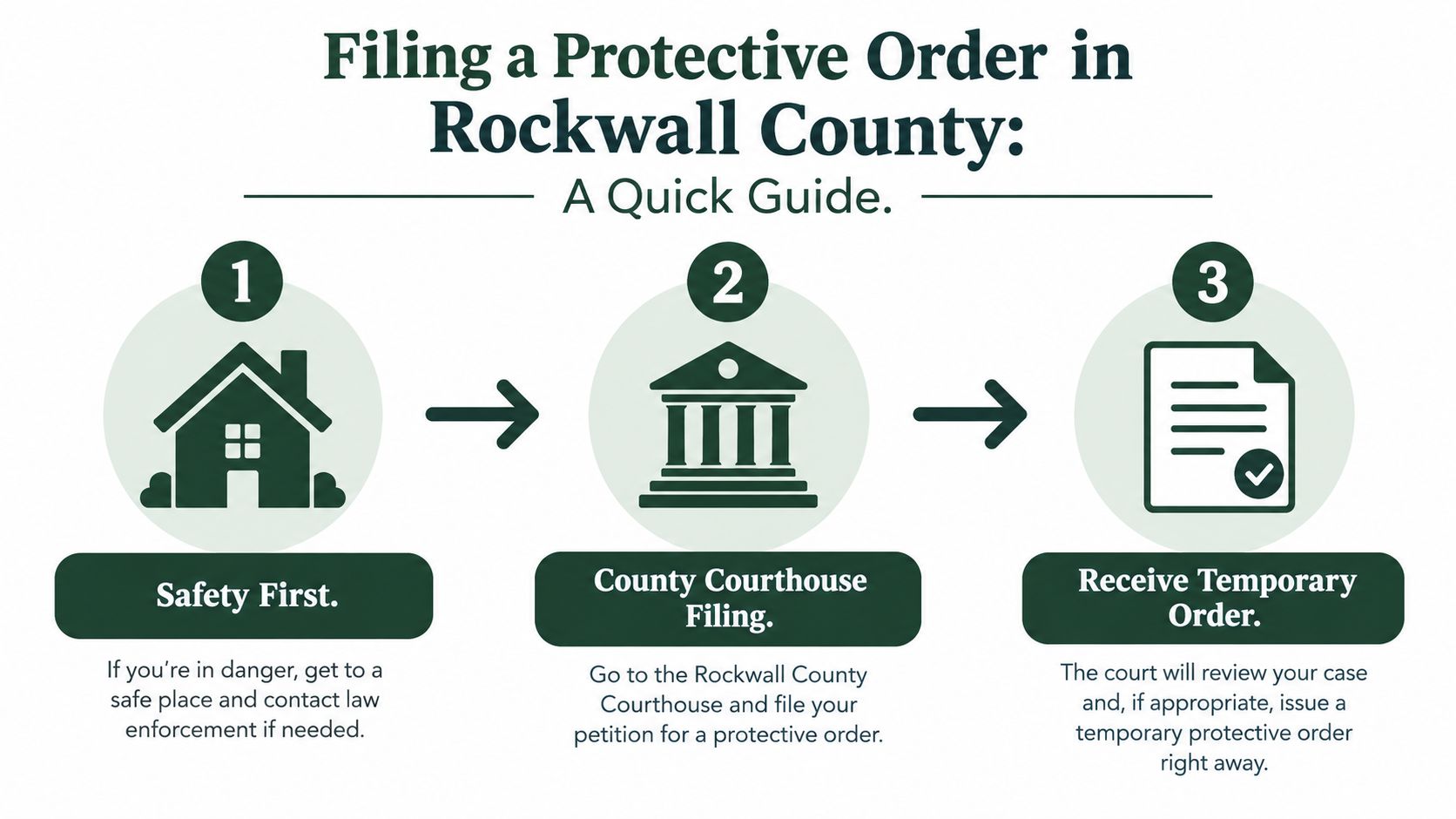
If you face immediate danger, reach a safe location and contact law enforcement or emergency services first. A protective-order application is a court process, not a substitute for emergency assistance.
Choosing the Correct Venue Under Texas Law
Texas law generally permits filing in the county where you live, where the respondent lives, or where an element of the alleged violence or offense occurred. For many Rockwall residents, that points to Rockwall County. But the respondent's residence or the location of the conduct may support filing elsewhere.
The rule people miss most often involves an existing family-law case. If a divorce or case affecting the parent-child relationship, commonly called a SAPCR, is already pending, the protective-order paperwork generally belongs in the county where that case is pending, or in the applicant's county of residence in circumstances recognized by Texas law. The clerk must be told about the pending case. The Texas venue statute for protective-order applications describes the statutory venue framework.
Consider a hypothetical. A parent lives in Rockwall but has an existing custody case pending in another Texas county. Filing a new standalone application in Rockwall may be the wrong move because the pending family case can control where the protective-order request must be filed. The fact that the parent now lives in Rockwall doesn't automatically override that connection.
Practical rule: Before you drive to a courthouse, identify every pending divorce, custody, or parent-child case involving the same parties.
A mailing address also doesn't settle jurisdiction. Rowlett and Royse City can involve county-boundary questions, so verify the actual county tied to the residence, incident, and pending case rather than relying only on a city name.
| Venue Option | Typical Rockwall Scenario | Filing Office |
|---|---|---|
| Applicant's county | The applicant lives in Rockwall County | Proper local clerk or protective-order intake process |
| Respondent's county | The respondent lives in another Texas county | Clerk or authorized protective-order process in that county |
| County of the offense | The alleged violence occurred outside Rockwall County | Clerk or authorized protective-order process where it occurred |
| Pending family-law case | A divorce or SAPCR is already pending elsewhere | The court and county connected to that pending case, subject to the statutory rule |
For a broader explanation of which local courts handle different matters, review Rockwall County court-at-law jurisdiction. Don't treat a wrong venue as a harmless technicality. It can lead to rejection, transfer, or delay while you redirect the application.
Rockwall County Filing Locations and Intake Support
If you arrive at the wrong office, your packet can stall before a judge reviews it. Confirm the current Rockwall County location and the office accepting protective-order applications before you travel. The local process may involve the Criminal District Attorney's protective-order unit, while Women In Need helps eligible applicants prepare and understand the paperwork at 904 N. Goliad St., Rockwall, Texas 75087, telephone (972) 772-3000. Confirm current contact details before going.
The key distinction is intake support versus court filing. An advocacy group can help organize your account of events, complete forms, and prepare you for intake. It is not the filing court. The District Clerk or the District Attorney's protective-order unit is the formal filing channel, depending on the case and applicable process.
A pending divorce, custody, or parent-child case can change the correct route. Tell the intake office about that case, including its county and cause information, before submitting anything. The pending-case exception may direct the application to the court handling that matter rather than the office you first considered.
Ask these questions before you go
- Where is my application formally filed? Confirm whether the District Clerk or the prosecutor's protective-order unit accepts it.
- Does a pending family-law case control the filing route? Provide the court, county, and cause number.
- What service information is required? A reliable daytime address can affect notice.
- Who will help prepare the packet? Ask the advocacy organization what form assistance and accompaniment it provides.
The Rockwall County District Clerk's family-case filing information can clarify clerk-related logistics, although protective-order intake may follow a different workflow.

Before leaving home, confirm the venue, packet-preparation help, filing office, service requirements, and hearing-notice procedure. That checklist prevents the common mistake of treating an advocate, clerk, and prosecutor's unit as the same office.
Forms, Documents, and What to Bring to the Courthouse
Texas uses a standardized protective-order application adopted through the Office of Court Administration. That statewide form structure matters because applicants shouldn't rely on an improvised local petition or a handwritten narrative alone. The Texas protective-order application guidance describes the general filing sequence and advises applicants to make copies of completed forms before taking them to the courthouse.
Your packet may include:
- Application or petition: State the relationship, the conduct, and the protection requested.
- Confidential information form: Provide protected identifying and contact information required for court administration.
- Proposed temporary ex parte order: Give the judge a clear document to consider if immediate protection is requested.
- Alternative-service paperwork: If you don't know where the respondent can be found, ask what motion or application is needed rather than leaving service information blank.
The facts matter more than dramatic wording. Write down specific incidents, approximate dates if exact dates aren't available, locations, threats, physical conduct, stalking behavior, property damage, and conduct affecting children. Explain why you believe protection is needed now.
Bring organized supporting material
Bring a government-issued photo ID if available, along with:
- Incident notes: Keep events in chronological order.
- Communications: Print or preserve relevant texts, emails, voicemails, and social-media messages.
- Photographs: Include images of injuries, damaged property, or other physical evidence.
- Witness information: Write down names and reliable contact details.
- Related case information: Bring any divorce, custody, support, or temporary-order cause information.
Ask the clerk or intake unit about any filing fee and whether an indigence affidavit can be used to request a waiver. Don't assume a police report is required before you can apply. A protective-order application is a separate court filing, although law-enforcement records and other evidence may support the facts you provide.
Use plain, complete answers. Omitting a prior case, leaving out service information, or submitting a packet without the proposed emergency relief document can create avoidable processing problems.
After You File Service Hearings and Next Steps
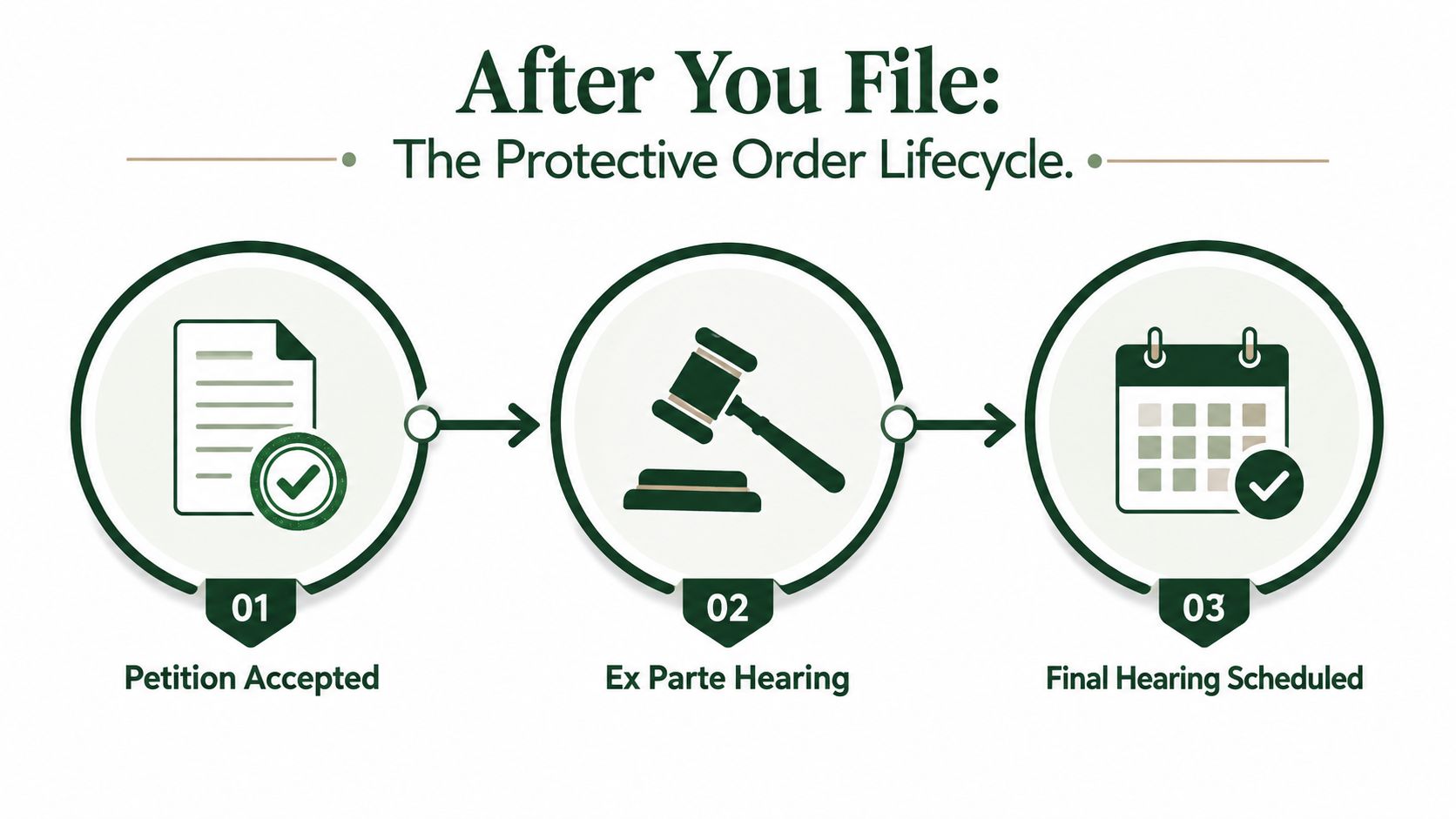
Filing starts the case. It doesn't automatically mean the respondent has been notified, and it doesn't automatically mean a final protective order has been entered.
The court may review a request for a temporary ex parte protective order, which is short-term relief considered without the respondent present when the legal requirements for immediate protection are met. Texas protective-order materials explain that the clerk enters the application into the protective-order registry within 24 hours in the applicable process, as described in the Texas protective-order registry materials. The exact timing of judicial review, service, and the hearing depends on the filing and the court's handling of the matter.
Service controls the next stage
The respondent generally must receive legally sufficient notice of the hearing before the court proceeds on a final order, subject to the rules governing service and alternative service. Give the most accurate daytime address you have. If the respondent may be at work, has moved, or can't be located, tell the clerk or protective-order unit immediately and ask about available service options.
At the final hearing, the applicant may present testimony, documents, photographs, communications, and witnesses. The respondent may appear and contest the request. The judge decides whether the evidence satisfies the legal standard for a final protective order and what restrictions, if any, should be included.
A temporary order and a final order are different stages. Don't confuse an emergency review with completion of the case, and don't miss the hearing date listed in the notice.
After an order is granted, Texas courts' materials show that it is entered into the Protective Order Registry of Texas, known as PROTECT. Ask how to obtain a certified copy if you need to provide the order to a school, employer, law-enforcement agency, or an out-of-state authority. For general information about service and legal papers, see the Rockwall County constable service resource, but confirm the correct service channel for your protective-order case.
Common Mistakes to Avoid and Practical Tips
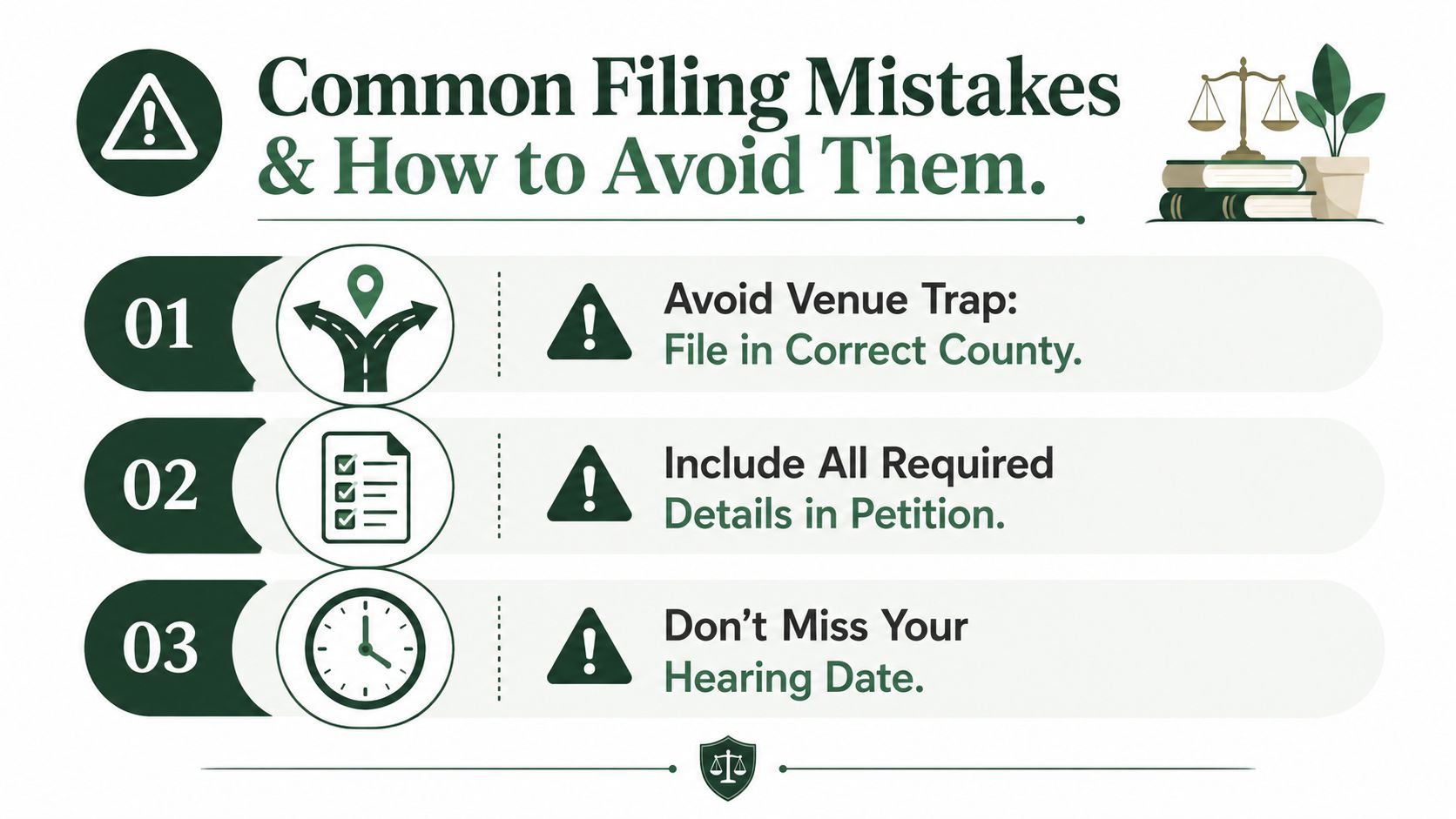
The most damaging mistake is filing in Rockwall County without checking for a pending divorce or SAPCR in another county. That exception can control venue, even when the applicant lives in Rockwall. Tell the intake office about every related family-law case before the application is filed.
A vague statement such as “the abuse is ongoing” doesn't give the court the concrete account it needs. Describe separate incidents, identify what happened, explain where it happened, and connect the facts to the protection you're requesting.
Prevent service problems
Service often slows a case when the applicant provides an old address, an outdated workplace, or no usable location at all. If you don't know where the respondent is, say so immediately and ask about alternative service instead of hoping the process server will locate the person without additional information.
Other practical steps can reduce avoidable delays:
- Arrive prepared: Bring copies of the completed packet and organized evidence.
- Protect your privacy: Ask how confidential contact information will be handled.
- Request language assistance: Tell the office if you need a translator or interpreter.
- Track the hearing: Keep the notice in a safe place and plan transportation.
- Confirm registry entry: After the final hearing, contact the clerk to verify that the order was transmitted and ask for a certified copy.
A civil protective order also differs from an emergency protective order connected to a criminal case. Those processes can involve different offices and legal triggers, so don't assume the civil application and a criminal-case order are interchangeable.
If a protective-order request overlaps with divorce, custody, child support, possession, enforcement, CPS involvement, relocation, or temporary orders, get legal guidance before filing. The facts can affect both the protective-order case and the existing family-law litigation.
The Law Office of Bryan Fagan, PLLC offers guidance on Rockwall County protective-order filings, pending divorce and custody cases, service issues, and related family-law matters. Visit The Law Office of Bryan Fagan, PLLC to learn about the local Rockwall office and request help evaluating your next step.