
You've downloaded a Texas family-law packet, filled in what appears to be the right information, and still aren't sure what happens when you walk into the Rockwall County Courthouse. That uncertainty is normal. A form can help you start a case, but it can't decide which court has authority, tell you whether service was completed correctly, prepare you for a contested hearing, or protect you from agreeing away important property or parental rights.
For residents of Rockwall, Heath, Fate, Royse City, McLendon-Chisholm, Mobile City, and other Rockwall County communities, the Rockwall County Law Library self-represented family forms resources provide a practical starting point. Use them to identify the correct paperwork and research the process. Then treat filing, service, hearings, support processing, and final orders as separate legal tasks.
Table of Contents
- Locating Family Law Resources at the Rockwall County Courthouse
- Choosing the Right Texas Family Law Form Packet
- Filing Procedures and Requirements at the District Clerk
- Hidden Steps Beyond the Initial Paperwork Filing
- Recognizing When Self-Representation Becomes a Liability
- Your Next Steps for Rockwall County Family Court
Locating Family Law Resources at the Rockwall County Courthouse
You may arrive at the courthouse carrying a folder, a phone full of downloaded forms, and more questions than answers. Start with the courthouse resource designed for public legal research, not with random forms found through a search engine.
The Rockwall County Law Library is in Room 2023 on the second floor of the Rockwall County Courthouse. Its public hours are Monday through Friday, from 8 a.m. to 5 p.m., according to the Rockwall County family-law law library resource page. The county identifies family-law resources involving divorce, custody, child support, visitation enforcement, modifications, protective orders, and paternity.
What to bring and where to go
Bring a government-issued identification document if courthouse security requires it, your case information, a charged phone or laptop if you have one, and a way to organize printed pages. Write down the exact relief you want before selecting forms. “I need custody paperwork” is too broad. You may need an original petition, a modification, an enforcement action, temporary orders, or another filing entirely.
The library is down the hallway left of the elevators toward the District Clerk's office, as described by the Rockwall County Law Library location information. The county also notes that the library has a public computer with internet access, which can help you download, complete, and print documents if you can't do that at home.
Practical rule: Use the law library to find and understand reliable legal materials. Don't expect library staff or clerk employees to choose your legal strategy or tell you what outcome to request.
The courthouse may contain the District Clerk, County Clerk, District Courts, and Courts at Law, but those offices don't perform the same function. A family-law filing may require interaction with the appropriate clerk, and the correct destination can depend on the type and posture of your case. A mailing address in Rowlett or Royse City also doesn't automatically determine county venue, because communities can cross county lines.
For a visual guide to the building and hearing logistics, review this Rockwall County Courthouse guide for family hearings. Before you leave, confirm which forms apply, which documents must accompany them, and what the clerk needs for submission.
Choosing the Right Texas Family Law Form Packet
The first decision isn't whether to use an online form or a printed packet. It's whether the packet matches your case.
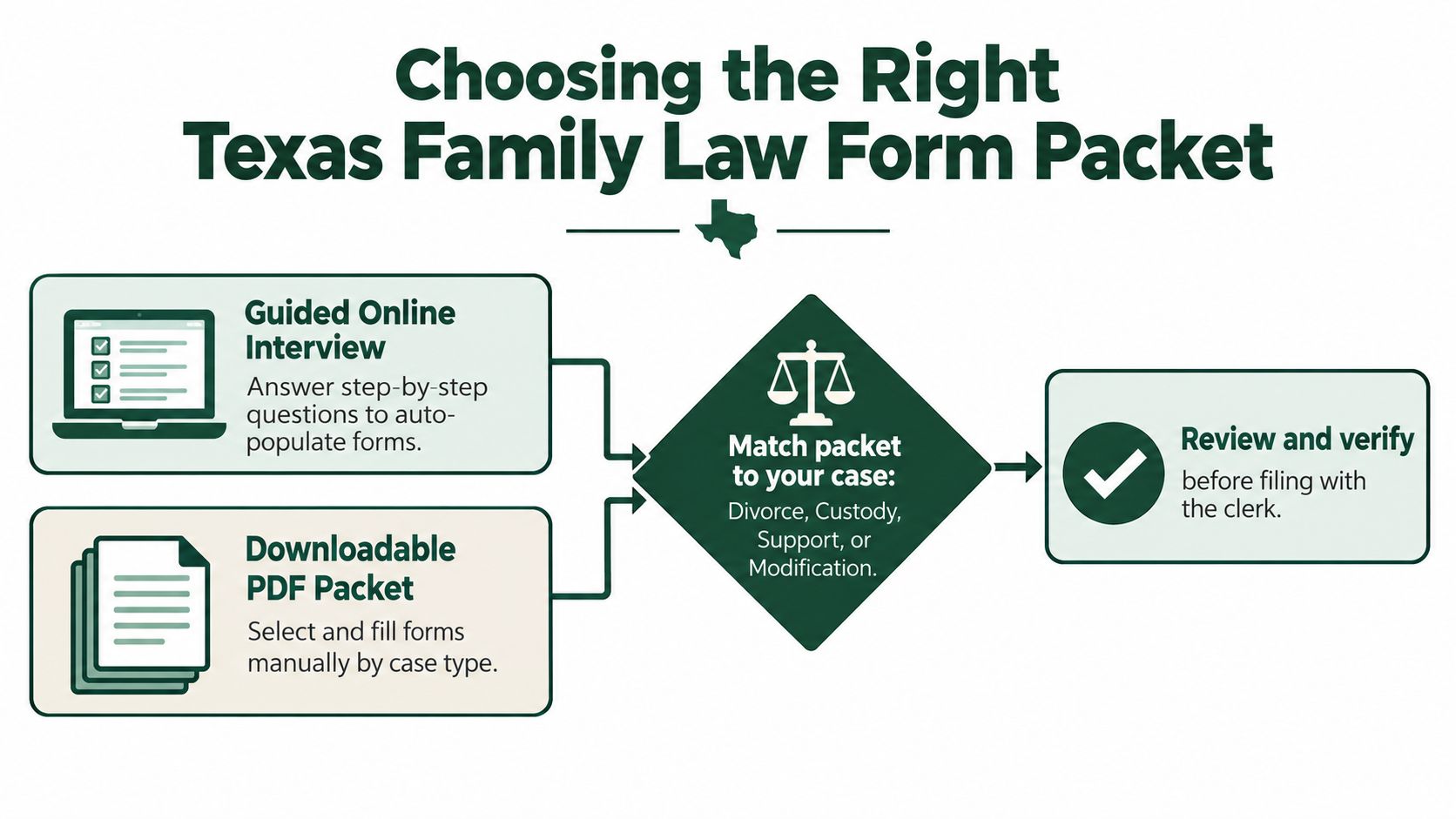
Texas self-help family-law workflows generally give you two ways to prepare documents:
- Guided online interviews ask questions and use your answers to populate forms.
- Blank or downloadable forms let you select a packet and complete it manually.
The guided route can reduce transcription mistakes because the system places answers into the document. The manual route can be useful when you need to review every field yourself or work from printed materials at the courthouse. Neither route determines whether the case qualifies for that packet.
Start with the case type
Separate your legal problem from the document you found first.
- Uncontested divorce: Confirm whether you and your spouse agree on every issue covered by the proposed final order.
- Divorce with children: Look for the form set addressing conservatorship, possession, support, and required child-related paperwork.
- Custody or support modification: Identify the existing order and the specific change you seek. A new-petition packet may not fit a post-judgment modification.
- Enforcement: Focus on the alleged violation, the existing order, and the relief available through an enforcement filing.
- Protective order: Safety concerns and family violence allegations require careful attention to immediate protection, notice, and hearing procedures.
- Paternity or parental rights: Determine whether parentage has already been legally established and what additional relief is being requested.
Texas court guidance limits some approved family-law forms, including the Supreme Court-approved divorce packet, to uncontested divorces without children or real property. The Texas Court Help resources warn that using a packet outside its intended category can create filing defects or require refiling.
That limitation matters in Rockwall County. A couple who agrees on a simple divorce may fit a standard packet. A spouse seeking a share of a house, retirement account, business interest, or other significant property needs a more careful analysis. So does a parent disputing relocation, possession, decision-making authority, or child support.
Use a decision test before drafting
Ask four questions:
- Do minor children or child-support issues exist?
- Is there real property or complicated marital property?
- Does a prior order already control the parties?
- Does the other person agree to every requested term?
If any answer creates uncertainty, stop before signing. Forms are not interchangeable, and a completed packet can still be legally unsuitable.
Filing Procedures and Requirements at the District Clerk
Once your documents are complete, filing becomes an administrative process with legal consequences. The clerk receives and processes paperwork, but the clerk isn't your lawyer and usually can't redesign an incomplete case for you.
For a new Texas civil or family filing, including certain family-law and post-judgment matters, the Civil Case Information Sheet is required according to the Rockwall County Court at Law information page. That page also identifies supplemental instructions and definitions for self-represented parties. Review the Rockwall County Court at Law filing information before submitting your packet.
A practical filing sequence
First, check every document against the instructions for the specific case type. Confirm names are consistent, attachments are included, and the requested relief matches the petition and proposed orders. If you're filing after an existing case or order, identify that prior case accurately rather than treating the matter as brand new.
Next, prepare the Civil Case Information Sheet when it applies. Then determine whether you'll file in person or through electronic filing. Texas self-represented parties may use the state's self-help portal for e-filing instead of filing paper documents with the clerk, but the online option doesn't remove the responsibility to submit a complete and appropriate package.
You'll also need to address filing fees. The amount and any waiver procedure can depend on the filing and your circumstances, so confirm the current requirement with the appropriate clerk or official county information. If you can't afford the applicable fee, ask about the process for requesting a waiver before assuming the clerk will waive it automatically.
Paper filing versus electronic filing
In-person filing allows you to ask where to submit documents, but staff generally can't give legal advice or evaluate whether your requested relief is wise. E-filing can save a courthouse trip, but a rejected submission still requires correction, and electronic confirmation doesn't mean the entire case is procedurally complete.
Use the Rockwall County District Clerk e-filing requirements for a family case as a preparation aid, then verify current instructions directly before filing. Save every confirmation, file-stamped copy, and clerk communication.
Hidden Steps Beyond the Initial Paperwork Filing
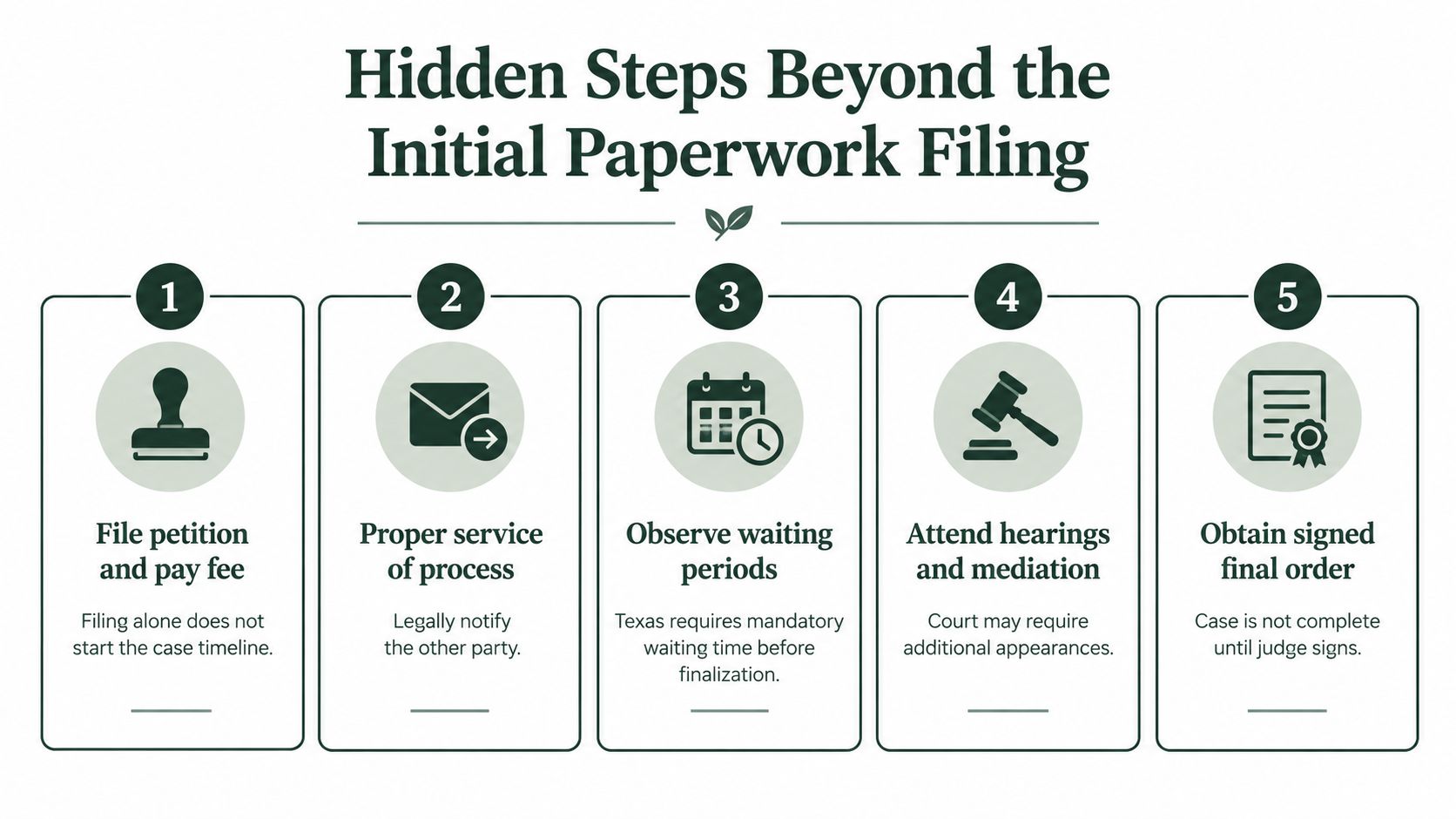
Filing a petition starts a court case. It doesn't finish one, and it may not even move the case forward until the next procedural requirement is completed.
The biggest mistake is treating the file-stamped petition as proof that the other party has been legally notified. Service of process is the formal method of notifying the respondent about the lawsuit. In some matters, the respondent may be able to waive formal service or file an answer, but you must use the legally appropriate procedure for your situation.
What still has to happen
After filing, review the case-specific instructions and determine which of these tasks apply:
- Service or waiver: The other party must receive legally sufficient notice unless a valid alternative applies.
- Hearing arrangements: A hearing may require proper notice, a setting request, or additional documents.
- Child-support processing: A support case may involve setup through the appropriate state or county process.
- Vital-statistics paperwork: A divorce or other family-law matter may require forms beyond the petition and final order.
- Final order: The case isn't complete merely because the parties signed an agreement. The judge must sign the appropriate order when judicial approval is required.
Texas Court Help states that courts cannot reject a filing because the person filing is unrepresented. That protection doesn't excuse errors. The Texas forms information from the Texas courts explains that self-represented litigants still must complete case-specific requirements, including child-support setup, vital-statistics forms, and hearing notices.
A common example is an uncontested divorce. The spouses may agree privately, but the court still needs a legally acceptable path to judgment. If children, property, support, or retirement interests are involved, the final order must accurately address those subjects. A missing term can create problems long after the case appears finished.
The following video may help you understand the general role of paperwork and court procedure:
Filing is the beginning of the court process. Service, notice, evidence, hearings, and a signed final order can determine whether the case actually reaches a lawful resolution.
Keep a master file containing the filed petition, stamped copies, service records, waivers, correspondence, hearing information, proposed orders, and any signed orders. Don't rely on a phone screenshot or memory when a procedural dispute arises.
Recognizing When Self-Representation Becomes a Liability
Self-representation can be reasonable for a simple, uncontested matter. It becomes dangerous when the legal problem involves disputed facts, substantial property, safety concerns, or consequences you can't easily reverse.
A contested divorce is not an uncontested divorce with more paperwork. If spouses disagree about the house, retirement accounts, debt allocation, spousal support, or the validity of an agreement, a form packet cannot value the interests, develop evidence, negotiate terms, or preserve objections for appeal.
Warning signs your case needs counsel
Consider obtaining legal advice before filing if:
- Custody is contested: You and the other parent disagree about conservatorship, decision-making, possession, relocation, school issues, or geographic restrictions.
- Property is complicated: The marital estate includes a business, multiple properties, retirement accounts, separate-property claims, inherited assets, or substantial debt.
- Safety is involved: Family violence allegations, protective orders, threats, stalking, or coercive control can change how you approach service, hearings, and evidence.
- CPS is involved: A child-protection investigation can affect parental rights and may require coordination across court and agency proceedings.
- A prior order is being violated: Enforcement requires matching the alleged conduct to precise order language and presenting admissible proof.
- An appeal is possible: Appeals depend on preserving the record and following specialized rules. A do-it-yourself filing may not protect an issue for review.
A parent in Heath seeking to relocate with a child, for example, may need more than a modification form. The outcome can turn on the existing order, the requested geographic change, notice, evidence, and the child's circumstances. A parent in Royse City may also need to confirm which county controls the existing case if the family has moved.
For a dispute involving a child's interests, review information about amicus attorney appointment and cost in Rockwall County matters. An amicus appointment isn't a substitute for your own lawyer, but it illustrates why courts may need a structured process when children's interests are central.
Forms cannot make strategic decisions
A form can ask whether you want certain relief. It can't explain the consequences of selecting that relief, identify a weakness in your evidence, or negotiate language that protects you. It also can't tell you whether a proposed agreement gives up rights involving property, support, possession, or future modification.
Limited-scope assistance may be worth asking about if full representation isn't realistic. An attorney may be able to review a packet, advise on a specific issue, or help prepare for a hearing, but the arrangement must be clearly defined. Don't assume that a brief document review means a lawyer is responsible for filing, service, deadlines, or courtroom appearances.
Your Next Steps for Rockwall County Family Court
Use the Rockwall County Law Library as a working resource, not as a substitute for case evaluation. Before you file, write down the exact case type, identify any existing orders, separate agreed issues from disputed issues, and confirm whether children, real property, safety allegations, or complicated financial interests are involved.
A sensible preparation checklist looks like this:
- Visit or contact the law library: Go to Room 2023 on the second floor of the Rockwall County Courthouse during its public hours, Monday through Friday from 8 a.m. to 5 p.m.
- Match the packet: Choose divorce, custody, support, enforcement, modification, protective-order, or paternity materials based on the actual relief requested.
- Review every limitation: Don't use a simplified packet if your facts fall outside its stated category.
- Prepare local filing materials: Include the Civil Case Information Sheet when required and confirm the appropriate clerk and filing method.
- Plan the next stage: Address service, hearing notice, child-support processing, vital-statistics forms, and the proposed final order.
- Get advice at the warning signs: Seek counsel before filing if the case is contested, high-asset, safety-related, CPS-related, or likely to involve an appeal.
If you're in Rockwall County and realize the forms aren't enough, move from research to a structured conversation about your facts, documents, goals, and risks. A local office can help you understand whether you need full representation, focused legal guidance, or another path.
The Law Office of Bryan Fagan, PLLC offers family-law guidance and representation for Rockwall County matters involving divorce, custody, support, modifications, enforcement, protective orders, CPS issues, property disputes, and appeals. Visit The Law Office of Bryan Fagan, PLLC to learn about the local Rockwall office and request a consultation before a filing mistake becomes a larger problem.