
In a Texas family case in district court, a jury demand is typically due at least 30 days before the final trial setting, and the jury fee must also be handled within that window or the right can be waived. In Rockwall County, that means you shouldn't assume a jury happens automatically in your divorce or custody case, and you also can't ignore any scheduling order that sets an earlier deadline.
If you're in Rockwall, Heath, Fate, Royse City, McLendon-Chisholm, or another Rockwall County community, this issue usually comes up at a stressful moment. You've been served. A final trial is on the horizon. You think a jury might be better than leaving everything to one judge. Then you find mixed information online about 14 days, 30 days, and different fee amounts.
That confusion is real. Family-law jury demands sit at the intersection of statewide civil rules, family-case practice, and local clerk workflow. Missing one step can mean losing the jury right before the courtroom doors even open.
Table of Contents
- What a Jury Demand Means in a Rockwall County Family Case
- Which Family-Law Issues Can a Jury Decide in Texas
- Preparing and Filing Your Written Jury Demand
- Paying the Jury Fee at the Rockwall County District Clerk
- A Realistic Rockwall County Family-Case Timeline
- Common Mistakes and How to Avoid a Waived Jury Right
- Verifying the Details and Your Next Steps
What a Jury Demand Means in a Rockwall County Family Case
A jury demand is a written request filed in your pending case asking that jury-eligible issues be decided by citizens instead of only by the judge. In a Rockwall County divorce, SAPCR, modification, or other district-court family case, that filing usually goes through the Rockwall County District Clerk.
What the demand actually does
If you live in Rockwall County and you've just been served with a divorce or custody case, asking for a jury doesn't mean every issue automatically goes to six jurors. It means you're preserving the right to have a jury decide certain factual questions that Texas law allows a jury to decide.
That distinction matters. Some parts of a family case can be presented to a jury. Other parts stay with the judge no matter what.
Practical rule: A jury demand is a separate procedural step. It isn't built into your answer, and paying money alone doesn't create the jury setting.
The deadline that confuses people
The most useful answer for family cases is this: Texas family-law guidance commonly applies a 30-day deadline before the final trial setting, while more general civil materials often refer to a 14-day rule in other contexts. Rockwall County public filing guidance also still includes older language stating that the $22 jury fee must be paid within 14 days before trial in general civil guidance, which is one reason people researching family cases get mixed answers (Rockwall County filing guidance).
Texas family-law guidance and rule summaries also reflect a major point many self-represented parties miss: for family cases in district court, the working deadline is commonly treated as no later than 30 days before the final trial setting, even though other civil or lower-court materials may discuss shorter deadlines in different settings (Texas jury demand deadline overview).
Why timing matters in Rockwall County
Under Texas civil procedure, a jury request must be affirmatively filed, and the applicable jury fee must be paid on time. A Texas rule compilation reflecting the statewide framework explains that in civil cases, including family-law matters, a jury demand generally must be filed at least 30 days before trial, and the requesting party must pay the jury fee within that same period. It also warns that missing the deadline can waive the right unless the court excuses the late filing for good cause (Texas Rules of Civil Procedure reference).
For a Rockwall County case, the practical takeaway is simple:
- File the written demand: It must be in writing.
- Handle the fee on time: The clerk's office is part of the process.
- Check the court's scheduling order: The assigned court can set an earlier deadline than the rule's minimum.
Which Family-Law Issues Can a Jury Decide in Texas
The smartest jury-demand decision starts with one question: what issue are you asking a jury to decide? In many Rockwall County family cases, the answer is narrower than people expect.
Divorce and property disputes often drive the jury decision
A jury can be strategically useful when the fight is about the marital estate. In a divorce, that may include disputes over whether property is separate or community, whether one spouse has a reimbursement claim tied to money spent during the marriage, or whether one spouse breached duties tied to managing marital property.
For example, a spouse in Heath may claim a business interest is separate property, while the other spouse argues part of its value belongs to the community estate. Or a spouse in Fate may argue community funds were used to improve separate real estate and reimbursement should be considered. Those are the kinds of factual disputes that can make a jury demand worth discussing.
The jury's role still has limits. Even when a jury answers factual questions, the judge remains responsible for entering the final orders and applying the law.
Child-related issues usually stay with the judge
When parents in Rockwall or the Rockwall County portion of Rowlett are fighting about conservatorship, possession, access, child support, temporary orders, or related best-interest questions, the judge often remains the central decision-maker. That's because many of those rulings depend on legal standards and discretionary decisions the court must make.
A jury demand may not change the outcome of who decides those issues. So if your case is mainly about visitation logistics, support enforcement, temporary restrictions, or a modification tied to a child's current needs, a jury request may add cost and complexity without shifting the key decision away from the bench.
A jury can be powerful in the right family case. It can also be a distraction in the wrong one.
Jury-Eligible vs. Judge-Decided Family Issues in Texas
| Issue | Who Decides | Notes for Rockwall County Cases |
|---|---|---|
| Characterization of property as separate or community | Jury may decide factual disputes | Often important in contested divorce and high-asset property cases |
| Reimbursement claims involving marital funds or property | Jury may decide factual components | Can arise when one spouse says community resources benefited separate property |
| Certain fiduciary-duty-related disputes tied to the marital estate | Jury may decide factual questions | Usually matters more in complex estate division than routine divorce |
| Final property division order | Judge | Even where a jury answers fact questions, the court signs the final decree |
| Conservatorship and many parenting decisions | Judge | Best-interest analysis remains central |
| Possession and access details | Judge | Common in custody and modification cases |
| Child support | Judge | Support rulings are generally handled by the court |
| Spousal maintenance | Judge | A legal and discretionary issue for the court |
A practical way to decide
If your Rockwall County case is mostly about property facts, a jury may deserve serious attention. If it's mostly about parenting arrangements, support, or temporary relief, a jury request may not change who makes the final decision on the issues that matter most.
That's why the question isn't just "Can I ask for a jury?" It's "Will a jury decide the dispute I'm having?"
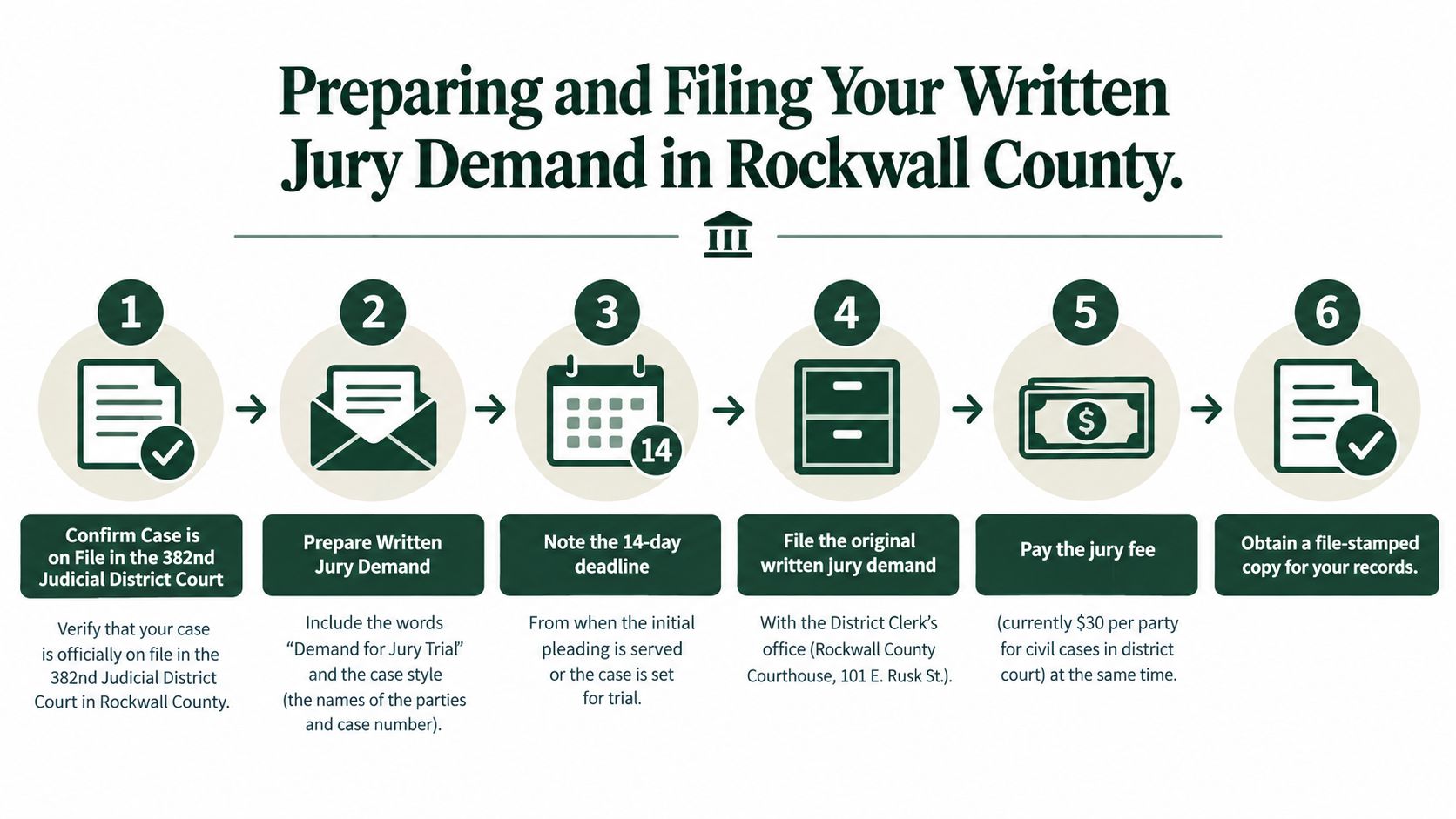
Preparing and Filing Your Written Jury Demand
Once you've decided a jury demand makes sense, the next step is mechanical. Procedure matters here. A strong argument won't help if the written demand never reaches the file or if the fee piece gets missed.
Start with the case details
Before you draft anything, confirm the family case is on file and identify the correct case style and cause number. In Rockwall County family matters, district-court cases may be assigned within the county's district-court system, so make sure you're using the exact caption that appears on the docket.
Your written filing is commonly titled Demand for Jury Trial. It should clearly identify:
- The case name: Use the exact style from the court file.
- The cause number: Don't guess.
- The requesting party: State who is making the demand.
- The request itself: Say that the party demands trial by jury on jury-eligible issues.
- A signature block: The party or the attorney signs it.
Some filers also keep separate proof showing the jury fee was paid, so there isn't later confusion about whether both steps were completed.
File it with the Rockwall County District Clerk
In a district-court family case, the filing point is the Rockwall County District Clerk. The clerk's office receives the document, logs it into the case, and processes the fee component tied to the jury request.
If you're filing electronically, check the county-specific workflow before you submit. This guide to Rockwall County District Clerk e-filing requirements for family cases can help you think through the practical side of submitting the document correctly.
If you're filing in person, keep copies and make sure you leave with proof that the demand was accepted.
What to keep in your records
Don't treat this as a one-paper task. Keep a small jury-demand file with:
- The filed demand
- Proof of payment
- Any service confirmation showing the other side received it
- The scheduling order or notice of final trial
- Any later reset notice if the trial date changes
A realistic example helps. Say a spouse in Royse City has a divorce pending in Rockwall County involving a disputed house down payment and separate-property tracing. The final trial gets set. The spouse files a short written demand, pays the fee through the District Clerk, serves the other side, and keeps file-stamped proof. That's the kind of organized paper trail that prevents last-minute arguments about waiver.
If a deadline fight happens later, your best friend is paperwork. File-stamped copies and a receipt tell the court what happened and when.
Paying the Jury Fee at the Rockwall County District Clerk
The fee question is where many people get tripped up. That's because public materials don't all show the same number, and the answer can depend on which court level your case is in.
What the fee sources show
Texas judiciary fee schedules identify a mandatory jury-demand fee of $10 in district court and $5 in county court for written jury demands, while older or local materials still refer to $22 in some contexts (Texas Judicial Branch fee schedule). That mismatch is exactly why people researching a Rockwall County jury trial demand in a family case often come away uncertain.
Separate Texas filing-fee materials also show that jury-fee categories are governed by statute and court-administration materials, and that county-specific procedures still matter when you're dealing with a local clerk's office (Texas civil filing-fee schedule materials).
Rockwall County Jury Fee Payment at a Glance
| Item | Detail |
|---|---|
| Where family district-court filings go | Rockwall County District Clerk |
| What you're paying for | Written jury demand in a civil or family case |
| District-court fee shown in current statewide schedule | $10 |
| County-court fee shown in current statewide schedule | $5 |
| Older amount still seen in some public materials | $22 |
| Best practice | Confirm the current amount with the clerk for your specific court and case type before filing |
| What to keep | Receipt or other proof of payment with your filed demand papers |
What to bring and what to ask
When you handle the fee, bring the essentials:
- Your cause number: The clerk needs the exact case.
- The case style: Helpful if there are name variations.
- Your written demand: Especially if paying in person at the same time.
- Payment readiness: Confirm accepted methods before you go.
If you're trying to sort out current filing charges more broadly, this page on the Rockwall County District Clerk divorce filing fee schedule is a useful starting point.
If you can't afford the fee, ask about the process for filing a statement of inability to pay costs in your case. Fee issues don't disappear just because money is tight, so don't wait until the deadline passes to raise it.
A Realistic Rockwall County Family-Case Timeline
A deadline makes more sense when you can see where it lands in a real case. Family cases rarely move in a perfectly straight line, but the sequence below is close to what many Rockwall County litigants experience in a contested divorce involving both property and parenting disputes.
A sample timeline from filing to trial
A spouse in Rockwall files for divorce. The petition raises property-division issues, and the other spouse responds with child-related requests. The case is filed in district court, and after service and initial filings, the court later issues a final trial setting.
Texas judiciary data helps explain why many parties don't think about a jury at first. One annual Texas report states that 342,813 family cases were disposed statewide, while only 0.2% of family-law cases were settled by a jury or directed verdict (Texas Judiciary Annual Statistical Report). In plain English, jury trials are unusual in family court. That rarity is exactly why the demand deadline gets overlooked.

Where the jury demand fits
Once the final trial is set, the jury-demand clock becomes real. In a family case, the safer working assumption is that the written demand and fee should be completed no later than the family-law deadline discussed earlier, unless the court's scheduling order requires action sooner.
That means the moment you receive a scheduling order or trial notice, you should stop thinking in generalities and start reading dates. In some cases, a pretrial order or local schedule may effectively force the issue earlier than you expected.
A continuance can also change the situation. If trial moves, the practical question becomes whether your prior jury demand remains properly in place and whether anything else needs attention on the clerk side. Don't assume a reset cures every earlier defect.
A county-specific reality check
Rockwall County families often research the court itself only after the case feels urgent. If your matter is pending in district court, review local docket information and procedures early. This guide to Rockwall County 382nd District Court family docket procedures is a sensible place to orient yourself.
The jury deadline doesn't usually become a problem because someone disagreed about the law. It becomes a problem because someone waited too long to match the law to the actual trial setting.
For a resident of McLendon-Chisholm or the Rockwall County side of Royse City, the lesson is the same as it is for someone living near downtown Rockwall. Venue and court assignment matter more than your mailing city, and the trial date on the court's paperwork controls more than internet summaries do.
Common Mistakes and How to Avoid a Waived Jury Right
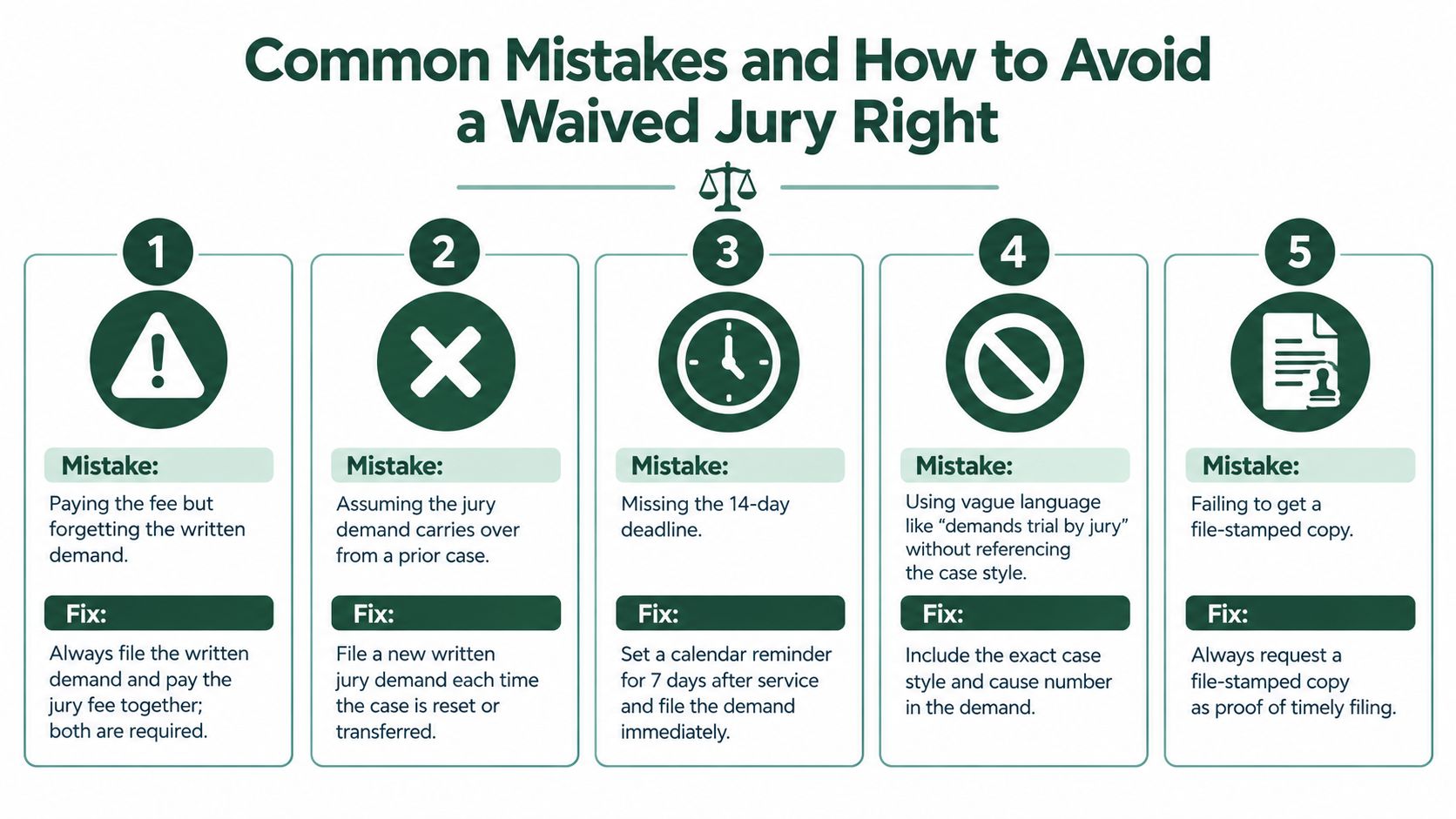
Most waived jury rights happen for ordinary reasons. Someone assumed the fee alone was enough. Someone used the wrong deadline. Someone asked orally in court and thought that counted.
The mistakes that show up most often
- Paying the fee but never filing the written demand: The fix is simple. Treat the written demand and the fee as a pair, and complete both.
- Relying on a general rule without reading the scheduling order: If the court set an earlier deadline, that's the date you need to work from.
- Assuming every family issue goes to a jury: Before filing, identify the actual disputed issue and whether a jury would decide it.
- Confusing district-court and county-court fee amounts: The amount can differ by court level, so verify the fee with the clerk before relying on a checklist you found online.
Smaller errors that still cause big trouble
Some mistakes look minor but can create a messy record:
- No proof of filing: Always keep a file-stamped copy.
- No proof of payment: Keep the receipt with the demand papers.
- No service on the other side: Make sure the opposing party or counsel receives the filing.
- Oral request only: A hallway conversation or in-court statement doesn't replace a written filed demand.
What to do if you're already close to trial
If you just realized the deadline may have passed, don't assume all hope is gone and don't assume you're fine either. Texas materials discussing this issue note that a late demand may be excused for good cause, but that is discretionary and shouldn't be counted on as your plan.
The better approach is immediate damage control. Confirm the trial setting, gather every filed paper, check the docket, and get clear on whether the demand, the fee, or both are missing. Then act quickly based on the actual record.
Verifying the Details and Your Next Steps
By this point, the main pattern should be clear. The Rockwall County jury trial demand family case fee and deadline question isn't hard because the concept is complicated. It's hard because several public references use different numbers or different timing rules depending on court type and context.
What to verify with the District Clerk
Before you file anything, or before you assume your earlier filing was enough, verify the practical details with the Rockwall County District Clerk for your specific case.
Use a checklist like this:
- Pull your case information: Confirm the exact cause number, case style, and assigned court.
- Read the latest trial notice or scheduling order: Don't rely on memory.
- Confirm the current jury fee for your court level: Public references can lag behind current statewide schedules.
- Ask how payment is recorded: You want a clear record connecting the fee to your case.
- Keep proof together: Store the demand, receipt, and service proof in one place.
When a lawyer can add real value
Some people can manage the filing piece on their own, especially if the issue is narrow and the deadline is still comfortably ahead. But a jury demand is often most useful in the very cases that are already legally dense.
That includes situations like:
- Contested property characterization
- Tracing claims in a high-asset divorce
- Reimbursement disputes
- Complicated pleadings involving multiple family-law issues
- Cases where the final trial setting is already close
If you're in Rockwall, Heath, Fate, Royse City, or another part of the county and your case includes a serious property fight, a jury demand is usually less about paperwork and more about strategy. You need to know whether a jury would decide the issue that matters most.
One step to take this week
If your family case is already on file, pull your most recent court notice and calendar the jury-demand deadline from the actual final trial setting, not from something you vaguely remember reading online. Then verify the fee and filing method with the clerk before the week ends.
That one step can tell you whether you still have time, whether the clerk record matches your assumption, and whether you need legal help now instead of later.
If you want hands-on help instead of piecing this together yourself, The Law Office of Bryan Fagan, PLLC helps Rockwall County families evaluate whether a jury demand makes sense, prepare the filing correctly, and line it up with the court calendar in divorce, custody, modification, and property cases. The firm has a local Rockwall office, and for many people that's the difference between reading about procedure and getting the next step done.