
You're preparing for a Rockwall County family-court hearing, but English isn't the language you use comfortably in legal proceedings. Maybe the hearing concerns divorce, custody, child support, possession, a modification, enforcement, or a protective order. You may be wondering whether the court will automatically provide an interpreter or whether you must arrange one yourself.
The short answer is that Texas treats court interpretation as a formal right, not a courtesy. For a Rockwall County family hearing, raise the need in writing as soon as you know the hearing date, use the appropriate motion, set that motion for hearing, notify the other side, and coordinate with the assigned court. Early action gives the court time to determine the need and appoint a qualified interpreter before testimony begins.
Table of Contents
- What to Know Before You Request an Interpreter in Rockwall County Family Court
- Who Qualifies for an Interpreter and How Texas Law Distinguishes Language Needs
- How to File Your Interpreter Request and Notify the Court on Time
- Where to Direct Your Request in Rockwall County and What Remote Options Cover
- Common Mistakes That Delay Family Court Hearings and How to Avoid Them
- Next Steps After You File Your Request in Rockwall County
What to Know Before You Request an Interpreter in Rockwall County Family Court
A Spanish-speaking parent in Rockwall may arrive for a temporary-orders hearing about a child's residence and visitation. The parent may handle everyday English but struggle to follow legal questions, explain financial details, or answer testimony about the child. Asking a relative to translate at the courthouse does not replace a formal request for a court interpreter.
Under Texas Government Code § 57.002, a court must appoint a licensed court interpreter in a civil or criminal proceeding when a party files a motion for an interpreter or a witness requests one. The statute also applies in counties with populations of 50,000 or more. In a Rockwall County family case, raise the request through the court process before the hearing. Do not rely on finding help after you arrive. Texas court interpreter guidance describes the statutory framework and available interpreter services.
The right applies across family-law disputes
Language access may affect many types of Rockwall County family proceedings:
- Divorce hearings: Interpretation may be needed for testimony about property, debts, income, or household circumstances.
- Child custody and SAPCR matters: A parent or witness may need help understanding questions about conservatorship, possession, schooling, medical care, or parental responsibilities.
- Child support proceedings: Accurate communication can affect testimony about employment, income, expenses, and prior orders.
- Temporary orders and modifications: These hearings may address immediate parenting, support, residence, or safety issues.
- Enforcement proceedings: The person accused of violating an order, or a witness describing the alleged violation, may need interpretation.
- Protective-order matters: Clear communication matters when testimony concerns family violence, threats, or safety planning.
Your case will be assigned to one Rockwall County family court, and that court controls interpreter coordination. Confirm the court shown on your case record before sending the request. The court assignment, rather than the city in a mailing address, determines where the request belongs. A person living in Rockwall, Heath, Fate, Royse City, or McLendon-Chisholm should check the case record. Rowlett can cross county boundaries, so its city name alone does not identify the court handling the case.
Practical rule: Tell the court about the language need when the hearing is set, not when you arrive at the courthouse.
A request made on the hearing day may delay the proceeding. The judge may need to decide whether an interpreter is required and whether a qualified interpreter is available. Early notice also matters for a final hearing, because Texas family-court guidance requires setting the hearing with at least 45 days' notice to the other parent. Texas Law Help's family-court guide advises requesting an interpreter when the final hearing is set and notifying the court coordinator or administrator at least one week before the hearing.
You generally start the request. The court decides whether interpretation is needed and appoints the interpreter. That process means you are asking the court to address a language-access need, not asking a relative or friend to manage legal communication for you. The request still must be placed properly before the assigned court and made early enough for coordination.
Who Qualifies for an Interpreter and How Texas Law Distinguishes Language Needs
Texas family courts recognize two separate language-access needs. The first involves limited English proficiency, or LEP, when a person can hear but cannot understand or communicate in English well enough to participate in the proceeding. The second involves a deaf or hard-of-hearing participant who needs an interpreter or another communication service because spoken language cannot be heard or processed effectively.
The distinction matters in Rockwall County family cases, including matters heard in the 382nd District Court, 439th District Court, and Rockwall County Courts at Law. A parent, another party, or a witness may need assistance in a case involving custody, support, property, or safety. The court then determines what qualified service is appropriate.

Limited English proficiency is broader than document translation
A person may need an interpreter even if they speak some English. A family-court hearing can involve questions, objections, sworn testimony, legal terms, and rapid exchanges. Understanding English at work or in a store does not necessarily mean understanding a custody hearing well enough to protect one's position.
State the specific language required and identify the person who needs interpretation. If the request concerns a witness, name the witness and describe the expected testimony when possible. If a parent needs interpretation for the entire hearing, say that directly instead of using a vague phrase such as “language difficulty.”
The same principle applies whether the hearing is before a district court or a county court at law. The assigned court needs enough information to arrange the correct service for the proceeding.
Hearing impairment requires the right communication service
A deaf or hard-of-hearing participant may need a certified interpreter or another court-approved accommodation. The correct service depends on how that person communicates and what the court can arrange. Describe the communication need early so the assigned Rockwall court can determine the appropriate assistance.
Credentialing applies to both language categories. A person interpreting testimony generally must have the required court-interpreter credentials before serving in a Texas court. The interpreter must provide proof of qualification to the judge or court reporter under the applicable statute and administrative requirements. Texas administrative rules on court-interpreter qualifications describe that credentialing framework.
A bilingual relative may understand both languages, but familiarity does not establish the legal qualification to interpret sworn testimony. A family member can summarize, omit details, or affect the testimony through personal involvement. The court must decide who may serve as the official interpreter.
For example, a Spanish-speaking parent in a custody dispute might bring a bilingual sibling. The sibling could misunderstand a question about possession or translate a legal term inaccurately. The judge might then hear an answer that does not fully reflect the parent's testimony.
The request should therefore identify the participant's actual communication need, not merely state that someone in the family speaks English and another language. A formal court-appointed interpreter protects the accuracy of testimony about children, finances, property, and alleged violence.
How to File Your Interpreter Request and Notify the Court on Time
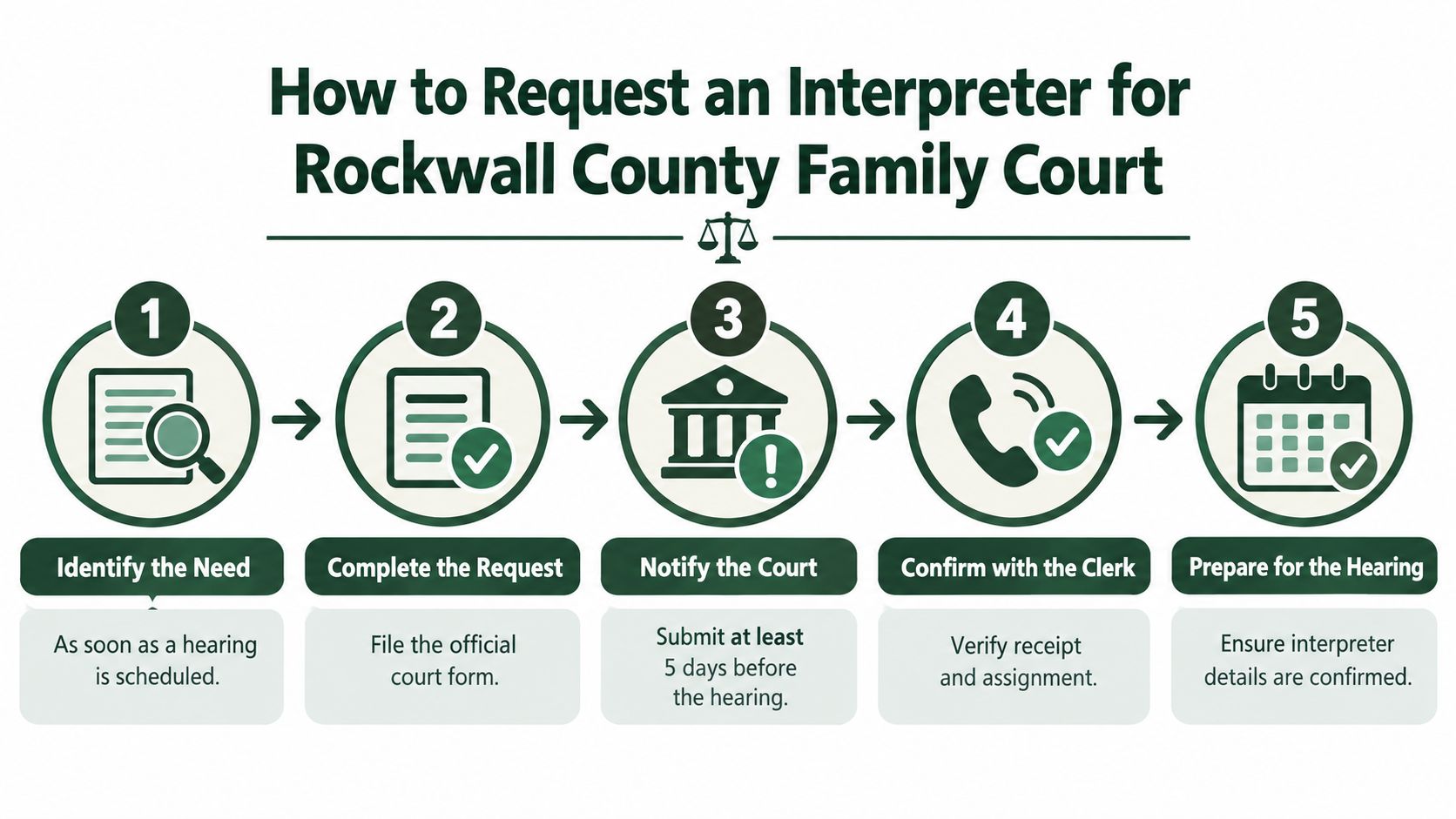
The safest process begins when the hearing date becomes known. Texas Law Help identifies the state form Motion to Appoint a Language Interpreter and Notice of Hearing, TC-PR-LI-104. The requesting party must set a hearing on the motion and notify the other side. This turns a casual request into a filed matter the court can address.
Start by reviewing the notice, order, or case record to identify the assigned Rockwall County court. Then gather the information the motion will need:
- Case information: Include the case number and the names of the parties exactly as they appear in the case.
- Hearing information: State the date, time, type of hearing, and assigned court if known.
- Language information: Identify the spoken language or communication service required.
- Participant information: Specify whether the need concerns a party, a witness, or both.
- Scope of assistance: Explain whether interpretation is needed for the entire hearing or for particular testimony.
Use the official form rather than relying only on an email or phone message. A written filing gives the judge a clear request and creates a record showing that language access was raised.
Set the motion and provide notice
Filing the motion is only part of the process. The motion must be set for hearing, and the other side must receive notice of that hearing. If the case involves two parents, notify the other parent through the required case process. Texas Law Help says the requesting party must set a hearing on the motion and notify the other side.
Contact the assigned court coordinator or administrator to learn how that court wants the motion set and how interpreter coordination should be handled. Don't assume that filing with the clerk alone completes every coordination step. Court staff can confirm the local scheduling contact, while the judge determines the legal request.
For filing logistics, consult the Rockwall County District Clerk e-filing requirements for family cases. The filing method and local instructions can change, so verify current requirements before submitting documents.
Give the court early notice
Texas Law Help advises notifying the court coordinator or administrator at least one week before the hearing. It also identifies requesting the interpreter when the final hearing is set as the best practice. A final hearing itself must be set with at least 45 days' notice to the other parent, which provides an opportunity to address language access before the case reaches the merits.
Keep proof of every step:
- Save the filed motion and any filing confirmation.
- Keep the notice showing when the motion was set.
- Preserve proof that the other side received notice.
- Record when you contacted the court coordinator or administrator.
- Ask how and when interpreter assignment will be confirmed.
- Follow up if the court hasn't confirmed the arrangement.
The infographic below summarizes the practical sequence.
A short video can also help self-represented parties understand why preparation and communication with the court matter:
Where to Direct Your Request in Rockwall County and What Remote Options Cover
Confirm the assigned court on your case number and filed documents. In Rockwall County, a family case may be set in the 382nd District Court, the 439th District Court, or a Rockwall County Court at Law. The request should go to the coordinator for that court, with notice to the appropriate clerk. The District Clerk generally handles district court matters, while the County Clerk handles county court matters. If the assignment is unclear, either clerk or the court coordinator can help identify the correct contact.
The courthouse includes multiple offices and courtrooms, so the filing location and hearing location may not be the same. Check this Rockwall County courthouse guide for family hearings for local logistics, then verify current instructions with the assigned court or clerk. Include your case number, hearing date, courtroom if known, requested language, and whether the proceeding will involve testimony.
In-person and remote coverage are different options
A contested custody, support, or temporary-orders hearing with sworn testimony usually calls for the assigned court to arrange a qualified in-person interpreter. Remote interpretation may fit a shorter, non-contested hearing, but it is not automatically available for every language or proceeding.
The Texas Court Remote Interpreter Service serves courts handling short, non-contested, non-evidentiary hearings that typically last 30 minutes or less. The state identifies Spanish, French, Portuguese, and German as supported languages. The Rockwall court must still decide whether the hearing meets those limits and whether the service is available for that setting. Texas court interpreter FAQs describe the remote service and its restrictions.
| Hearing Type | Best Interpreter Path | Key Timing Check |
|---|---|---|
| Contested custody or support hearing with testimony | Ask the assigned court to arrange a licensed interpreter | Raise the need when the hearing is set |
| Temporary orders involving sworn testimony | Confirm an appointed qualified interpreter with the court coordinator | Follow up before the appearance |
| Short, non-contested, non-evidentiary hearing | Ask whether Texas Court Remote Interpreter Service applies | Confirm that the hearing fits the service limits |
| Final divorce or custody hearing | File the motion and coordinate formal appointment | Plan early, with the final setting and required notice |
| Hearing involving deaf or hard-of-hearing communication needs | Describe the communication accommodation needed | Give the court enough information to arrange the correct service |
Remote capacity is statewide and limited. It may help with a qualifying Rockwall hearing, but it should not be treated as a guaranteed replacement for a formally appointed interpreter in a contested family matter. When uncertain, ask the assigned coordinator which format and interpreter arrangement the court will approve.
Common Mistakes That Delay Family Court Hearings and How to Avoid Them
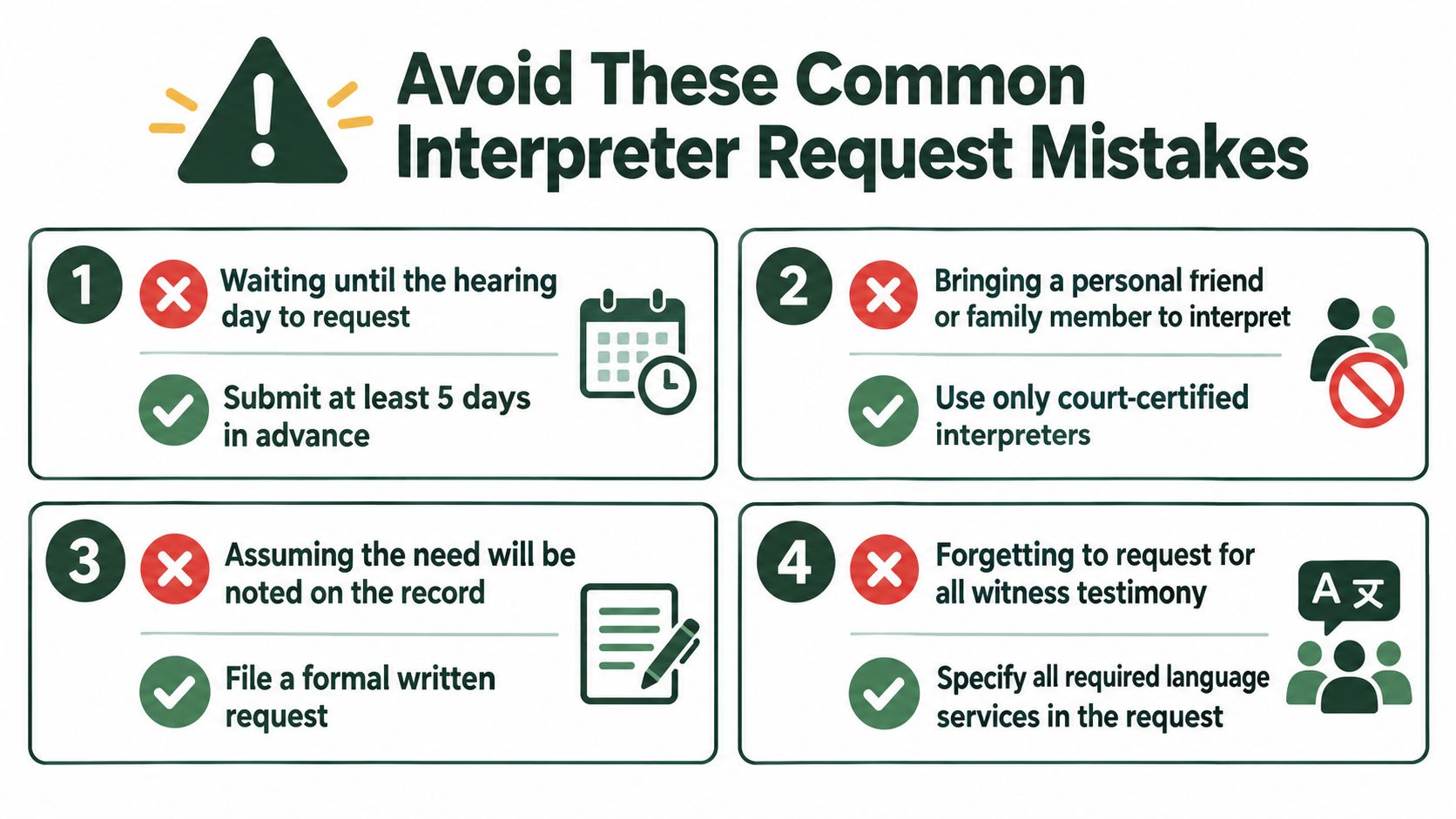
A Rockwall family-court hearing can be delayed when the interpreter need is mentioned casually, raised only at the courthouse, or never connected to the assigned court coordinator. The judge and court staff need time to confirm the language need, arrange a qualified interpreter, and determine whether the setting can use a remote service.
Waiting until the hearing day
Raise the interpreter issue when the 382nd, 439th, or a Rockwall County Court at Law hearing is scheduled. Notify the assigned coordinator or administrator at least one week before the appearance, as Texas Law Help advises. A late request can leave the court choosing between pausing the proceeding, rescheduling it, or proceeding without the language support a participant needs.
Bringing a personal interpreter
A bilingual friend or relative may understand everyday conversation without having the qualification required for testimony. Texas rules require the court to confirm the interpreter's current certificate or comparable legal certification and receive proof of qualification. The Texas interpreter credentialing rule under 26 Tex. Admin. Code § 360.313 explains the qualification standard the court must apply.
Personal interpreters can also create confusion about who is interpreting, especially when a party or witness discusses possession, family violence, support, or enforcement. Court interpretation preserves the exact words used in testimony.
Failing to set the motion
Filing a motion does not automatically place it on a judge's hearing calendar. The requesting party must set the motion and notify the other side, then keep the setting information and notice records with the case documents. A motion that was filed but never set may not be addressed before the scheduled family hearing.
Assuming remote capacity is unlimited
The statewide remote service reported 4,223 hearings served across 120 counties in FY 2024, including free Spanish, French, and Portuguese interpretation, according to the FY 2024 annual report of judicial support. That use shows the service can assist qualifying Rockwall matters, while its capacity remains limited.
The service also places family-law cases in priority position 5, below several higher-priority categories. Availability therefore depends on the hearing and current demand. Ask the assigned coordinator whether the remote option fits the proceeding instead of treating it as guaranteed.
If a missed appointment or unavailable interpreter may require a new setting, consult the Rockwall County reset and continuance guide for family cases and confirm the current procedure with the assigned court.
Next Steps After You File Your Request in Rockwall County
After the request is filed and properly set, the judge determines whether an interpreter is needed and the court appoints a qualified interpreter. Don't treat the filing confirmation as proof that an interpreter has been assigned. Confirm the appointment, language, hearing date, and whether the service will be in person or remote with the assigned court coordinator.
Before the hearing, organize the documents and information you may need. Bring your case information, hearing notice, filed interpreter request, proof of notice, and any court communication confirming the appointment. If a witness also needs interpretation, verify that the court knows about that witness before the hearing begins.
Interpretation generally occurs during the proceeding as the judge, attorneys, parties, and witnesses communicate. Speak directly to the judge or the person answering questions, use short complete answers, and tell the interpreter if you don't understand a question. Don't ask a relative to fill in gaps or explain legal issues during the hearing.
A practical follow-up checklist
- Confirm the assignment: Ask the coordinator whether a qualified interpreter has been appointed.
- Confirm the language: Make sure the court understands the exact language or communication service required.
- Confirm the format: Verify whether the interpreter will appear in person or remotely.
- Confirm the hearing: Recheck the date, time, courtroom, or remote-access details.
- Keep records: Save filings, notices, emails, and confirmation messages.
- Raise changes promptly: Notify the court if the hearing, witness list, or language need changes.
If you still have questions about a Rockwall County divorce, custody, child-support, possession, enforcement, protective-order, paternity, CPS, adoption, property-division, or family-law appeal matter, get advice based on your actual case documents. The courthouse, District Clerk, County Clerk, and assigned court coordinator can verify current local logistics, while a qualified family-law attorney can help evaluate how the interpreter issue fits into the larger case.
The Law Office of Bryan Fagan, PLLC offers guidance on family-law proceedings, including preparing a written interpreter request and coordinating language access for Rockwall County hearings. Visit The Law Office of Bryan Fagan, PLLC to review local family-law resources and request a consultation about your situation.