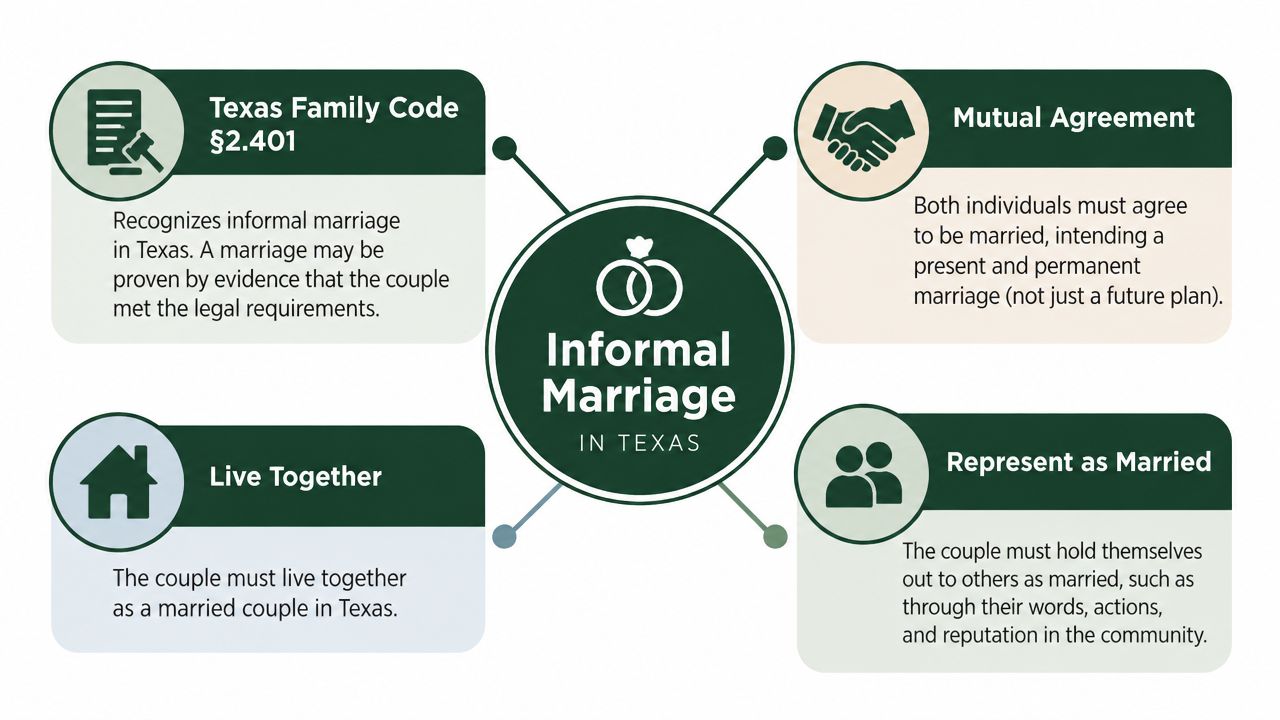
In Texas, an informal marriage can be proven either by filing a Declaration and Registration of Informal Marriage with the county clerk or by showing agreement to be married, cohabitation in Texas as spouses, and holding out to others as married. For a Rockwall County couple, the filing is completed through the County Clerk, with both parties appearing together, signing in the clerk's presence, and completing the required oath.
You may be looking at this process because you and your partner have shared a home for years, combined finances, raised children, or represented yourselves as married, but never had a formal ceremony. Or you may be dealing with a divorce, probate issue, benefits question, property dispute, or family-law filing and need to know whether Texas recognizes your relationship as a marriage.
The phrase Rockwall County informal marriage declaration county clerk describes a specific local filing within a statewide Texas legal framework. The county clerk is the local recording point, but the legal requirements come from Texas law. The practical details matter because an incomplete form, a missing document, or a failure to appear together can prevent the clerk from certifying and recording the declaration.
Table of Contents
- What an Informal Marriage Is in Texas
- Who Can File a Declaration in Rockwall County
- What to Bring and How the Form Works
- What Happens at the Rockwall County Clerk's Office
- Fees, Hours, and Processing to Expect
- Legal Effects Once the Declaration Is Recorded
- Common Mistakes and When to Call an Attorney
What an Informal Marriage Is in Texas
Texas recognizes informal marriage, commonly called common-law marriage, as a legally recognized marriage when the required elements are established. Under Texas Family Code § 2.401, the couple must have agreed to be married, lived together in Texas as spouses, and represented to others that they were married.
There are two basic ways to establish the relationship:
- File a declaration. The couple signs a Declaration and Registration of Informal Marriage with the county clerk.
- Prove the elements later. If no declaration was filed, a spouse may need to present evidence of agreement, cohabitation, and holding out in a court proceeding.
The filing usually offers clearer proof. A recorded declaration gives a county-held record that can be requested later from the county where it was filed, as explained by the Texas State Law Library's marriage-record guidance. Without that record, the parties may have to reconstruct the relationship through testimony, financial records, correspondence, tax documents, or statements from people who knew them as a married couple.
A declaration can become particularly significant when a relationship ends or one spouse dies. It may help identify the parties' marital status in a divorce filed through the appropriate Rockwall County court, a probate matter, a property dispute, or a claim involving spousal rights. It doesn't resolve every legal question, but it can reduce a dispute over whether a marriage existed in the first place.
Practical rule: Filing the declaration creates documentation. It doesn't replace legal advice when the couple has disputed relationship facts, an earlier marriage, substantial property, or a pending court case.
Who Can File a Declaration in Rockwall County
Before driving from Rockwall, Heath, Fate, Royse City, McLendon-Chisholm, or another Rockwall County community to the clerk's office, confirm that both parties can legally make the declaration. Texas law places limits on age, capacity, existing marital status, and family relationship.
The core pre-visit checklist is straightforward:
- Age: Both parties should be at least 18 for the clerk-controlled filing process described in Texas Family Code § 2.404. The statute identifies under-18 parties as a filing failure point, while Texas Family Code § 2.402 contains separate rules involving a 16- or 17-year-old, including parental consent, a qualifying court order, or a parent joining in the declaration. This area deserves careful legal review before anyone signs.
- Capacity: Each person must understand the nature of the declaration and be able to provide a meaningful oath.
- No existing marriage: A person generally can't declare an informal marriage while still married to someone else.
- No prohibited relationship: Texas Family Code § 2.022 addresses prohibited degrees of relationship. A marriage within a prohibited degree, including a first-cousin-or-closer relationship covered by the statute, can create serious validity problems.
- Free consent: Both people must be willing to make the declaration and swear to the required facts.
The clerk is not just accepting a document at a drop box. Under Texas Family Code § 2.404, the clerk must verify required information and supporting documents, administer the oath, witness both signatures, execute the certificate, record the declaration, and send a copy to the Bureau of Vital Statistics.

If either person omits required information or documents, is under 18 for purposes of the clerk's certification, or marks the relationship statement false, the clerk may not certify or record the declaration. If either person has an uncertain divorce history, questions about a former spouse, or doubts about the relationship's legal elements, speak with a family-law attorney before making a sworn filing.
What to Bring and How the Form Works
The document used for this process is the Declaration and Registration of Informal Marriage, a Bureau of Vital Statistics form commonly identified as Form VS-131.1, revised 2018. The Texas State Law Library describes the declaration as the document used to register a common-law marriage with the county clerk. Rockwall County confirms that its clerk's office makes formal and informal marriage license applications available online.
Start with the form itself, then verify the current version and local filing instructions before visiting. A lawyer may prepare a comparable document for filing, but the clerk controls the oath, signatures, certification, recording, and transmission of the record.

Information the form requests
The form requires personal information for both parties, including each person's full legal name, date of birth, residence information, and identifying information used to verify identity. It also asks for information about prior marriages and the parties' sworn relationship statements. Complete the form carefully and use names that match the identification you present, unless the form specifically calls for a different legal-history entry.
A practical preparation list includes:
- The completed form: Fill in the document in ink, but don't sign it until the clerk instructs you to do so.
- Government-issued photo identification: Each party should bring identification that allows the clerk to verify identity, full legal name, and date of birth.
- Social Security information: Have both Social Security numbers available if the form requests them.
- Prior-marriage details: Bring accurate information about any prior marriage and its termination. Don't guess when a sworn filing is involved.
- Privacy questions: Ask about the optional confidential version associated with HB 1193 if public access creates a safety or privacy concern.
Rockwall County's clerk office address is listed in the provided local filing information as 1011 E. Yellowjacket Lane, Rockwall, TX 75087. Other statutory information identifies the county clerk's office at 1111 E Yellowjacket Lane, Suite 100, Rockwall, TX 75087, so confirm the current address and filing location with the county before leaving home. Both parties must appear together and swear or affirm before the clerk.
For help locating general family-law forms and self-represented resources, see the Rockwall County law library and self-represented family forms resource.
The following video provides additional visual context about the declaration form and filing process:
What Happens at the Rockwall County Clerk's Office
A typical visit starts with both partners arriving together at the Rockwall County Clerk's office. At the counter, they identify themselves, explain that they want to file a Declaration and Registration of Informal Marriage, and confirm which current form and supporting documents the clerk requires.
Consider a hypothetical couple from Heath. They completed the non-signature portions of the form at home, brought their identification, and reviewed their prior-marriage information. At the office, the clerk checks the submission for required information and documents. If something is missing, the couple may have to correct it before the clerk can proceed.
The live execution step
The important part many online summaries skip is what happens at the desk. Both parties must be present at the same time. The clerk or deputy administers the oath, and the couple answers for themselves under oath rather than relying on a friend or witness to establish the marriage.
The parties then sign in the clerk's presence. They swear to the relationship facts and marital-status information required by the form. The clerk witnesses the signatures, completes the clerk's certificate, records the declaration, returns the original as required by law, and sends a copy to the Bureau of Vital Statistics under the statutory process.
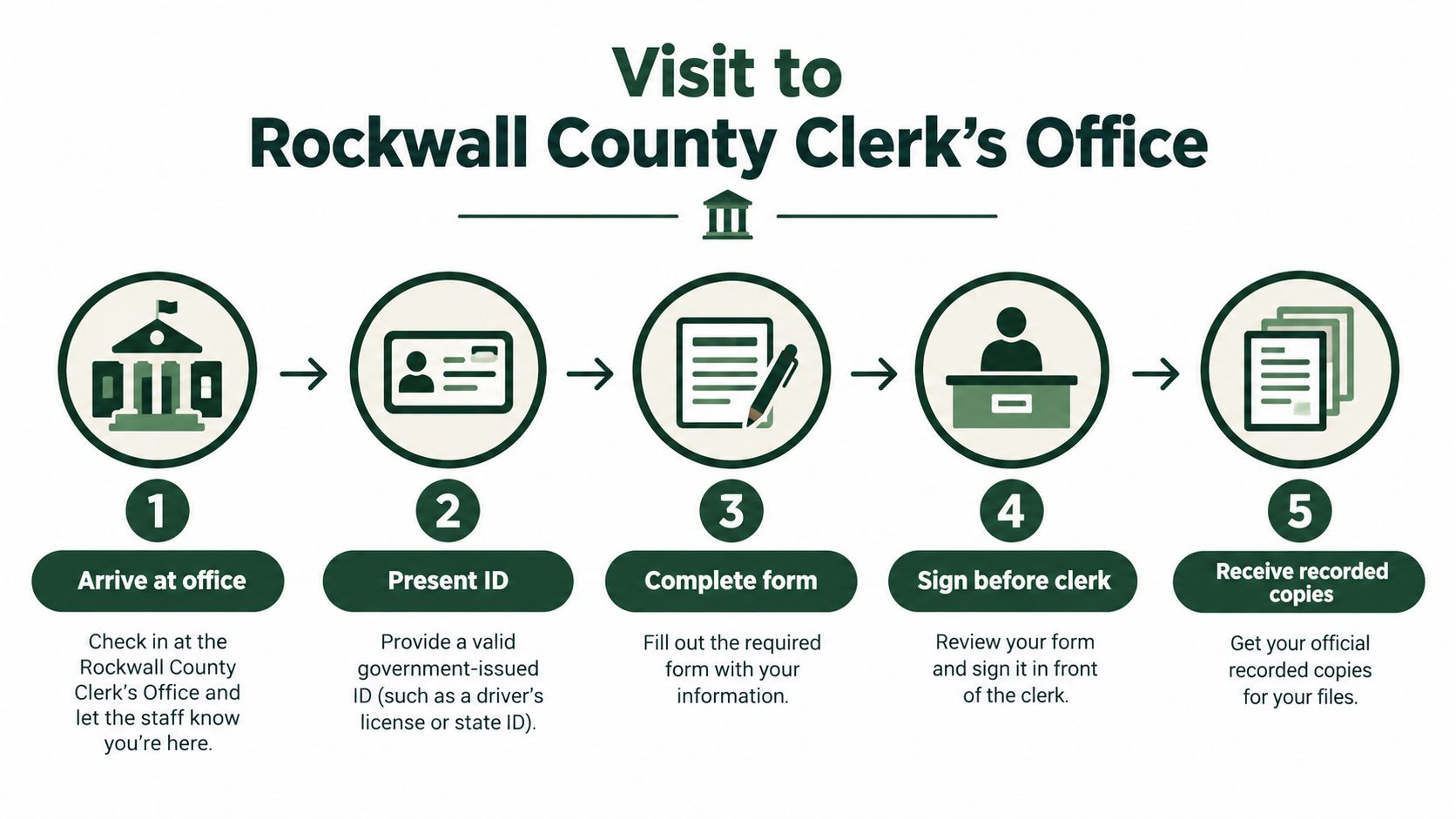
Ask what copies you'll receive and whether a certified copy is available for the purpose you have in mind. A recorded declaration can be useful later, but different agencies and legal proceedings may request different forms of proof.
HB 1193 is also relevant to the visit. A 2025 county-clerk presentation states that an applicant may request confidentiality for identifying information and that clerks may not publicly disclose that information except to the named applicant or legal representative. The same presentation describes an alternate file number option and the ability to decline a public copy. Because implementation and public-facing forms may change, ask the Rockwall County Clerk how the current confidential process works before signing.
Local courthouse geography can be confusing, particularly when county offices and court facilities use different buildings. The Rockwall County courthouse and justice-center guide can help you identify the relevant local setting, but the clerk should confirm the current filing location.
Fees, Hours, and Processing to Expect
Fees, payment methods, and office procedures can change. The Rockwall County Clerk's posted amounts control, so verify the recording fee and the separate charge for any certified copy before traveling. Bring payment that the clerk accepts and a little extra for copy charges that may have changed.
The statutory information provided for Rockwall County identifies public hours as Monday through Friday, 8 a.m. to 5 p.m., and identifies the clerk office at 1111 E Yellowjacket Lane, Suite 100, Rockwall, TX 75087. Other local filing information lists a different street number, so confirm the address and lobby hours directly before your visit.
| Rockwall County Clerk, Informal Marriage Filing Snapshot | Typical Detail | Verify Before Filing |
|---|---|---|
| Recording fee | A county recording charge applies | Confirm the current amount |
| Certified copy | An additional copy charge may apply | Ask for the current certified-copy fee |
| Payment | The office's accepted methods control | Confirm whether debit cards are accepted |
| In-person processing | The clerk records a properly completed filing through the office process | Ask whether same-day completion is available |
| Mailed filing | A mailed declaration may require notarization instead of a clerk's oath | Confirm mailing instructions and notarization requirements |
| Hours and location | Clerk hours and location should be checked before travel | Call or consult the official county website |
In-person filing is often the most direct option because both parties can complete the oath and signature step at the clerk's counter. If you can't attend together, don't assume mailing is interchangeable. The oath and notarization requirements can differ.
For context on how a marriage license process differs from an informal-marriage declaration, review the Rockwall County marriage license waiting-period resource. The procedures aren't the same, so use the document that matches your legal situation.
Legal Effects Once the Declaration Is Recorded
Once the declaration is properly executed and recorded, it creates an official county record of the informal marriage. Texas law treats an informal marriage as a marriage for relevant legal purposes, but the declaration doesn't automatically answer every question about property, debts, parentage, or estate rights.
The practical value is proof. A spouse who later needs to establish the relationship can request the record from the county where it was filed, rather than relying entirely on memories and indirect evidence. The Texas State Law Library explains that the filing county matters because record requests go to the county clerk where the declaration was filed.
Family-law consequences
If the relationship ends, the parties generally address the end of the marriage through divorce rather than treating the relationship as an ordinary cohabitation arrangement. That distinction can affect:
- Property division: Income and debts acquired during marriage may raise community-property questions, but characterization depends on the facts and applicable law.
- Parentage and support: A marital record may become relevant in disputes involving parental rights, paternity, child support, or possession and visitation. It doesn't determine custody or support by itself.
- Court filings: A spouse may need to identify the marriage when filing a divorce, responding to a family-law case, or seeking temporary orders.
- Estate and probate matters: The record can help establish the claimed marital relationship when inheritance, probate administration, beneficiary designations, or estate planning documents are under review.
- Benefits and medical decisions: Agencies, institutions, and benefit administrators may request proof of marriage, and a recorded declaration can be an important document.
The declaration also creates a stronger documentary starting point than a later claim based only on relationship evidence. It doesn't prevent every challenge. Someone may still dispute validity, capacity, an existing marriage, prohibited kinship, or the accuracy of a sworn statement.
A Texas informal marriage ends through a legally recognized event, such as death or a court judgment dissolving the marriage. Texas law also addresses a properly executed signed waiver on the applicable form, so a person considering a waiver should obtain advice before signing. A waiver can carry consequences that aren't obvious from the form alone.
Common Mistakes and When to Call an Attorney
Most filing problems are preventable. The clerk's role is a compliance check, and the office can't certify and record a declaration that fails statutory requirements.
Common mistakes include:
- Arriving separately: Both parties must appear together for the clerk-controlled oath and signature process.
- Signing too early: Don't sign at home if the form requires signatures in the clerk's presence.
- Using an outdated form: Confirm that you're using the current version accepted by the county and the Bureau of Vital Statistics.
- Leaving fields incomplete: Missing addresses, identification information, or prior-marriage details can stop the filing.
- Creating name mismatches: Make sure names on the form are consistent with identification and legal records, and ask about any legitimate discrepancy before taking the oath.
- Relying on a witness: A witness doesn't substitute for the parties' own sworn statements and required appearance.
- Ignoring privacy: If public disclosure could create a safety concern, ask about the HB 1193 confidentiality option before the record is completed.
- Guessing about a former spouse: Uncertainty about whether or how a prior marriage ended should be resolved before making a new declaration.
Situations that deserve legal review
Call a Rockwall County family-law attorney before filing if either person has a pending divorce, an uncertain identity or status of a former spouse, a possible bigamy issue, or a disputed claim that the couple agreed to be married. Legal advice is also sensible when the filing connects to substantial property, a community estate, estate planning, probate, children, relocation, protective orders, or an existing custody or support case.
A declaration may affect how a later divorce addresses property division, high-asset accounts, parental rights, child support, or temporary orders. If the relationship facts are contested, filing a sworn document without understanding the consequences can create a problem rather than solve one.
Verify the current form, address, hours, fees, payment methods, and confidentiality procedure directly with the Rockwall County Clerk before visiting.
The Law Office of Bryan Fagan, PLLC offers family-law guidance for Rockwall County residents dealing with informal-marriage questions, divorce, property disputes, custody, support, and related proceedings. If you need help deciding whether to file or understanding what the declaration could mean for your family, visit The Law Office of Bryan Fagan, PLLC to review available resources and request the next step.