In Texas, a guardian of the person must file the Annual Report within 60 days after the anniversary of the date the guardian qualified, and the report must cover the full 12-month period that ended on that anniversary. To identify your Rockwall County deadline, confirm the exact qualification date in your order and qualification papers rather than guessing from the hearing date.
A family in Rockwall, Heath, Fate, Royse City, or McLendon-Chisholm may receive an appointment order, complete the oath and bond, and then assume the difficult daily work of caring for a protected person. Months later, the first annual report deadline can arrive without much warning. The safest approach is to treat the qualification date as the starting point, keep records throughout the year, and contact the appropriate Rockwall County filing office early if anything is unclear.
Table of Contents
- When Your Rockwall County Guardianship Annual Report Is Due
- How to Find Your Exact Deadline in Your Court Order and Qualification Papers
- What Your Annual Report Must Include and Documents to Prepare
- How to File Your Annual Report With the Rockwall County Court
- What Happens If You Miss the Deadline and How to Fix It
- Next Steps for Rockwall County Guardians and Where to Get Help
When Your Rockwall County Guardianship Annual Report Is Due
Suppose a Rockwall County family member was appointed guardian of a person. The appointment hearing occurred on one date, but the guardian completed the required qualification steps on another date. For the annual report, the relevant date is generally the date the guardian qualified to serve, not the day the judge held the hearing.
Texas guidance provides that a guardian of the person must file an Annual Report every year within 60 days of the anniversary of the date the guardian qualified to serve. The report must describe a complete 12-month reporting period, rather than offering only a current update about the ward. The Texas Judicial Branch guardianship help page identifies the subjects the report must address, including the protected person's mental and physical condition, social and intellectual functioning, and living conditions.

Why the hearing date can create confusion
The hearing date may be easy to remember because it was the day the court considered the guardianship. But qualification is a separate milestone. Your oath, bond paperwork, or letters of guardianship may show when you completed the steps that made you eligible to act as guardian.
A guardian who uses the hearing date instead of the qualification date may calculate the wrong reporting period and due date. The Texas Estates Code reporting provisions describe an anniversary-based cycle. The reporting period begins on the date the guardian qualifies and continues for a full year, followed by the filing window that ends on the 60th day after that period ends.
The calendar-year portal rule is different
Texas also uses a calendar-year reporting cycle in its state guardianship reporting system. The state says reports for calendar year 2025 must include all of 2025, were not accepted before January 1, 2026, and were due by January 31, 2026, as explained on the Texas Judicial Branch annual reporting page.
That calendar-year process can look inconsistent with the anniversary rule, but the two concepts answer different questions. Your court-supervised reporting duty may follow the qualification anniversary, while the state portal may apply a calendar-year submission window for the reports it receives. Read the directions connected to your guardianship and verify which filing route applies.
Practical rule: Don't estimate the Rockwall County guardianship annual report filing deadline from memory. Find the qualification date in your own paperwork, map the full reporting year, and allow time to correct an incomplete filing.
How to Find Your Exact Deadline in Your Court Order and Qualification Papers
Start with the documents created when the guardianship became active. The court order may establish the appointment, while the oath, bond, and letters may show the qualification information needed to calculate the annual reporting cycle.

Follow the paperwork, not the assumption
Use this process:
-
Locate the qualification oath. Look for the date you signed or took the oath of guardian. A clerk's stamp, filing stamp, or other court notation may help identify when the document became part of the record.
-
Review the surety bond. If a bond was required, compare the bond date with the oath and other qualification paperwork. The bond may help confirm the timing, but don't assume it controls if the documents show different dates.
-
Check the letters of guardianship. These letters demonstrate your authority to act and may contain a qualification date or related filing information. Keep the letters with your other court papers.
-
Compare the dates with the order. The appointment hearing date and qualification date may differ. If they don't line up, ask the filing office or a qualified attorney which date controls your reporting calculation.
-
Map the reporting period. Begin with the qualification date and identify the corresponding anniversary. The report should cover the entire 12-month period leading up to that anniversary.
-
Count the filing window. The Annual Report is due no later than the 60th day after the reporting period ends, subject to the directions applicable to your case.
Consider a hypothetical guardian who qualified on March 15. The first reporting period would run for the full year beginning on that qualification date. The filing window would then extend through the 60th day after the anniversary period ends. The example illustrates the method, but your documents control because qualification dates and court instructions differ from case to case.
Use a verification checklist
Before preparing the report, write down:
- The exact qualification date.
- The date the 12-month reporting period ends.
- The resulting 60-day filing deadline.
- Whether you serve as guardian of the person, guardian of the estate, or both.
- Any instructions or forms provided by the court or clerk.
- The office or filing route that will receive the report.
Don't substitute the date you filed the original application, the date of the hearing, or the date you first began helping your family member. Those dates may matter for other reasons, but they aren't automatically the qualification date for annual reporting.
What Your Annual Report Must Include and Documents to Prepare
The Annual Report serves a protective purpose. It gives the court information about how the ward is doing and whether the guardianship continues to address the person's needs. Texas Judicial Branch guidance identifies the ward's mental and physical condition, social and intellectual functioning, and living conditions as core subjects of the report.
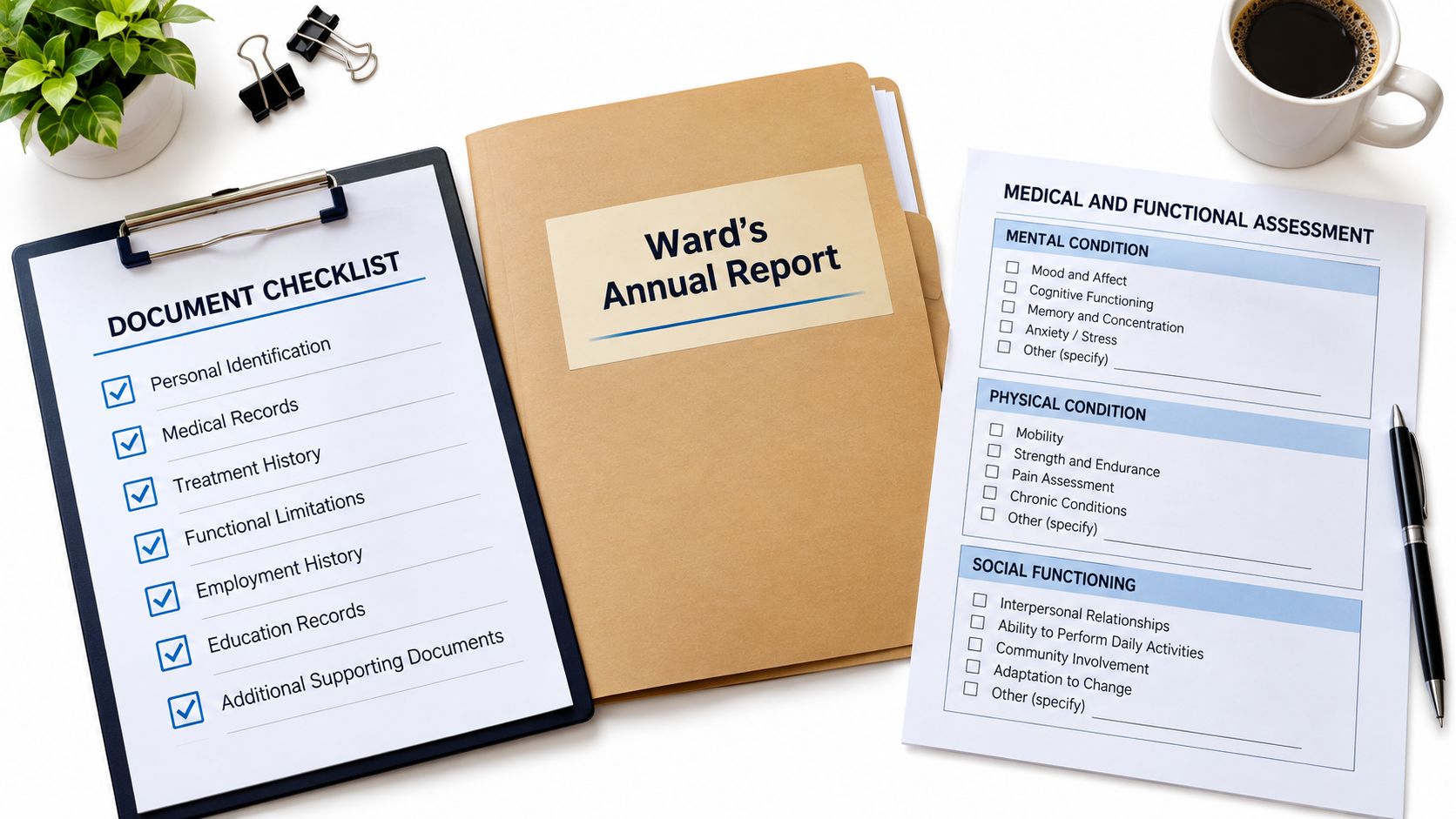
A useful report should explain the ward's condition across the full reporting year. A description limited to the person's circumstances on the day you complete the form may leave out important changes, care decisions, moves, treatment developments, or changes in daily functioning.
Information to gather before completing the form
Keep notes throughout the year rather than trying to reconstruct everything at the deadline. Your working file may include:
- Medical information: Important appointments, diagnoses, treatment changes, hospitalizations, and care recommendations.
- Daily functioning notes: Changes in communication, mobility, memory, social interaction, or ability to participate in ordinary activities.
- Living-condition records: Where the ward lived, who provided care, changes in placement, and significant safety or supervision concerns.
- Care coordination records: Names of facilities, caregivers, providers, or agencies involved in the ward's care.
- Decision records: Notes showing major decisions made for the ward, why they were needed, and how they related to the ward's welfare.
- Supporting documents: Relevant statements, care summaries, or records that help explain the information in the report.
You may not need to attach every document you collected. The court's form, order, and local filing directions determine what must accompany the report. Still, organized source material helps you answer accurately and respond if the clerk or court identifies a deficiency.
Remember the estate account
A guardian of the person files the Annual Report about the ward's condition and circumstances. If you also serve as guardian of the estate, a separate annual account may be due on the same 60-day anniversary timeline, according to Texas court instructions for guardians of the person and estate.
An annual account concerns financial activity. It isn't a substitute for the personal-status report, and filing one doesn't eliminate the other. Confirm the roles listed in your appointment documents before assuming you have only one annual obligation.
How to File Your Annual Report With the Rockwall County Court
Rockwall County's published filing information identifies the county's official filing office for civil, guardianship, and probate filings at 1111 E Yellowjacket Lane, Suite 100, Rockwall, TX 75087. The published telephone number is 972-204-6300, and the Rockwall County civil, guardianship, and probate filing resource is the appropriate place to verify current local information.
The precise clerk involved can depend on the case and filing type. Rockwall County has both a County Clerk and a District Clerk, and readers shouldn't assume that the label “courthouse filing” alone identifies the correct office. Use the guardianship case information and confirm with the filing office before delivering or transmitting documents.

Prepare for submission
Before you submit the report:
- Check the case information. Confirm the ward's name, cause number, court, guardian role, and reporting period.
- Complete every applicable part. Don't leave questions unanswered unless the form or clerk directs you to do so.
- Review the coverage period. Make sure the narrative addresses the entire 12-month period, not only recent events.
- Include required attachments. Follow the court's current instructions for supporting documents, signatures, verification, and any separate estate account.
- Confirm the delivery method. Ask the appropriate Rockwall County office whether the current process is in-person, electronic, by mail, or another approved method. Don't assume a method remains available without checking.
A filing isn't safely complete merely because you handed over a packet or sent a transmission. Ask how acceptance is confirmed and whether the filing will receive a file-stamped copy, electronic confirmation, or another record of submission. Keep that proof with your guardianship documents.
If the clerk identifies a deficiency
A deficiency may concern a missing signature, incorrect case information, an incomplete answer, or an omitted attachment. Ask what must be corrected, whether the filing date is preserved, and how the corrected document should be submitted. If you can't resolve the issue promptly, consult counsel rather than allowing the 60-day period to pass while the packet remains incomplete.
For broader context about how county probate jurisdiction is organized, see the Rockwall County court and probate jurisdiction resource. Local filing information can change, so verify the current procedure directly with the county office.
The following video may help orient families to the broader guardianship process, but it doesn't replace the instructions for your specific Rockwall County case.
What Happens If You Miss the Deadline and How to Fix It
A missed annual report deadline can have serious consequences. Texas Bar materials state that failing to file the annual report can result in removal as guardian and a fine of up to $1,000. The Texas Bar guardianship guidance explains why a guardian shouldn't treat the report as an informal family update. It is a court obligation.
A late report may also be incomplete. A packet that describes only the ward's current condition, omits part of the reporting year, or fails to include a required component can create a separate compliance problem. Court notices or clerk communications may require a response, and ignoring them can make the situation more difficult.
Act before the deadline expires
If the deadline is approaching:
- Finish the full-year review: Gather records from the entire reporting period, not just the most recent weeks.
- Contact the filing office: Confirm the correct form, submission method, and any local requirements.
- Identify missing information: Request records or explanations promptly instead of waiting until the final day.
- Ask for legal help when roles overlap: A guardian of both the person and estate may have to prepare an Annual Report and an annual account.
If the deadline has passed, act promptly. Contact the appropriate Rockwall County filing office, prepare the complete report, and ask how the court wants the late filing handled. A guardian may also need to request additional time when the circumstances justify it, but an extension isn't guaranteed. Any request should be made as soon as possible and should explain the reason for the delay.
Don't confuse cure with automatic forgiveness
Filing late is better than continuing to wait, but filing alone doesn't guarantee that the court will treat the issue as resolved. The court may require a hearing, a written explanation, additional documentation, or another corrective step depending on the case.
If you need a hearing or must address a court notice, the Rockwall County court coordinator resource may help you understand the administrative starting point. It doesn't determine whether the court will grant relief, and it isn't a substitute for legal advice about your facts.
Next Steps for Rockwall County Guardians and Where to Get Help
Set up a repeating compliance system immediately after filing. Write the next qualification anniversary on your calendar, create a preparation reminder 30 days before that anniversary, and maintain a simple file of the ward's condition and living circumstances throughout the year.
A practical checklist looks like this:
- Calendar the anniversary: Use the qualification date shown in your oath, bond, letters, or related court paperwork.
- Start early: Review the reporting form and gather records before the filing window becomes urgent.
- Track the ward's year: Note meaningful changes in health, functioning, care, residence, and supervision.
- Check both roles: Determine whether you also serve as guardian of the estate and may owe an annual account.
- Confirm acceptance: Retain proof that the Rockwall County office received and accepted the filing.
- Respond quickly: Address any deficiency notice, request for clarification, or court communication.
The Rockwall County filing office at 1111 E Yellowjacket Lane, Suite 100, Rockwall, TX 75087 handles the county's published civil, guardianship, and probate filing functions, and its published phone number is 972-204-6300. Before traveling from Rockwall, Heath, Fate, Royse City, McLendon-Chisholm, or another county community, verify current hours and submission procedures.
A qualified attorney can be useful when the qualification date is unclear, the report is late, the court has issued a notice, or the guardianship includes estate management. The guardianship practice resource from The Law Office of Bryan Fagan, PLLC offers another place to begin researching the legal issues. If you live in a community such as Rowlett, confirm the county that controls your case because a mailing city doesn't always determine venue or jurisdiction.
If your deadline is close, gather your qualification papers and call the Rockwall County filing office first. If the date, filing role, or response to a late report remains uncertain, organize those documents for a fact-specific consultation rather than guessing.
The Law Office of Bryan Fagan, PLLC offers guidance with Texas guardianship reports, deadline questions, extensions, and related estate-account obligations for Rockwall County families. Visit The Law Office of Bryan Fagan, PLLC to review local resources and request help determining the next practical step for your guardianship matter.