
The base divorce filing fee in Rockwall County is $350.00 under the most recent published district clerk schedule, but your total out-of-pocket cost often exceeds that amount because service, copies, court-facility, and payment-processing fees may apply.
You may be standing at the Rockwall County Government Center with a completed divorce petition, a card ready for payment, and no clear answer about the final amount. That situation is avoidable. The Rockwall County District Clerk divorce filing fee schedule should be treated as a starting point, not a promise that every divorce costs the same to open.
That distinction matters whether you live in Rockwall, Heath, Fate, Royse City, McLendon-Chisholm, Mobile City, or the Rockwall County portion of Rowlett. A city mailing address doesn't always identify the county with authority over a case, particularly in communities that cross county lines. Confirm the applicable county and filing office before you submit anything.
Table of Contents
- Understanding the Rockwall County Divorce Filing Fee
- Common Fee Categories in a Rockwall County Divorce
- Estimating Your Total Filing Cost
- Accepted Payment Methods and Convenience Fees
- Fee Waivers and the Indigent Affidavit Process
- Common Filing Fee Mistakes to Avoid
- Next Steps and Contact Information
- Quick Reference Checklist for Rockwall County Divorce Filers
Understanding the Rockwall County Divorce Filing Fee
Rockwall County's district clerk civil and family fee schedule lists a $350.00 base filing fee for a divorce or annulment as of January 1, 2022. The figure appears in the county's published civil and family fee schedule, but it isn't the only charge that can arise in a family-law case.
The schedule separates the base filing charge from other items, including issuance, copies, certification, and motion-related fees. The practical lesson is simple: don't budget for divorce as a single flat payment. The amount you pay depends partly on what you file, how the other spouse receives notice, and what documents you later need.
Why the headline amount isn't the whole bill
An uncontested divorce in which the other spouse signs the appropriate paperwork may involve a different set of charges from a contested case requiring formal service. A case involving children may also require filings concerning conservatorship, child support, possession and visitation, or temporary orders. Those legal issues don't necessarily change the base divorce charge by themselves, but they can lead to additional filings and procedural expenses.
Post-judgment matters create another cost category. Rockwall's schedule separately lists related family filings, including adoption at $350.00 and enforcement of a divorce decree at $350.00, while several motions or ancillary family filings appear at $15.00 or $80.00 depending on the filing type. Those amounts come from the same published schedule and show why a later enforcement or modification isn't an administrative continuation of the original divorce.
Practical rule: Before filing, identify every document you expect to submit, how service will occur, and whether you may need certified copies. Then confirm the current amount with the clerk.
The Rockwall County 382nd District Court family docket procedures can help you understand the local court context. The District Clerk processes the filing. The judge doesn't accept your petition directly at the bench.
Common Fee Categories in a Rockwall County Divorce
The fee schedule becomes easier to use when you separate charges by purpose. The base filing fee opens the case. Other fees may arise because the clerk must issue documents, arrange notice, provide records, or process later requests.
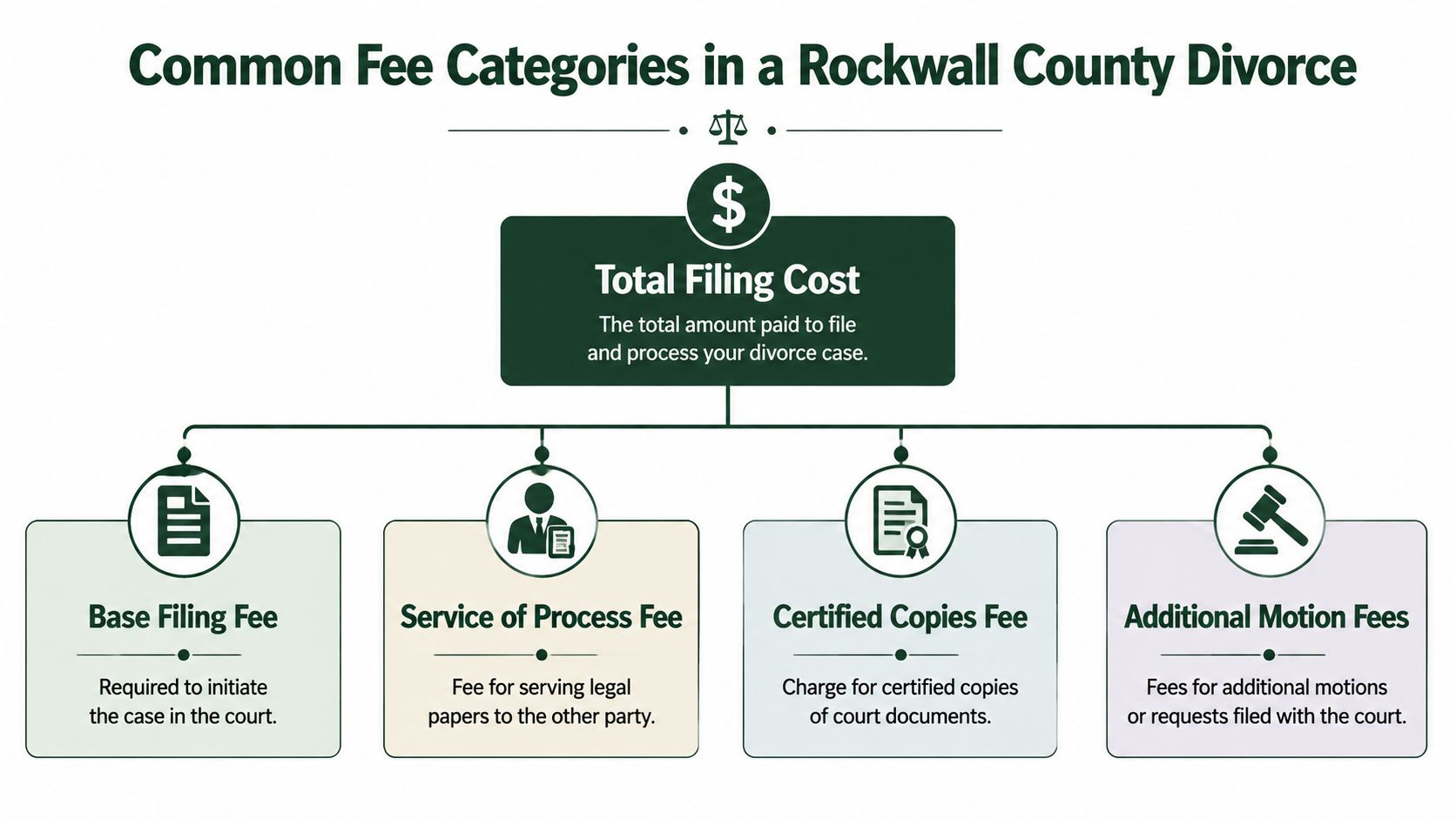
The base filing charge
The $350.00 divorce or annulment filing fee is the charge associated with starting the district-court case under Rockwall County's published schedule as of January 1, 2022. Filing the Original Petition for Divorce places the case into the district court system and creates the court file.
That payment doesn't cover every later event. It also doesn't answer whether a particular filing is classified as a divorce, modification, enforcement action, protective-order matter, or another family-law proceeding.
Service and citation charges
If your spouse must be formally served, the clerk may issue a citation and the authorized process server or sheriff may charge for service. Service tells the respondent that a case has been filed and provides the documents needed to respond.
Service may not be necessary in the same way when the respondent voluntarily signs a waiver or participates through an agreed process, but the paperwork must be legally sufficient. Don't assume that sending papers by ordinary mail accomplishes formal service.
Copies and certified records
You may need ordinary copies for your records, counsel, a financial institution, or another proceeding. A certified copy carries a clerk's certification that the document is an official court record. People commonly request certified copies of a final decree when changing records, proving the divorce, or implementing property-related obligations.
Motions and later filings
Temporary orders, enforcement pleadings, modifications, and other requests can carry separate charges. Rockwall's schedule lists several motion or ancillary family filings at $15.00 or $80.00, depending on the filing type, and lists enforcement of a divorce decree at $350.00. Read the line item that matches the document you're submitting rather than assuming every family filing uses the divorce fee.
Decrees and other record services
A final decree may require copies or certification after the judge signs it. Clerks may also charge for document-related services listed separately on the schedule. The precise amount depends on what you request and how the clerk categorizes it.
If your case involves children, property division, support, or temporary relief, ask for a fee explanation tied to the actual pleading. A contested high-asset divorce may create more document and hearing needs than a simple agreed case, while a custody or support matter may follow a different filing path altogether.
Estimating Your Total Filing Cost
Use the base fee as the first line in your estimate, then add only the categories that fit your case. The county's published schedule and the Texas Judicial Branch guidance are more reliable than an old online checklist because local assessments and statutory components can change.
The Texas Judicial Branch identifies a Rockwall County Civil Court Facility Fee ranging from $0.01 to $15.00, tied to Government Code section 51.709 and applicable to new civil suits except certain excluded actions. The Texas Judicial Branch county civil filing-fee guidance explains that this is a local county fee, not a universal statewide charge.
| Fee Type | Typical Amount | When It Applies |
|---|---|---|
| Divorce or annulment base filing fee | $350.00 | When the district-court divorce case is opened under Rockwall County's published schedule |
| Civil court facility fee | $0.01 to $15.00 | When the local fee applies to a new civil suit, subject to listed exclusions |
| Service of process | Varies by service method | When the other spouse must receive formal legal service |
| Certified-mail citation or related issuance | Varies by filing and service method | When the selected method requires clerk-issued documents or certified mailing |
| Copies and certification | Varies by request | When you order ordinary or certified court records |
| Additional motion or ancillary filing | $15.00 or $80.00, depending on filing type | When you submit a qualifying motion or related family filing |
| Enforcement of a divorce decree | $350.00 under the published schedule | When a separate enforcement case is filed |
The table isn't a substitute for a current quote from the clerk. It shows the structure you should use when planning. Two families filing in the same county can face different totals because one may need formal service, certified records, or additional pleadings while the other doesn't.
Children and post-judgment matters
A divorce involving children often requires decisions about custody, child support, and possession and visitation. Those issues can produce additional pleadings, hearings, and later enforcement or modification work. A later filing isn't automatically covered by the original divorce payment.
The same principle applies to protective orders, paternity matters, CPS-related litigation, relocation disputes, adoption, and appeals. Each proceeding has its own procedural posture. Ask the clerk or a family-law attorney which filing category applies before paying.
Why old fee tables cause trouble
Texas fee guidance has changed over time. An older state-style schedule listed a $283.00 total base fee for divorce cases and $277.00 for general civil cases, with a separate family-protection fee for divorce cases only. That historical comparison illustrates why a fee quoted from an older website may not match Rockwall's current posted schedule. The historical Texas district-court fee schedule shouldn't replace current county confirmation.
Accepted Payment Methods and Convenience Fees
Rockwall County's official civil and family page states that paying by credit card through the county's accepted merchant system carries a 2.35% convenience fee, with a $2 minimum. The Rockwall County Civil and Family payment information is the place to verify the county's current payment instructions before you go.
That fee is separate from the court filing charge. If you use a card, the merchant system adds the convenience charge to the transaction. For a divorce filing with a $350.00 base fee, the percentage calculation is less than the minimum threshold, so the minimum convenience charge would control for that base amount alone. Additional charges can change the transaction calculation, and the clerk should confirm the final amount.
Choose the payment method deliberately
Before filing, ask the District Clerk which payment forms are currently accepted for:
- In-person filing: Confirm whether the counter accepts your intended payment type and whether separate charges must be paid in the same transaction.
- Online filing or payment: Check the county's accepted merchant system and review the total displayed before submitting payment.
- Mail procedures: Verify whether the clerk accepts mailed filings, what payment instrument is required, and how the office handles returned or incomplete submissions.
Don't assume that a payment method available for one county office is available for another. The District Clerk and County Clerk handle different records and filing categories, and family district-court paperwork belongs with the District Clerk.
If your payment is declined or short, the clerk may not be able to process the filing. Have a written estimate, confirm the accepted method, and keep the receipt and confirmation information. When you contact the office, describe the exact filing, not just “a family case.” A divorce petition, enforcement action, modification, and motion may appear under different fee lines.
Fee Waivers and the Indigent Affidavit Process
If you can't afford the filing fee, don't abandon the case and don't guess at the waiver process. Texas courts generally provide a procedure for a person who claims an inability to pay court costs, commonly handled through an affidavit of indigence or inability to pay. The clerk can provide current procedural information, and a family-law attorney can help you understand what financial facts the court will need.

A realistic example
Suppose a Rockwall resident has lost household income, is supporting children, and can't pay the filing charge without falling behind on rent, utilities, or food. That person may ask about an affidavit of inability to pay instead of submitting an incomplete petition with no payment.
The affidavit should be truthful and complete. It may require information about income, benefits, housing costs, dependents, assets, debts, and ordinary living expenses. The filer must disclose the financial picture, sign the form as required, and follow any notarization or verification instructions that apply.
What to do before submitting the affidavit
Use this sequence:
- Ask the District Clerk for the current form and filing instructions.
- Gather accurate financial information instead of estimating from memory.
- Complete every applicable portion and explain unusual circumstances clearly.
- Sign and notarize the affidavit if the current instructions require it.
- Submit the affidavit with the petition or as directed by the clerk.
- Watch for a court decision or further request concerning the claimed inability to pay.
A waiver request isn't an automatic approval. The court decides whether the filer qualifies, and the court may ask for clarification or additional information. A denial may leave costs due, so ask what happens next rather than assuming the case has been fully accepted without payment.
For answers to common procedural questions, review the Rockwall divorce FAQ. If your case also involves custody, support, protective orders, or immediate safety concerns, tell the attorney that at the beginning of any consultation. Those issues can affect what needs to be filed first.
Common Filing Fee Mistakes to Avoid
The most expensive assumption is that the published base fee equals the final cost. It doesn't. Rockwall's schedule separates filing, service, copy, certification, and motion-related charges, so a filer who brings only the headline amount may face a payment problem at the counter.

Mistakes that create avoidable delays
- Relying on an old fee schedule: Texas court guidance and county fee pages continue to be updated, including guidance revised in late 2025 and county pages updated in 2026. Check the current Texas civil and family action guidance and Rockwall's current page before filing.
- Ignoring service costs: Formal service may require citation issuance and a service charge. Decide whether service is needed and which lawful method fits the case.
- Paying by card without calculating the surcharge: The county's merchant convenience fee is added to the transaction. Ask for the complete amount before authorizing payment.
- Confusing the clerks' offices: The District Clerk processes district-court family cases. The County Clerk handles different county records and filing categories.
- Assuming every family filing costs the same: An enforcement, modification, protective-order matter, adoption, or motion may have a different fee classification.
- Submitting incomplete paperwork: A correct payment doesn't cure an incomplete petition, missing information, or an incorrect venue assumption. Verify the county based on the facts, not merely the mailing city.
The better approach
Prepare a fee worksheet before you leave home. List the base filing, local facility assessment, service method, expected copies, certification requests, and any motion you plan to file at the same time. Then call the clerk and ask whether each item applies to your exact filing.
Don't pressure the clerk to answer legal strategy questions. Clerks can explain administrative requirements and fees, but they can't advise you whether to seek temporary orders, how to divide property, or what custody position to take. Those questions belong with a qualified Texas family-law attorney.
Next Steps and Contact Information
Start with the county, not the payment screen. Confirm that your case belongs in Rockwall County, particularly if you live in Rowlett or another community that crosses county boundaries. A mailing address alone doesn't establish venue or jurisdiction.
The Rockwall County District Clerk is the filing office for district-court family cases. The Rockwall County 382nd District Court page states that district court files are maintained by the District Clerk on the second floor of the Government Center and directs parties to contact the office at 972-204-6500. Verify the current office location, hours, filing options, and fee amount before traveling.
A practical preparation sequence
- Identify the case type. Decide whether you're opening a divorce, custody, support, paternity, enforcement, modification, protective-order, adoption, or another family-law matter.
- Confirm the county. Don't rely only on the city printed in your address.
- Ask about the current fee lines. Give the clerk the exact pleading and service method.
- Prepare payment and documents. Keep copies of everything submitted and every receipt.
- Address urgent issues early. Temporary orders, threats, child-safety concerns, CPS contact, relocation, and protective-order needs may require immediate legal analysis.
- Get advice for complex cases. High-asset property, business interests, retirement accounts, disputed parenting rights, relocation, and contested support can create consequences far beyond the filing charge.
The clerk accepts and processes documents. The assigned district court hears disputes and signs orders. Understanding that division helps you direct administrative questions to the clerk and legal questions to counsel. For a broader explanation of local court roles, see how Rockwall County Courts at Law jurisdiction works.
The Law Office of Bryan Fagan, PLLC maintains a local Rockwall office and handles family-law matters including divorce, custody, support, modifications, enforcement, protective orders, property division, CPS issues, adoption, and appeals. A consultation is especially sensible when the fee question is only the first issue in a larger dispute.
Quick Reference Checklist for Rockwall County Divorce Filers
Save this checklist before contacting the District Clerk or beginning an electronic filing:
- Verify the current base fee: Confirm the amount for the exact pleading you intend to file.
- Confirm county authority: Check whether your address is actually in Rockwall County.
- Identify the service method: Determine whether the other spouse needs formal service, certified mail, or another lawful process.
- Add local and document charges: Ask about the civil court facility fee, copies, certification, citation, and any motion-related fee.
- Choose payment carefully: If paying by credit card, account for the county's merchant convenience charge.
- Prepare waiver information: If you can't afford court costs, ask for the current affidavit of indigence procedure and provide complete financial information.
- Call before traveling: Contact the District Clerk at 972-204-6500 to verify current administrative details.
- Get legal advice when the stakes are high: Discuss children, support, property, safety, relocation, CPS, or an existing order with a qualified family-law attorney.

The Law Office of Bryan Fagan, PLLC helps Rockwall County clients understand filing costs, service choices, custody concerns, support issues, property division, and the next steps in a family-law case. Visit The Law Office of Bryan Fagan, PLLC to review local resources and request a consultation before you file.