
A lot of Rockwall County families hit the same wall at the same time. The motion to modify is filed, the divorce or custody case is active, and then nothing happens because no hearing date has been set. If that sounds familiar, the fix is procedural, not mysterious. In Rockwall County, the court coordinator is the person who manages the judge's docket, and if you want a hearing, you have to work through that channel the right way.
That matters because the process is not one-size-fits-all. A request for temporary orders, an uncontested final divorce hearing, and a contested enforcement motion do not move through the docket the same way. You need the right court, the right docket block, the right notice, and the right filing sequence, or your setting gets pushed back.
Table of Contents
- Why the Court Coordinator Sets Your Hearing in Rockwall County
- Identifying the Correct Court and Docket in Rockwall County
- Contacting the Rockwall County Court Coordinator Step by Step
- Texas Notice Rules That Affect Your Rockwall County Hearing
- Agreed and Contested Hearings in Rockwall County Family Court
- Filing, Fees, and Service for Rockwall County Hearings
- Practical Next Steps for Rockwall County Families
Why the Court Coordinator Sets Your Hearing in Rockwall County
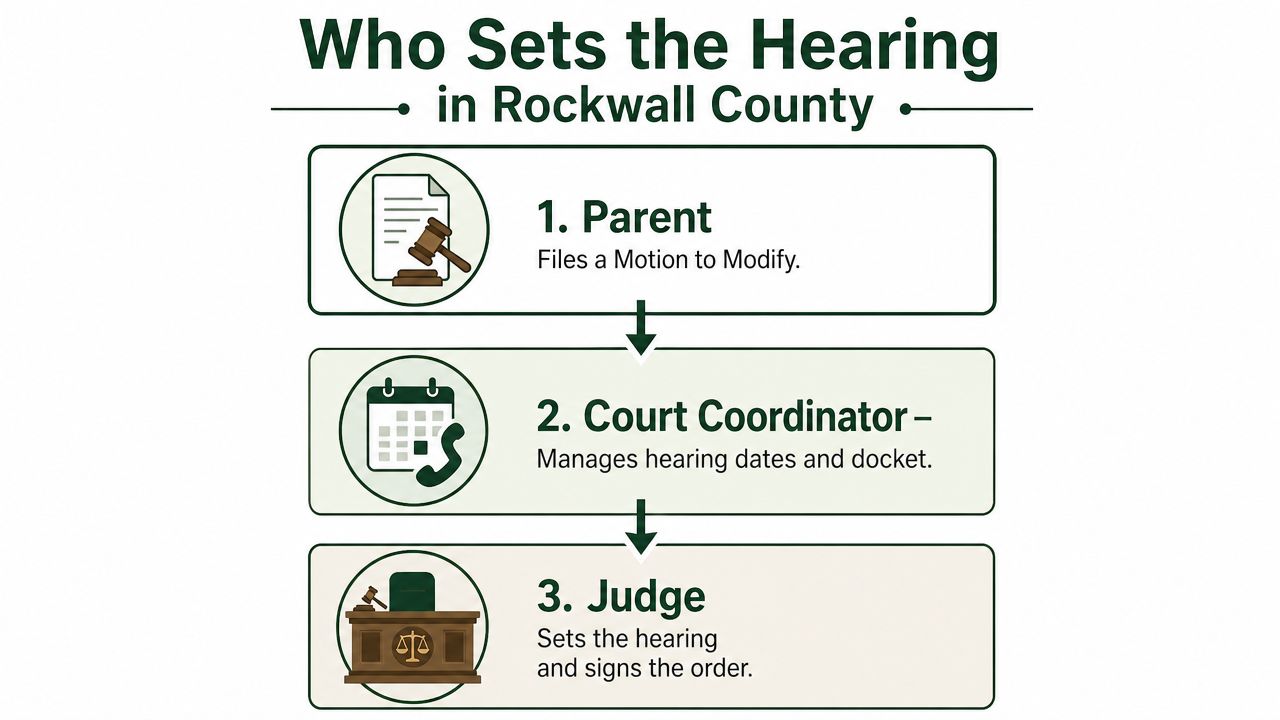
A parent files a custody-modification motion, expects the court to assign a date, and then waits while the case remains idle. The problem is usually procedural. The judge decides the case, but the court coordinator manages the judge's calendar, available settings, and hearing logistics. Rockwall County uses court-specific contact points and docket information, including the 382nd District Court's contact and docket page, rather than one countywide calendar.
That division of responsibility determines how you request a setting. The coordinator can identify available docket blocks, process a hearing request, and keep the matter on the correct calendar. The coordinator cannot decide custody, rule on evidence, or grant the relief requested. Those decisions belong to the judge.
Start with the court assigned to your case. Rockwall County's courthouse is at 1111 E Yellowjacket Lane in Rockwall, and each court has its own contact path. A request sent to the wrong office can sit unanswered while an available setting passes.
The hearing type matters, too. Temporary orders, uncontested final divorce hearings, and contested enforcement matters may require different docket treatment. Before contacting the coordinator, have the cause number, case style, requested hearing type, and your available dates ready. Confirm whether the matter is agreed or contested, then ask which docket block applies.
Practical rule: use the assigned court's coordinator and follow that court's submission instructions. The wrong contact can cost days and delay notice to the other side.
For the court-division question that often causes confusion, review this guide to Rockwall County Court at Law jurisdiction and case assignments. Choosing the correct court first keeps the hearing request from being redirected.
Identifying the Correct Court and Docket in Rockwall County
Before you ask for a hearing, match the case to the right court and the right docket block. Rockwall County's docket schedule shows that hearings are organized by docket type, not by a single open calendar. The county lists different time blocks for civil docket matters, short civil hearings, criminal dockets, and jury trials, including civil docket at 1:15 p.m. on Monday and short civil hearings at 2:30 p.m. on Thursday Rockwall County docket schedule.
That matters because family-law requests don't fit everywhere. A temporary-orders request may belong on one type of setting, while an uncontested final divorce hearing may be handled differently. TexasLawHelp also notes that the process usually starts by identifying the correct court and then contacting the court coordinator who manages that judge's calendar TexasLawHelp uncontested final hearing guidance.
What to verify before you send anything
- The assigned court. Confirm whether the case is in the 382nd District Court, the 439th District Court, or a County Court at Law.
- The docket block. Make sure your request matches the hearing type the court uses.
- The case status. If you're uncertain whether the matter is active, confirm that first with the clerk.
- The right contact. Each court has its own coordinator or office contact path.
Don't email a coordinator about a case that's still pending in another court. That's a fast way to get ignored or redirected.
If you're comparing which Rockwall County family court may handle your matter, this Rockwall County 382nd District Court family docket procedures guide is useful because it shows why docket matching comes before hearing requests.
| Rockwall County Family-Law Courts at a Glance | Typical Family-Law Matters | Docket Block | Coordinator Contact |
|---|---|---|---|
| 382nd District Court | Divorce, custody, modifications, enforcement | Court-specific family docket | Court coordinator or district clerk office |
| 439th District Court | Family-law matters assigned to that court | Court-specific family docket | Court office contact listed by the court |
| County Court at Law | Related family matters within that court's jurisdiction | Court-specific settings | Court coordinator contact |
Contacting the Rockwall County Court Coordinator Step by Step
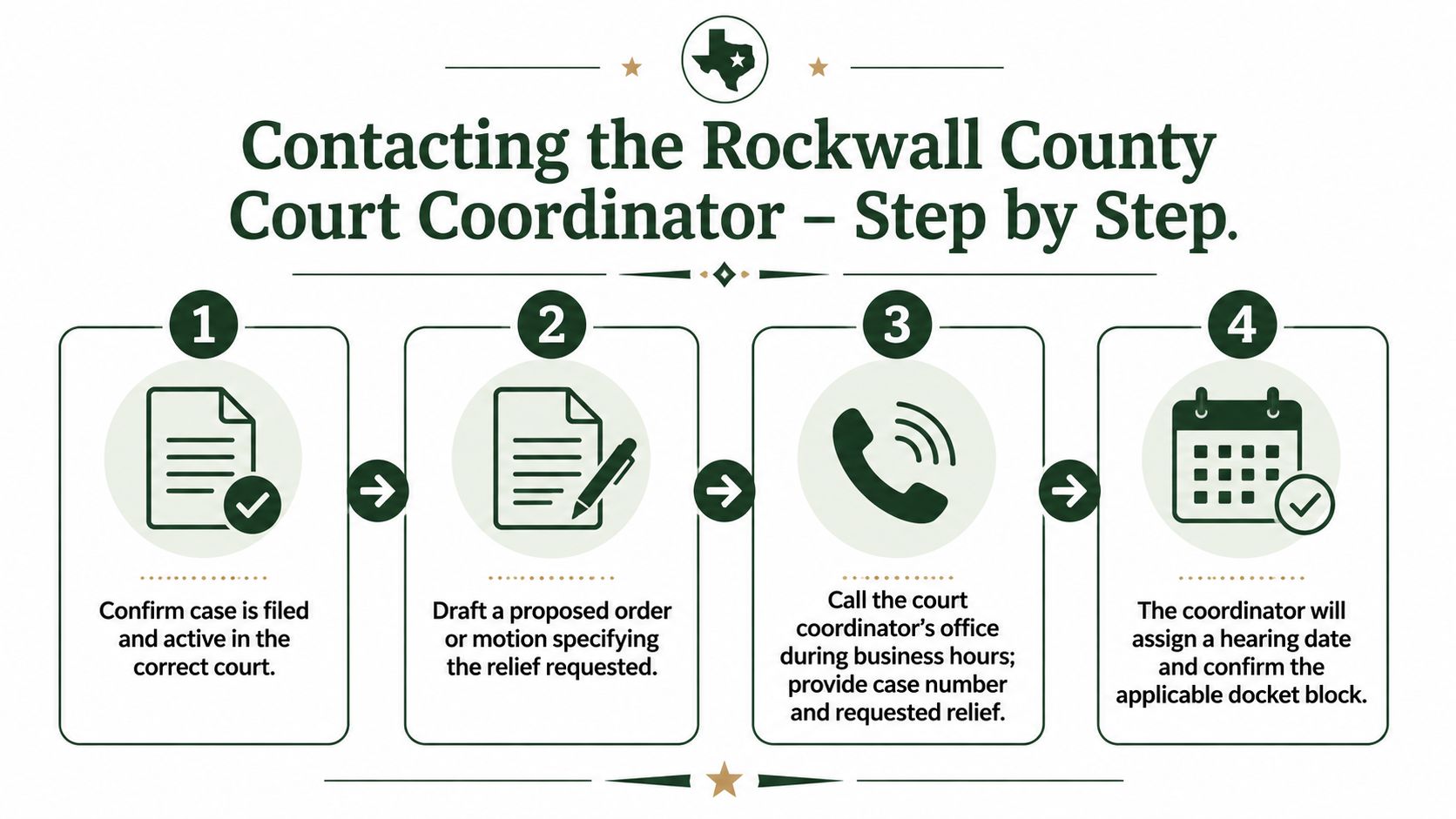
The cleanest requests are the ones that arrive prepared. Start by confirming the case is filed and active in the correct court, because coordinators are not there to sort out jurisdiction problems for you. Then draft the motion or proposed order that matches the relief you want, whether that's temporary orders, enforcement, a modification, or an agreed final setting.
The county resources show that Rockwall County uses separate court contact points, and Texas family-law procedure expects the coordinator to manage the setting process. Some Rockwall County pages also emphasize that questions about policy and procedure belong with the court coordinators, not random staff members Rockwall County Court at Law page. That's the line you work through.
A practical sequence that actually works
- Confirm filing and court assignment. Make sure the case number, party names, and assigned court are right.
- Draft the request. Include the specific relief you're asking for and attach a proposed order when the motion calls for one.
- Email or call the coordinator. Give the case number, party names, hearing type, and three possible dates within the right docket block.
- Wait for confirmation. If the matter is calendared, confirm the setting in writing so there's no confusion later.
- File the notice of hearing. Use eFileTexas or file at the Rockwall County District Clerk window once the date is set.
- Check status if needed. The courthouse contact line can help you confirm whether the request moved forward.
The county's district court pages also show that contact information is court-specific, including the 382nd District Court's direction to the District Clerk on the second floor and the 439th District Court's separate office details Rockwall County 382nd District Court page. That is your clue that there is no shortcut around the court's own process.
Texas Notice Rules That Affect Your Rockwall County Hearing
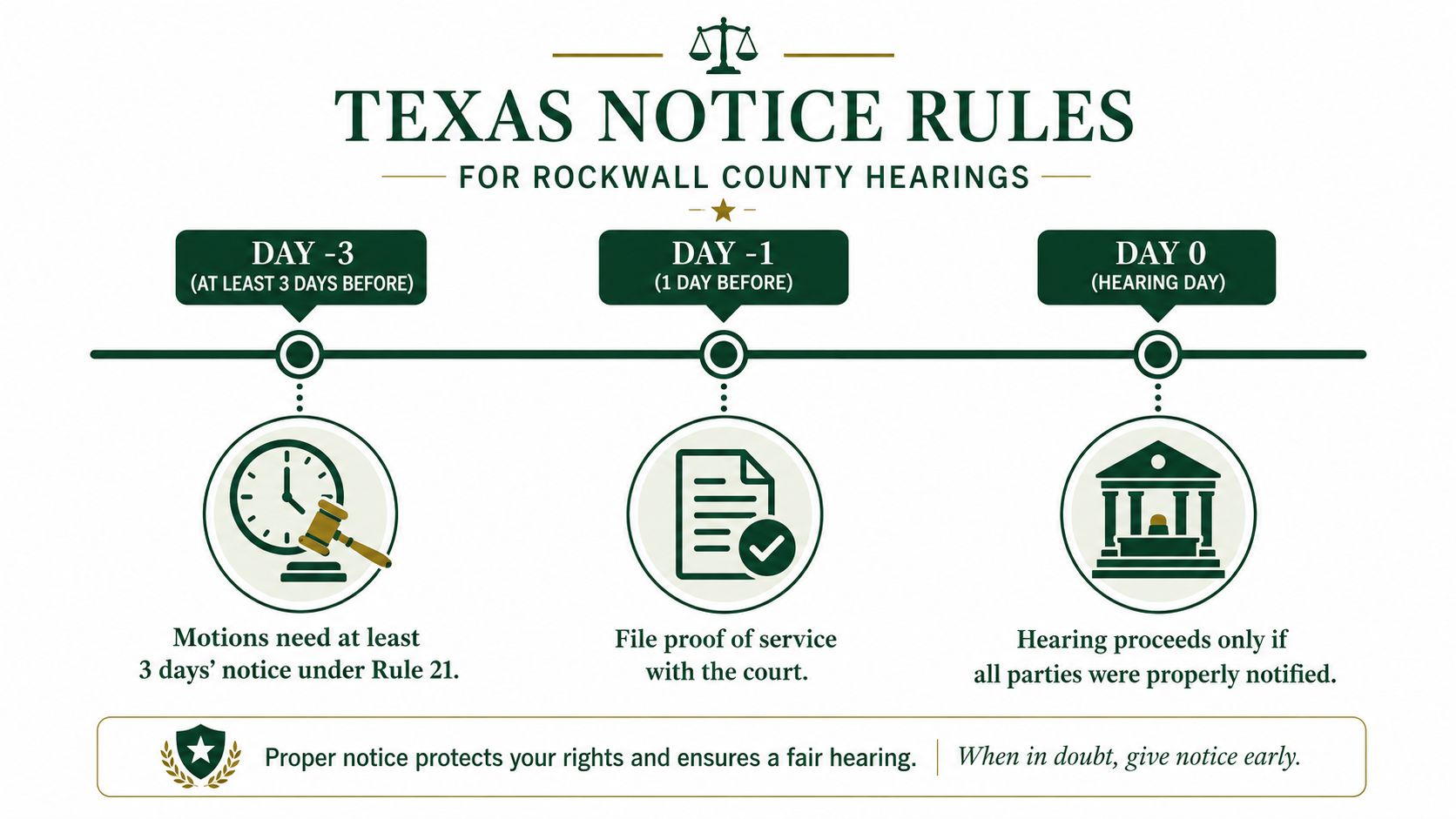
A hearing date is useless if the other side wasn't properly notified. Texas Rule of Civil Procedure 21 requires at least three days' notice for a hearing on a motion unless another rule sets a different deadline, and Rule 245 requires at least 45 days' notice for a first contested trial setting Texas court rules PDF. In a Rockwall County family case, those deadlines can control whether your hearing stays on the docket.
What that means in real life
If you're asking for temporary orders in a divorce or custody case, you can't just grab the next open date and hope for the best. The notice window has to fit the setting type, and the notice has to be served correctly. If you're setting a first contested trial, the calendar moves differently because Rule 245 gives the other side more lead time.
Texas Supreme Court materials also say that longer-than-half-day family settings must be placed on the Family Docket on Monday at 8:30 a.m., while shorter-than-half-day settings go on the Family Docket at 8:30 a.m. on Wednesday, Thursday, or Friday Texas Supreme Court administrative order. That's why hearing requests need to be matched to both duration and docket block.
Count calendar days, not wishful days. If the notice period is short, the coordinator can reject the setting or the court can refuse to hear it.
A common mistake is assuming business days control every notice calculation. They don't. Another mistake is waiting to file the notice until after the setting is “casually” approved. In family cases, the notice itself is part of the record that proves everyone was told the time, date, and expected hearing length.
For enforcement motions, the timing rules can be even tighter, and the court's notice requirements become critical to whether the hearing proceeds. That's why a hearing request should always be checked against the rule that governs the specific motion, not just a general calendar instinct.
Agreed and Contested Hearings in Rockwall County Family Court
Not every hearing request needs the same level of calendar time. An agreed final divorce, a stipulated modification, or another uncontested matter is usually easier to set because the parties have already narrowed the dispute. A contested enforcement motion or a disputed temporary-orders request takes more coordination, more notice, and usually more time on the docket.
Texas family-law guidance recognizes that uncontested matters may require a motion, a proposed agreed order, and use of a regular uncontested docket if the county has one. That means the coordinator often needs to know, up front, that the parties are in agreement before the matter gets calendared. In Rockwall County, that distinction matters because the courts do not waste docket time on matters that should have been handled as agreed settings.
Agreed settings are cleaner, but not automatic
If both sides have already signed off, send the documents that show it. That usually means the proposed order, any agreed motion, and any waiver or Rule 11 agreement the court expects. If the coordinator can see that the case is ready for an agreed slot, the setting process is usually smoother.
Contested settings need more discipline
A contested hearing is different because one side is asking for relief the other side may oppose. That can involve temporary orders, enforcement, child-related disputes, or property issues that need evidence and argument. The court may require more detailed scheduling, and the coordinator will care more about the docket block and the time requested.
| Element | Agreed Hearing | Contested Hearing |
|---|---|---|
| Level of agreement | Both sides have resolved the issue | One or both sides oppose the relief |
| Typical documents | Agreed motion, proposed agreed order, waiver or Rule 11 agreement | Motion, notice of hearing, supporting filings, exhibits if needed |
| Docket impact | Usually shorter and easier to calendar | Often needs more time and tighter notice compliance |
| Coordinator focus | Confirming the matter is truly ready | Matching the request to the proper hearing block |
If your case involves divorce, custody, or support, a Rockwall County family-law attorney can save you from a bad setting. A hearing that looks simple on paper can become a notice problem the moment it gets contested.
Filing, Fees, and Service for Rockwall County Hearings
Once the coordinator gives you a date, the clock changes. Now you have to file the notice correctly, pay whatever filing costs apply, and serve the other side in a way that can be proved later. That's not busywork. It's what keeps a hearing from getting knocked off the calendar.
In Rockwall County, family-law filings are commonly handled through e-filing, though in-person filing at the District Clerk's office remains available. The county's materials identify the District Clerk on the second floor for district-court files, and the local fee schedule for divorce filings is discussed in this Rockwall County District Clerk divorce filing fee schedule guide. If you're filing a motion tied to a family case, make sure the clerk receives the right document for the right court.
A Rockwall mother filing a motion for temporary child support, for example, might get the hearing date by email from the coordinator, e-file the notice that same day, and then serve the opposing parent through the method permitted by the rules. If she forgets the certificate of service, the other side can claim they never received notice, and the hearing may be delayed.
Service is not optional
For most motions, notice must be served under the applicable Texas rules, and the certificate of service is the proof that service happened. If electronic service applies, you need to follow the electronic-service rule. If service is by another method, the record should show when and how the notice went out.
If the other side can credibly argue they never got notice, the judge may stop the hearing before it starts.
Keep your filing receipt, your stamped notice, and your proof of service together. That paper trail matters more than people think, especially in contested family cases where one side later claims surprise.
Practical Next Steps for Rockwall County Families
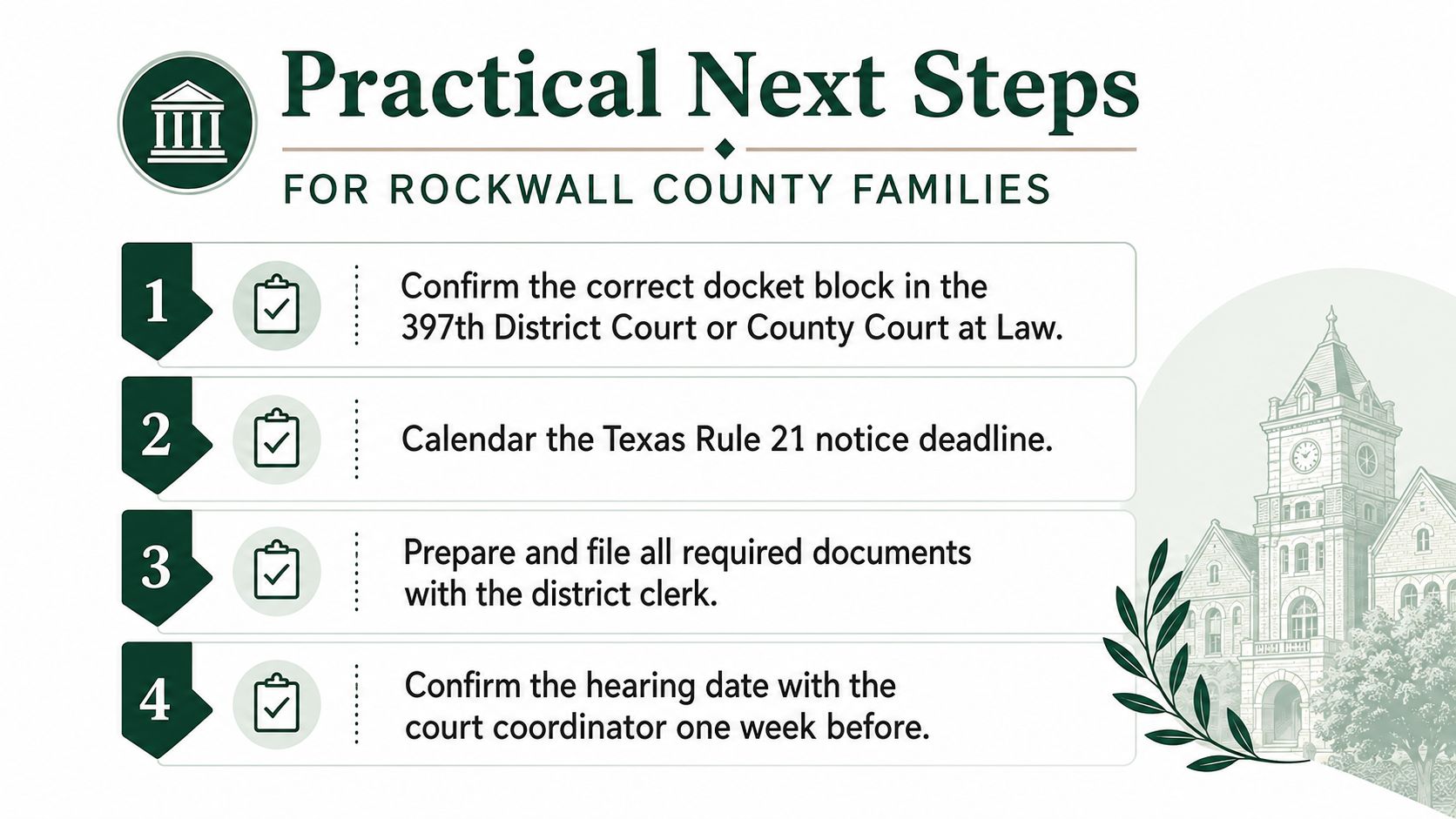
To set your hearing efficiently, follow this sequence: confirm whether your case belongs on the 382nd or 439th District Court docket, identify the correct docket block, and decide whether the request is agreed or contested. Calendar the Rule 21 or Rule 245 notice requirement, prepare the motion or proposed order, and send the request to the appropriate coordinator with the case number, parties' names, and hearing type. File the notice and preserve proof of service. A hearing date without proper notice can still result in a delay.
What to do if the setting stalls
If the coordinator does not confirm the request, follow up the next business day. If there is still no response, contact the clerk or courthouse office handling that court's records. Ask whether the request reached the correct desk and whether anything is missing. For family cases involving children or contested temporary orders, make that check well before the hearing date.
On hearing day, bring your identification, copies of filed documents, exhibits, required witnesses, and any payment method expected for a private court recorder. Review the court's instructions before arriving. If you need a continuance, request it early and explain the case-specific reason. Do not assume the court will reset the matter for convenience.
Rockwall County families in Rockwall, Heath, Fate, Royse City, McLendon-Chisholm, and nearby communities should treat hearing setup as part of the case. The coordinator manages the calendar, the rules govern notice, and the clerk maintains the filing record. A mistake in any one of those steps can postpone the hearing.
If your matter involves children, substantial property, enforcement, protective orders, or a contested temporary hearing, get legal help before setting it yourself. The sequence matters, and a small procedural error can delay a case carrying serious emotional and financial consequences.
If you're dealing with a divorce, custody dispute, enforcement action, or other family-law hearing in Rockwall County, The Law Office of Bryan Fagan, PLLC can help you line up the right court, the right docket, and the right notice so you don't lose time on preventable mistakes. Visit The Law Office of Bryan Fagan, PLLC to connect with a local Rockwall team that handles these hearings every day and can help you move your case forward the right way.