
You receive a court notice in your Rockwall County custody case saying someone will be appointed to focus on your child's welfare. Then you hear two unfamiliar terms, amicus attorney and guardian ad litem, and assume they mean roughly the same thing. They don't. In Texas family law, the correct role depends primarily on who filed the case, what relief is requested, and whether the matter is a private family dispute or a governmental CPS proceeding.
That distinction matters in Rockwall, Heath, Fate, Royse City, McLendon-Chisholm, and other county communities. A request using the wrong label can distract from the relief your child or family needs. The right starting point is the petition, the assigned court, and the appointment order, not the title that sounds most familiar.
Table of Contents
- Two Court-Appointed Roles Parents Often Confuse
- What a Rockwall County Amicus Attorney Actually Does
- What a Guardian Ad Litem Does in a Texas Custody Case
- Side-by-Side Comparison of the Two Roles
- Two Rockwall County Scenarios That Show the Difference
- Common Misconceptions That Trip Up Rockwall County Parents
- Practical Next Steps for Rockwall County Parents
- Questions Rockwall County Parents Ask Most Often
Two Court-Appointed Roles Parents Often Confuse
A private custody modification and a CPS case can both involve a court-appointed professional focused on a child. The titles sound similar, but the appointment depends on the type of lawsuit. Asking for the wrong role in Rockwall County can waste time and leave the court without the protection the case requires.
Texas law separates the roles:
- An amicus attorney is appointed in a private suit to provide legal services that help the court protect the child's best interests. The amicus does not represent the child as a conventional client.
- A guardian ad litem operates under a different appointment framework, particularly in a governmental lawsuit seeking termination of the parent-child relationship or appointment of a conservator for the child.
The distinction affects what the appointed professional does. In a private dispute involving custody, possession, visitation, or modification, an amicus attorney may review the evidence, participate within the appointment order, and advocate a best-interest position that differs from the child's stated wishes. A parent should read the order before assuming the attorney will conduct every interview, home visit, or courtroom task.
A guardian ad litem belongs to a different statutory structure in a governmental-entity case. Texas law generally requires the court to appoint one after the petition is filed and before the full adversary hearing. The same chapter bars appointment of an amicus attorney in that type of governmental-entity suit. Texas Family Code Chapter 107 provides the governing framework.
Practical rule: Identify the lawsuit before asking the court to appoint a child advocate.
Rockwall County's 382nd District Court and 439th District Court are general-jurisdiction trial courts that hear family-law and juvenile matters. The 439th District Court also handles CPS litigation, so the distinction matters immediately to a parent served in a Department of Family and Protective Services case. Rockwall County court information on the county website can help confirm local resources, but the pleadings and appointment order control the case.
What a Rockwall County Amicus Attorney Actually Does
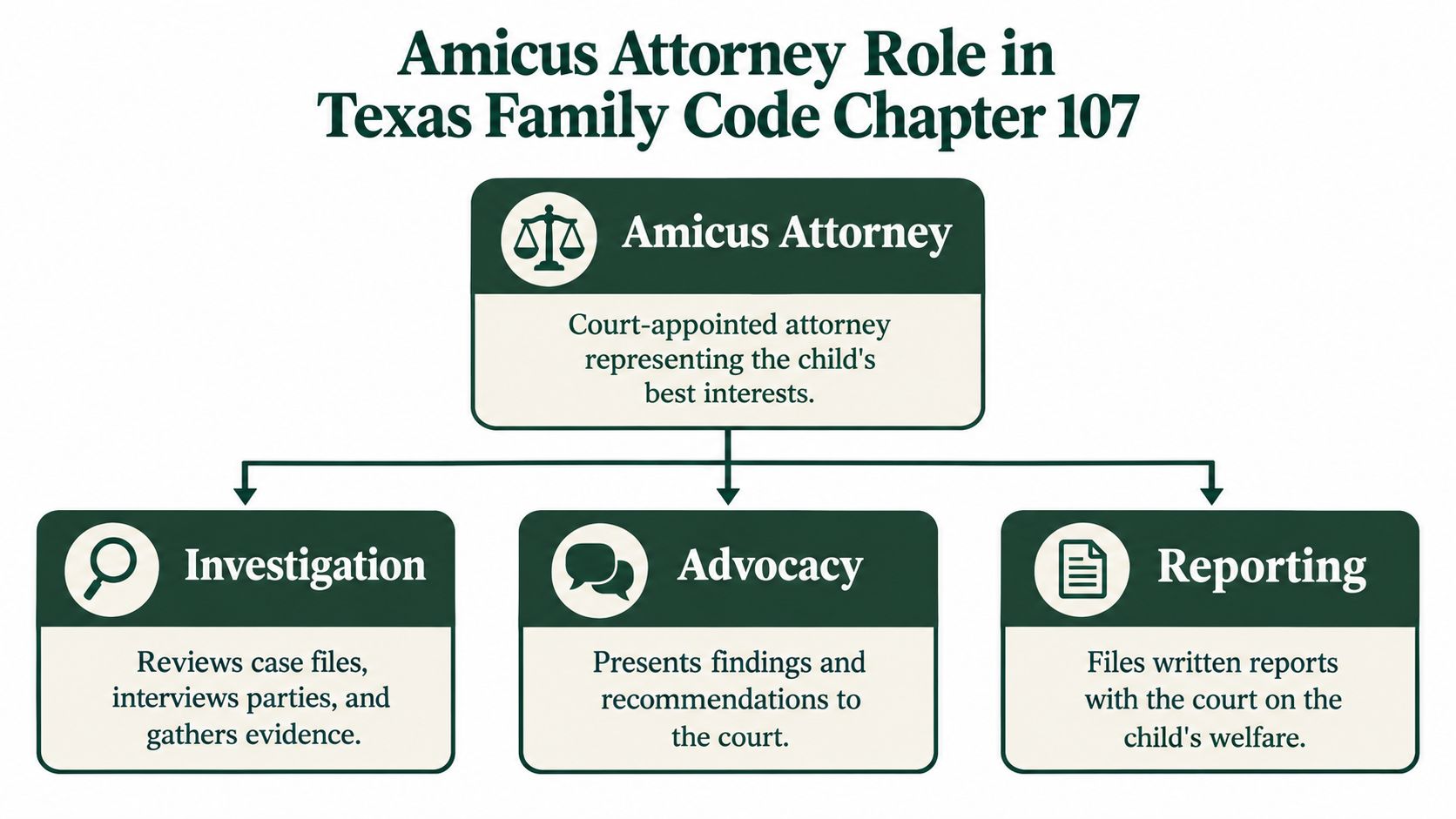
An amicus attorney is generally associated with a private suit, such as a divorce involving custody, a suit affecting the parent-child relationship, a possession dispute, or a modification proceeding. Under Texas Family Code §107.001, the amicus provides legal services that assist the court in protecting the child's best interests. The attorney isn't hired by either parent to advance that parent's litigation objectives.
That doesn't mean the amicus becomes the child's ordinary lawyer. The statute gives the role a legal and advocacy function, and the appointment order defines the boundaries. Before you assume the attorney will perform every possible interview, home visit, or courtroom task, read the order carefully.
The statutory job in practical terms
Texas Family Code §107.003 gives an amicus attorney procedural access that can make the appointment useful in a contested Rockwall County custody case. Subject to the order, the amicus may:
- Receive pleadings and hearing notices, so the attorney can follow the factual and procedural development of the case.
- Attend court proceedings, allowing the attorney to hear testimony and evaluate the evidence presented.
- Participate in authorized case staffings, when the appointment permits that involvement.
- Request clarification, if the appointment order is unclear about the attorney's authority or responsibilities.
Those powers allow the amicus to investigate within the authorized scope, question evidence, present legal positions, and make recommendations to the judge. The amicus may recommend an outcome different from the child's stated preference because the attorney isn't bound by the child's objectives.
That point often surprises parents. A child may say, “I want to live with Dad,” or “I don't want to visit Mom,” but the amicus evaluates the broader best-interest question under the appointment order. The recommendation may agree with the child, but it doesn't have to.
What parents should expect
The amicus usually functions as an additional legal voice focused on the child's welfare. The attorney doesn't replace your own family-law lawyer, doesn't become your advocate, and doesn't exist to make the litigation easier for either parent.
A parent seeking an appointment should explain the concrete problem the appointment would address. General conflict between parents may not explain why an amicus is needed. A motion should connect the requested appointment to disputed facts, the child's welfare, and the authority requested under the statute and proposed order.
The court decides whether an appointment is appropriate, and the order controls the precise assignment. That is why a parent should avoid promising the child that the amicus will “take your side.” The attorney's obligation is to assist the court, not to deliver a predetermined result.
What a Guardian Ad Litem Does in a Texas Custody Case
A guardian ad litem comes into the case through a different doorway. In a suit filed by a governmental entity seeking termination of the parent-child relationship or appointment of a conservator for a child, the court generally appoints a guardian ad litem right after the petition is filed and before the full adversary hearing. That same framework keeps the amicus attorney out of that kind of governmental case. Texas Family Code §107.001 and related provisions should be read alongside the pleadings and the court's order.

Why CPS case type controls
A Rockwall County CPS case is not a private custody fight with the state standing in the corner. The government has filed suit and asked for relief that can change the parent-child relationship, including termination or appointment of a conservator. That case type drives the appointment rules.
The 439th District Court's published information lists CPS matters among the cases it handles. A parent served in a Rockwall County Department of Family and Protective Services case should start with the petition, the relief requested, and the court's appointment order. Asking for an amicus attorney because the child needs protection can put the wrong procedure in front of the judge.
A guardian ad litem still serves a child-focused function, but parents should not treat the appointee as their own lawyer. The guardian ad litem investigates the child's situation within the appointment order and then reports or advocates in a way meant to help the court decide. The precise responsibilities depend on the governing law and order, which is different from a custody evaluation and social study process.
What the guardian ad litem means for a parent
The appointment does not decide the case. It also does not replace the parent's duty to answer the CPS petition, follow court orders, preserve evidence, and get independent legal advice.
A guardian ad litem may review information tied to the child's welfare and communicate a position to the judge. That can shape how the court views safety concerns, placement questions, services, and the relief requested. It does not let a parent treat the appointment as a substitute for defending the CPS case.
For a parent facing removal or a termination request, the first job is to respond to the governmental lawsuit with advice from a qualified Texas family-law attorney. The strategy should meet the petition and the requested relief head-on, not just ask for a different child representative.
Side-by-Side Comparison of the Two Roles
The fastest way to distinguish these appointments is to compare the case trigger rather than the title. A private custody fight and a governmental CPS suit can both involve serious concerns about a child, but Texas law does not treat the appointments as interchangeable.
| Feature | Amicus Attorney | Guardian Ad Litem |
|---|---|---|
| Appointment trigger | Generally appointed in a private suit to assist the court with the child's best interests | Generally required in a governmental-entity suit seeking termination of the parent-child relationship or appointment of a conservator |
| Client relationship | Doesn't represent the child as a conventional client and isn't bound by the child's stated objectives | Serves a distinct statutory child-focused role in the governmental-suit framework |
| Main function | Reviews facts and circumstances, participates as authorized, advocates a best-interest position, and makes recommendations | Investigates and reports or advocates regarding the child's welfare under the applicable governmental-suit framework |
| Typical Rockwall County setting | Divorce, private custody litigation, possession disputes, or modifications | CPS litigation filed by a governmental entity |
| Appointment source | Texas Family Code Chapter 107 and the court's appointment order | Texas Family Code Chapter 107 and the court's appointment framework for governmental suits |
| Can the parent use the appointee as personal counsel? | No | No |
The amicus appointment is best understood as a court-focused legal role in a private case. The attorney can receive pleadings and notices, attend proceedings, participate in authorized staffings, and seek clarification of an unclear order under Texas Family Code §107.003. The judge decides the appointment and scope.
The guardian ad litem appointment is tied to the governmental lawsuit itself. In a CPS case, the parent shouldn't frame the issue as a choice between two interchangeable professionals. The controlling question is whether the case falls within the statutory circumstances requiring a guardian ad litem.
The appointment protects the court's ability to evaluate the child's welfare. It doesn't give either parent a second personal attorney.
Both roles can influence the courtroom record, but neither guarantees a particular custody, possession, or parental-rights result. The appointee's recommendation is one part of the case. The judge still considers the pleadings, evidence, testimony, and governing law.
Two Rockwall County Scenarios That Show the Difference
Consider a private custody modification involving parents who live in Rockwall and Heath. One parent alleges that circumstances have changed and asks the court to modify possession or decision-making provisions. The other parent disputes the allegations, and the child's needs have become the central factual issue.
In that private case, a parent might ask the assigned district court to appoint an amicus attorney. The motion would need to explain why a child-focused legal appointment would assist the court and identify the authority requested. If appointed, the amicus would work within the order, review authorized information, attend proceedings, and present a best-interest position. The attorney wouldn't automatically adopt the child's preferred parent or act as counsel for either mother or father.
Now consider a different hypothetical. A Rockwall County parent is served with a Department of Family and Protective Services petition filed in the 439th District Court. The government seeks relief affecting the parent-child relationship. The parent believes the child needs an independent voice and asks for an amicus attorney.
That request uses the wrong framework. Because the case is a governmental-entity suit of the type described in Texas Family Code Chapter 107, the court generally appoints a guardian ad litem, and the same chapter prohibits appointing an amicus attorney in that suit. The parent's legal response should focus on the CPS petition, the allegations, the requested relief, and the deadlines and orders that apply to that case. A practical overview of the early CPS process is available in this guide to a Rockwall County child protective services removal hearing.
The lesson is straightforward: the filer and requested relief determine the role. A parent's preferred label doesn't change the statutory appointment framework.
Common Misconceptions That Trip Up Rockwall County Parents
“Any case involving a child can use an amicus attorney”
That's too broad. An amicus attorney is associated with the private-suit framework, while a governmental-entity suit covered by the relevant statutory chapter follows the guardian ad litem framework. A child's presence in the lawsuit isn't enough to decide which appointment applies.
“The appointee replaces my lawyer”
Neither role replaces your personal family-law attorney. In a divorce, custody modification, enforcement action, protective-order matter, or support dispute, your lawyer represents your interests. In a CPS case, you still need counsel focused on protecting your parental rights and responding to the government's allegations.
The court-appointed professional serves the court's child-focused needs. That professional won't confidentially plan your testimony, negotiate solely for your preferred outcome, or advise you as your personal advocate.
“The child's wishes control the recommendation”
They don't automatically control an amicus attorney's position. Texas law expressly states that an amicus isn't bound by the child's stated objectives. The appointee may consider what the child says, but may recommend a different outcome based on the child's broader best interests and the authority in the appointment order.
“My mailing city tells me which court has jurisdiction”
A city name isn't the same thing as county jurisdiction. Royse City and Rowlett cross county boundaries, so a mailing address may not answer which county and court handle a particular case. Residents should check the petition, case information, and official court notices rather than relying on the city listed in an address.
The same caution applies to people living in Rockwall, Heath, Fate, McLendon-Chisholm, Mobile City, or nearby communities. The assigned court and filed pleadings matter more than the label a parent prefers.
Practical Next Steps for Rockwall County Parents
A parent who gets handed court papers in Rockwall County should start with the paperwork, not with assumptions. Find the case number, assigned court, petition, hearing notice, and any proposed or signed appointment order. Do not ask for an amicus attorney until you know whether the case is a private family-law dispute or a case filed by a governmental entity.

Use this checklist:
- Identify the court. Confirm the case number and assigned court from official notices. Rockwall County's district courts handle family-law and juvenile matters, but the assignment in your paperwork controls.
- Read the petition. Determine who filed it and what relief is requested. A private custody modification is materially different from a CPS petition seeking governmental relief.
- Read the appointment order. Look for the role named, the statutory authority, and the tasks authorized. The order controls the appointee's scope.
- Prepare the correct response. If you need an appointment, or oppose one, explain the specific facts and request the correct statutory relief. A motion with the wrong title will not fix itself.
- Get case-specific advice. A Texas family-law attorney can evaluate whether an appointment belongs in your case and how it affects divorce, custody, possession, support, enforcement, modification, or CPS strategy.
Rockwall County lists the 439th District Court at 1111 East Yellowjacket Lane, Suite 401, Rockwall, Texas 75087. The county also publishes local resources for mediators, ad litems, and amicus appointments. The 382nd District Court resource page on the Rockwall County website identifies the District Clerk's office as a resource for filing and document-copy questions and lists 972-204-6500 for those questions. Verify current instructions before filing, because local information and court requirements can change.
For a focused explanation of the private-case appointment process, review Rockwall County amicus attorney appointments and cost. Bring your petition, notices, existing orders, communications relevant to the child's welfare, and a short timeline of the dispute when you consult counsel.
Questions Rockwall County Parents Ask Most Often
Who pays? The court's order and applicable law control allocation of fees and costs. Can I challenge the appointee? Possibly, but a challenge requires a legally supported basis, not disagreement with a recommendation. Can I choose the attorney? You may request a particular appointment, but the judge controls it. What if the wrong role was appointed? Raise the issue promptly with counsel, because the case type, pleadings, and order determine the proper remedy.
The Law Office of Bryan Fagan, PLLC can help Rockwall County parents evaluate whether an amicus attorney or guardian ad litem fits their case and prepare for the next court step. Visit The Law Office of Bryan Fagan, PLLC to connect with the firm's Rockwall office and discuss your custody, divorce, modification, or CPS concerns.